

Is a Heavy Duty Wall Mount Heavy Bag Hanger Worth It?
Last Updated: October 24, 2026
Quick Summary
A heavy duty wall mount heavy bag hanger is worth it when your wall can carry the load, because it turns dead wall space into a fixed training station without a ceiling joist. Pick a hanger rated above your filled bag weight and anchor it into masonry or at least two structural studs.
- A 100 lb bag on a 150 lb hanger is a safer pairing than a 150 lb bag on a 150 lb hanger.
- Dynamic forces from hooks, kicks and clinch work can peak several times the bag's dead weight.
- Lag bolts into at least two wood studs; sleeve or wedge anchors for masonry and brick.
- Standard wood framing is typically 16 inches on center, with 24 inches common in some construction.
- Add a rubber or foam isolation pad between the bracket and wall to cut vibration noise.
Table of Contents
- What a Heavy Duty Wall Mount Heavy Bag Hanger Actually Does
- Heavy Bag Hanger Capacity: What the Weight Rating Really Means
- Steel Construction, Finish, and What Survives Daily Commercial Use
- Choosing a Heavy Bag Wall Mount for Your Space
- Wall-Mounted Heavy Bag Installation: Studs, Masonry, and Fasteners
- Heavy Bag Wall Mount vs Ceiling Mount: Which Fits Your Gym
- Reducing Vibration and Noise Before Your Neighbors Complain
- Picking the Right Hanger for Your Training Space
- Frequently Asked Questions
What a Heavy Duty Wall Mount Heavy Bag Hanger Actually Does
A heavy duty wall mount heavy bag hanger is a steel bracket that anchors to a wall and holds a hanging bag in place, so you can train without a ceiling joist or a freestanding frame. At Combat Build Supply, we describe it simply: it is the fixed point that turns dead wall space into a training station. The hanger carries the bag's load, sets the bag's height, and determines how far the bag swings before it hits the wall. Get those three things right and the setup feels solid for years. Get them wrong and nothing else matters.
Heavy Bag Hanger Capacity: What the Weight Rating Really Means
The weight rating on a heavy bag hanger is the maximum bag weight the bracket is designed to support, and it is only half the story. A bracket rated for 150 lb capacity assumes the wall behind it can take the load too.
The part most product listings never explain is that a hanging bag does not load the wall like a shelf. A static 100 lb bag hanging still pulls down with 100 lb, but every hook, kick, and body-weight clinch adds a dynamic multiplier. When the bag swings out and snaps back, the peak force at the bracket can be several times the bag's dead weight.
Use this three-step check before you buy:
- Bag weight vs. hanger rating. Pick a hanger whose rated capacity exceeds your filled bag weight with headroom to spare. A 100 lb bag on a 150 lb hanger is a safer pairing than a 150 lb bag on a 150 lb hanger.
- Dynamic margin. Assume hard training, power hooks, heavy kicks, clinch work, can momentarily load the bracket well above the bag's static weight. The heavier and more aggressive the session, the more headroom you want.
- Wall capacity. The bracket is only as strong as what it is bolted to. Two studs or a solid masonry wall carry far more than drywall, and the fastener schedule matters as much as the steel rating.
If you are unsure whether your wall can carry the load, treat the rating as a ceiling to stay under, not a target to hit. The goal is a bracket that is stronger than the bag and a wall that is stronger than the bracket.
Steel Construction, Finish, and What Survives Daily Commercial Use
Look at three things on any wall bracket: steel gauge, weld quality, and finish. Structural steel plate with full welded construction resists the fatigue that comes from thousands of repeated impacts, and a powder-coated finish keeps rust off the metal in a humid garage or basement. Commercial grade matters most if the bag gets used daily. A home gym hanger sees a few sessions a week; a professional gym hanger sees dozens. The difference shows up at the welds first. Watch out: thin stamped steel and spot welds are the first things to fail on a cheap bracket, and they fail at the worst moment, mid-combination.
Choosing a Heavy Bag Wall Mount for Your Space
Measure before you buy. You need the distance from the wall to the bag's near edge, the clearance behind the bag for swing, and enough room in front for footwork. A rotating hanger or fold-flat storage helps in tight rooms, because you can swing the bag out of the way between sessions. If drilling is not an option, read our guide to hanging a heavy bag without drilling before you commit to a wall mount. For renters and small apartments, the honest answer is sometimes a heavy bag stand rather than a bracket. Wall mounts reward planning; they punish guesswork.
Wall-Mounted Heavy Bag Installation: Studs, Masonry, and Fasteners
Installation starts with the wall, not the bracket. On a wooden stud wall, locate studs with a stud finder, mark centers, and drive lag bolts through the bracket into at least two studs. On masonry or brick, use sleeve anchors or wedge anchors sized for the bracket's holes, and drill to the anchor's specified depth. Never trust drywall anchors with a hanging bag.
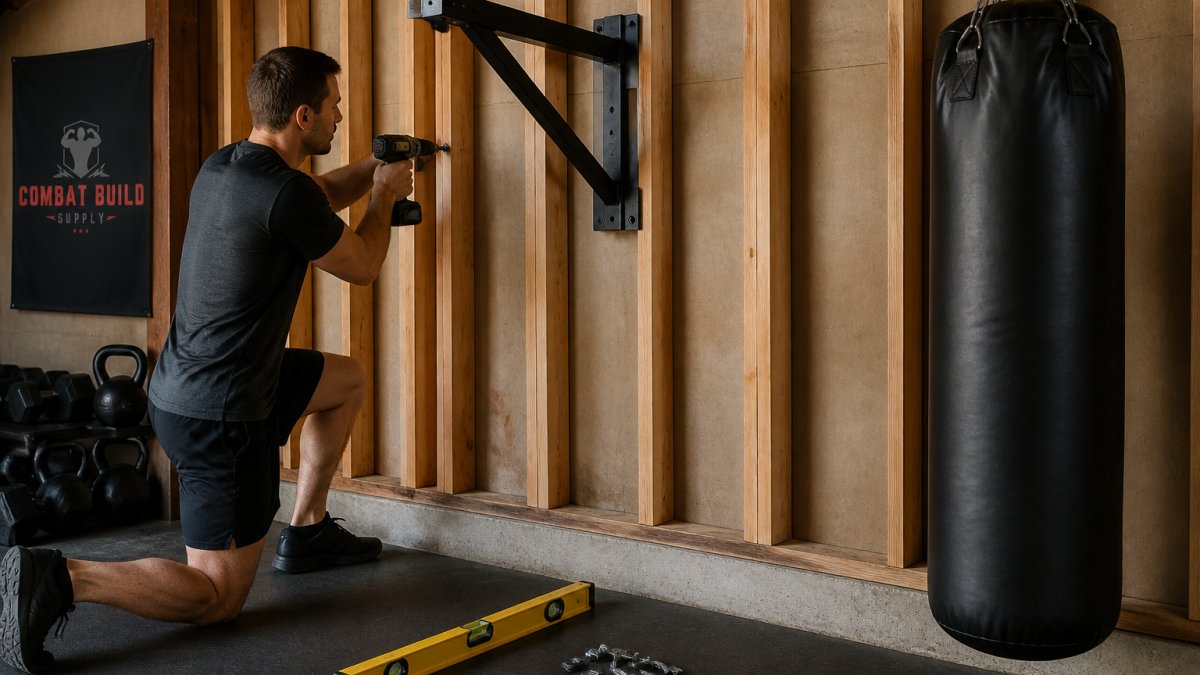
What separates a solid install from a failure is the prep work most guides skip. Run this checklist before the drill comes out:
- Confirm wall type. Knock and probe, or use a stud finder with a deep-scan mode, to tell wood-frame from masonry. The two need completely different fasteners.
- Map stud spacing. Standard wood framing is typically 16 inches on center, with 24 inches common in some construction. A bracket whose mounting holes land between studs cannot be safely lag-bolted, check hole spacing against your stud layout before buying.
- Check bag height and hanger reach. Measure from the floor to where the bag's top hardware will sit, add the hanger's reach from the wall, and confirm the bag hangs clear of the floor and any nearby obstacles.
- Verify swing clearance. Leave room behind and beside the bag for it to swing without slapping the wall, and enough floor space in front for footwork.
- Match fasteners to load. Lag bolts for wood studs; sleeve or wedge anchors for masonry and brick, drilled to the anchor manufacturer's specified diameter and depth.
For wood studs, lag bolts long enough to bite deep into the stud, not just the drywall layer, are the standard choice, and the bracket should span at least two studs so the load is shared. For masonry, sleeve anchors expand against the hole walls and suit solid brick or block, while wedge anchors are common in concrete; both depend on drilling the correct hole size and depth, so follow the anchor maker's spec rather than eyeballing it.
Uppercut Fixed Wall Punching Bag →
For brick specifically, our wall mounted heavy bag brackets for brick installation guide covers fastener selection step by step. If you want the full walkthrough from layout to final torque check, our professional grade heavy bag setup installation guide covers mounting and hardware in one place.
Heavy Bag Wall Mount vs Ceiling Mount: Which Fits Your Gym
Wall mount versus ceiling mount comes down to structure and swing. A ceiling mount hangs the bag from above, which gives a truer pendulum swing and frees floor space, but it needs a joist that can carry the load and enough ceiling height for the bag to hang clear. A wall mount needs a suitable wall and enough horizontal clearance, and it suits rooms with low ceilings. Basements with exposed joists favor ceiling mounts. Garages with block walls favor wall mounts. Apartments often favor neither, which is why we point renters to the best heavy bag stand for apartments as a no-damage alternative.
Reducing Vibration and Noise Before Your Neighbors Complain
Noise travels through structure, not air. When a bag is hit, vibration runs down the bracket and into the wall, and that is what your neighbor hears. Three fixes help: mount into solid structure rather than hollow drywall, add a rubber or foam isolation pad between the bracket and the wall, and keep the bag's mounting hardware tight so it does not rattle. A bag that swings freely also transmits less shock than one that slaps the wall on every hook. Check bolts monthly; loose fasteners are the loudest failure mode.
Picking the Right Hanger for Your Training Space
Match the hanger to how you train. If you throw heavy kicks and power shots, prioritize load capacity and steel construction. If space is tight, prioritize a rotating or fold-flat design. If you cannot drill, a stand is the answer.
| Setup | Best For | Watch Out For |
|---|---|---|
| Wall mount hanger | Garages, basements, block walls | Needs solid structure and swing clearance |
| Ceiling mount | Rooms with exposed joists, high ceilings | Requires a load-bearing joist |
| Freestanding stand | Apartments, renters, no-drill spaces | Takes up floor space |
One option worth knowing: the Uppercut Fixed Wall Punching Bag is a complete wall-mounted unit with a heavy-duty steel wall mount, high-density foam construction, and an angled surface for jabs, hooks, and kicks. If you are still deciding whether the investment is worth it, our breakdown of the benefits of using heavy bags for conditioning explains what consistent bag work does for strength and timing.

Frequently Asked Questions
What should I look for in a heavy-duty wall-mount heavy bag hanger?
Start with the weight rating and match it to your bag plus a safety margin. Check that the bracket is welded steel rather than stamped sheet metal, and confirm the mounting plate spans multiple studs or is rated for masonry. Measure the extension from the wall so you know your striking clearance before you drill. A hanger rated for 100 lb with a bag that weighs 100 lb leaves nothing in reserve, so size up where you can.
How much weight can a heavy bag hanger capacity support?
Capacity ratings vary widely by model, with common figures at 100 lb, 150 lb, and 300 lb. The rating describes the hanger, not your wall. A 300 lb rated bracket bolted into a single stud can still fail because the stud, not the steel, becomes the weak point. Add your bag's filled weight, then check that your mounting surface and fasteners are rated above that number.
Can you mount a heavy bag hanger to drywall?
No. Drywall alone will not hold a loaded heavy bag, and toggle bolts through drywall will pull out under repeated impact. Fairtex's structural setup guidance says wall mounts must be anchored into masonry, concrete, or directly into multiple structural wall studs, and warns against mounting a heavy bag without that support. Find the studs with a stud finder, or use a masonry anchor if your wall is concrete or brick.
How far should a heavy bag hang from the wall?
You need enough room to throw full punches and kicks without clipping the wall behind your target. A 30-inch extension is a common figure for wall brackets, but measure your own reach: stand in your stance, throw a hook and a roundhouse, and note how much space your knuckles and shin need. Leave extra room for bag swing on a chain-mounted bag, since a swinging bag travels further than a fixed one.
Are wall-mounted heavy bag hangers better than ceiling mounts?
It depends on your structure. Ceiling mounts need a joist directly overhead and enough height for the bag to hang clear of the floor, which rules out most basements and garages with low ceilings. Wall mounts work where you have a suitable wall and free floor space in front of it. When neither is possible, a free-standing bag stand is a workable alternative, and some stands have wheels for moving them out of the way.
The challenge is not buying a bracket; it is matching capacity, steel, and fasteners to the wall you actually have. At Combat Build Supply, we stock gear built to hold up, backed by free shipping on every order, a 100% refund for defective or non-functioning items, and support by live chat, email, or phone when you have a setup question. Get started with Combat Build Supply and build a training station that stays solid session after session.


