

Wall Mounted Heavy Bag Brackets for Brick: Installation Guide
Table of Contents
- Why Brick Walls Demand Specialized Heavy Bag Brackets
- Load Capacity and Weight Ratings for Brick Installation
- How to Install Heavy Bag Bracket on Brick: Step-by-Step
- Heavy Duty Masonry Anchors for Punching Bags: Types and Selection
- Steel Construction, Durability, and Impact Resistance
- Vibration Dampening, Maintenance, and Long-Term Performance
- Common Installation Mistakes and Safety Considerations
- Frequently Asked Questions
Last Updated: September 30, 2026
Why Brick Walls Demand Specialized Heavy Bag Brackets
Brick walls demand specialized heavy bag brackets brick because the material is denser than drywall and requires precision installation. A wall-mounted heavy bag bracket for brick must handle dynamic forces, repeated impact and swinging motion, while respecting masonry integrity.
Many builders overlook that brick quality varies dramatically. A 50-year-old wall behaves differently from new construction, and mortar condition, wall orientation, and anchor depth all affect performance.
Load Capacity and Weight Ratings for Brick Installation
Load capacity depends on the bracket's tensile strength, anchor system, and brick quality. A bracket rated for 300 pounds of static weight may handle a 150-pound heavy bag with dynamic impact forces only if installed correctly into solid brick.
Most heavy bag brackets brick support 200-400 pounds of static load when anchors are installed at proper depth and spacing. Expansion bolts, the most common anchor type, achieve holding power by expanding behind the masonry as you tighten them; deeper anchors engage more surface area and hold stronger.
A 100-pound heavy bag swinging and being struck applies forces far greater than 100 pounds at impact. The bracket must be rated for impact resistance, not just static weight; select a bracket rated significantly higher than your bag's weight.
Assess your brick's condition before installation. Soft or crumbling brick cannot hold heavy anchors reliably. If your wall shows significant deterioration, consider reinforcing the area or mounting to a different wall.
How to Install Heavy Bag Bracket on Brick: Step-by-Step
Installing a heavy bag bracket on brick is achievable without professional help but demands attention to detail: assess your wall, select the right tools and anchors, drill precisely, and anchor securely.
Assessing Your Brick Quality and Wall Integrity
Before drilling, assess the brick surface by touch. Soft brick, common in older construction, cannot reliably hold heavy anchors; hard, dense brick is essential.
Check mortar joints for crumbling or missing sections. Avoid drilling into mortar; always anchor into brick. If cracks exceed 1/8 inch, have the wall inspected before installation.
Test wall depth. Brick walls are typically 3.5-4 inches thick; anchors need 2.5-inch penetration for proper holding power. Veneer walls over concrete have different requirements.
Selecting the Right Masonry Drill Bit and Anchor Size
Use a carbide-tipped or diamond-tipped masonry drill bit, not a wood bit. Most heavy-duty brackets use 3/8-inch expansion bolts, requiring a 3/8-inch masonry drill bit.
Expansion bolts are the standard anchor for brick. A 3/8-inch expansion bolt with 2.5-inch embedment depth reliably holds 300+ pounds of static load in solid brick.
Purchase anchors rated for masonry, not drywall anchors. The difference is critical. Masonry anchors are engineered for the density and hardness of brick and concrete. Drywall anchors will pull free under dynamic load.
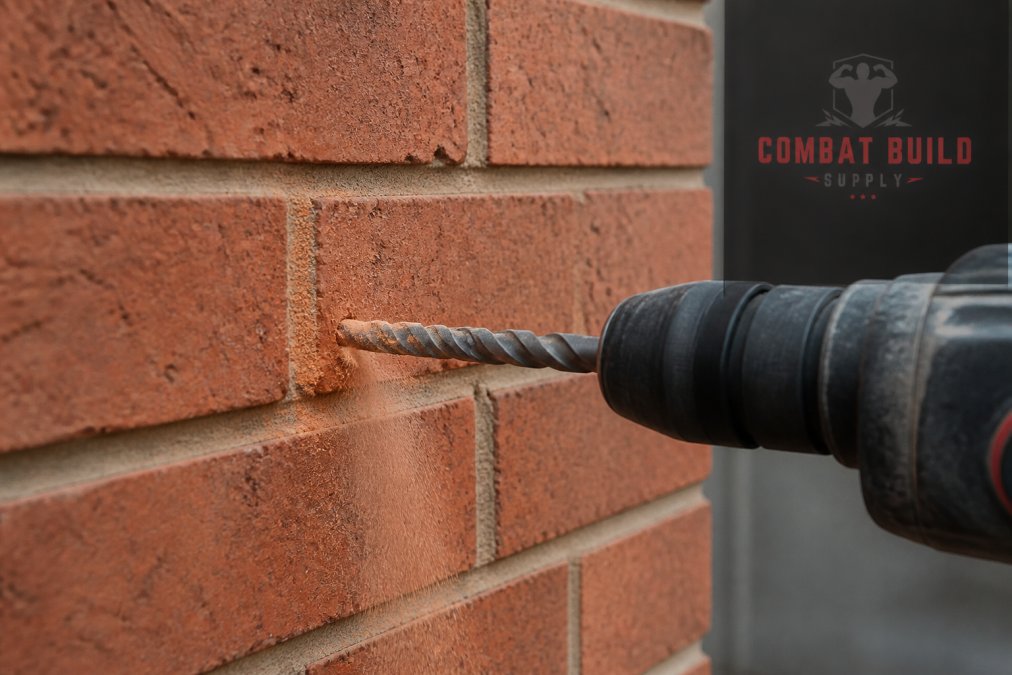
Drilling, Anchoring, and Mounting the Bracket
Mark drilling points clearly using the bracket's specified locations. Use a level to ensure marks are plumb. Drill slowly with moderate pressure; forcing the bit causes overheating and dulling.
Drill to at least 3 inches depth, clearing dust periodically to prevent anchor seating issues. Insert the expansion bolt anchor, hand-tighten first, then use a wrench to tighten gradually without over-tightening.
Install all bolts before mounting the bracket. Align the bracket and hand-tighten bolts, checking that it is level and flush against the wall. Tighten bolts in a cross pattern to ensure even pressure, following the manufacturer's torque specification.
Heavy Duty Masonry Anchors for Punching Bags: Types and Selection
The anchor you choose determines whether your installation is safe or risky. Three main types are used for heavy bag brackets: expansion bolts, sleeve anchors, and wedge anchors.
Expansion bolts are most common. They expand radially inside the brick, creating a mechanical grip with holding power of 200-400+ pounds depending on size and brick quality.
Sleeve anchors allow bolt removal and reinstallation without compromising the anchor, useful if you plan to adjust or relocate the bracket later. Holding power is comparable to expansion bolts.
Wedge anchors provide maximum holding power in very dense brick but are difficult to install and require precise drilling depth. They're unnecessary for most home gym installations unless brick is exceptionally hard.
Select anchor size to match your bracket's bolt holes. A 3/8-inch bolt requires a 3/8-inch anchor. Ensure anchors are rated for masonry, as brick has different load characteristics than concrete.
Steel Construction, Durability, and Impact Resistance
Heavy-duty brackets are typically made from 1/2-inch or 5/8-inch steel plate, welded and reinforced at stress points, to withstand thousands of impacts.
The bracket arm experiences the greatest stress and must be thick enough to resist bending under dynamic load. A thin arm will flex and eventually fatigue and crack.
Look for brackets with reinforced corners and gusset plates (additional steel pieces welded at angles to distribute stress). Powder-coated finishes protect against rust and corrosion in humid environments.
A bracket with a wide base and multiple mounting points distributes impact forces more effectively than a narrow design, resulting in greater stability and longer lifespan.
Vibration Dampening, Maintenance, and Long-Term Performance
Brick is dense and rigid, conducting vibration efficiently. Every punch and bag swing sends vibration through the masonry, creating noise in adjacent rooms and repeated vibration that loosens bolts and stresses the masonry around anchor points.
Vibration and Noise Transmission in Brick
Unlike drywall, which absorbs some vibration due to its flexibility, brick is a solid conductor. When a heavy bag swings and is struck, the impact force travels directly through the bracket into the wall. This vibration can be heard in adjacent rooms, particularly in basements or shared walls. The vibration also creates micro-movements at the anchor points, which over time loosens bolts and can cause anchors to shift. Mitigating these structural stresses requires a precise approach to attaching hardware to brick, a process that shares many of the same mechanical considerations as securing an aluminum fence to brick pillars.
Dampening materials reduce but do not eliminate this transmission. Rubber or neoprene pads placed between the bracket and the wall absorb some vibration energy by compressing slightly under load. These pads are inexpensive ($5-$15 for a set) and easy to install, simply place them under the bracket before tightening bolts. They reduce noise transmission by 30-50 percent, depending on pad thickness and material density.
For maximum dampening, use 1/2-inch-thick neoprene pads rated for vibration isolation. Thinner pads (1/4 inch) provide minimal benefit. The pads should be placed under all four mounting points of the bracket to distribute the dampening effect evenly. Rubber pads are less expensive but compress over time and lose effectiveness; neoprene is more durable and maintains its properties longer.
If noise remains a concern after installing pads, consider adding a second layer of dampening by mounting the bracket to a steel channel or beam that is itself isolated from the wall with additional pads. This creates a decoupled system where the bracket and bag move somewhat independently of the wall, reducing vibration transmission significantly. This approach is more complex but effective for shared walls or situations where noise is a critical concern.
Inspection and Maintenance Schedule
Regular maintenance is essential because vibration naturally loosens fasteners over time. Establish a maintenance schedule based on training frequency:
- Heavy training (5+ days per week): Inspect bolts weekly. A wrench applied to each bolt should show no movement. If a bolt has loosened, tighten it immediately.
- Moderate training (2-4 days per week): Inspect bolts every two weeks.
- Light training (1 day per week or less): Inspect bolts monthly.
When tightening bolts, use a wrench and apply firm pressure, but do not over-tighten.
Long-Term Performance and Bracket Longevity
A bracket that receives monthly inspections and has loose bolts tightened promptly will outlast an identical bracket that is ignored. The difference is often years. A well-maintained bracket in solid brick can remain safe and stable for 10+ years of regular training. A neglected bracket may fail within 2-3 years.
Common Installation Mistakes and Safety Considerations
The most common mistake is drilling into mortar joints instead of brick. Mortar is softer than brick and cannot hold anchors reliably. Always identify brick and drill into it. If your wall is mostly mortar, the brick quality is likely poor, consider a different location.
Frequently Asked Questions
What weight can a brick wall support for a heavy bag bracket?
Brick walls with proper heavy duty masonry anchors can typically support 100-300 pounds of dynamic load, depending on brick quality, mortar condition, and anchor depth. Solid brick construction rated for structural use handles higher loads than decorative brick veneer. Always verify your specific wall's condition and use anchors rated for at least 1.5 times your bag's weight plus impact force. If your brick shows cracks or soft mortar, load capacity drops significantly, have a structural assessment done before installation.
How do I install a heavy bag bracket on brick?
First, locate solid brick at least 6 inches from mortar joints and check for structural integrity. Mark your anchor holes using a level, then drill pilot holes with a masonry bit sized to your anchor specifications. Insert expansion bolts or lag shield anchors rated for your bracket's weight capacity, then hand-tighten fully before mounting the bracket. Use a torque wrench to tighten bolts to manufacturer specs, typically 40-60 foot-pounds. Test with light weight before full training use, and re-tighten bolts monthly during the first three months.
What type of anchors work best for punching bag brackets in brick?
Expansion bolts and lag shield anchors are the most reliable for heavy duty masonry anchors for punching bags. Expansion bolts create mechanical pressure as you tighten them, gripping the brick from inside the hole. Lag shields work similarly but accept wood screws. Both require 3/8-inch to 1/2-inch holes drilled 3-4 inches deep into solid brick. Avoid plastic anchors, they fail under the dynamic load of impact training. Always match anchor diameter and depth to your bracket's load rating and the brick's density.
Do I need a professional to mount a heavy bag bracket on brick?
Most homeowners can install a bracket with basic tools: a masonry drill bit, level, tape measure, and a torque wrench. The critical steps are assessing brick quality, drilling straight holes at the correct depth, and tightening anchors to specification. If your brick shows significant cracks, soft mortar, or you're unsure about wall integrity, hire a professional for a structural assessment. Poor installation risks bracket failure and injury, so take time to verify your brick condition and follow manufacturer guidelines precisely.


