

How to Choose Shin Guards for Muay Thai
Table of Contents
- What You'll Need Before Choosing Shin Guards
- Muay Thai Shin Guard Sizing: How to Measure and Fit
- Slip-On vs. Strapped Shin Guards: Which Style Works Best
- Muay Thai Shin Guards with Foot Protection vs. Shin-Only Design
- Best Muay Thai Shin Guards for Beginners
- Padding, Impact Absorption, and Protection Levels
- Weight, Bulk, and Mobility: Finding Your Balance
- Care, Cleaning, and When to Replace Your Shin Guards
- Frequently Asked Questions
Last Updated: October 8, 2026
What You'll Need Before Choosing Shin Guards
Learning how to choose shin guards for muay thai requires understanding your body, your training style, and what protection matters for your discipline.
Before shopping, gather a soft measuring tape, pen and paper, and ideally a pair of training shorts. Think about where you train: light sparring, heavy bag work, and competition each demand different protection.
Knowing what to measure and prioritize makes the difference between guards that protect you and ones that sit in a closet.
Muay Thai Shin Guard Sizing: How to Measure and Fit
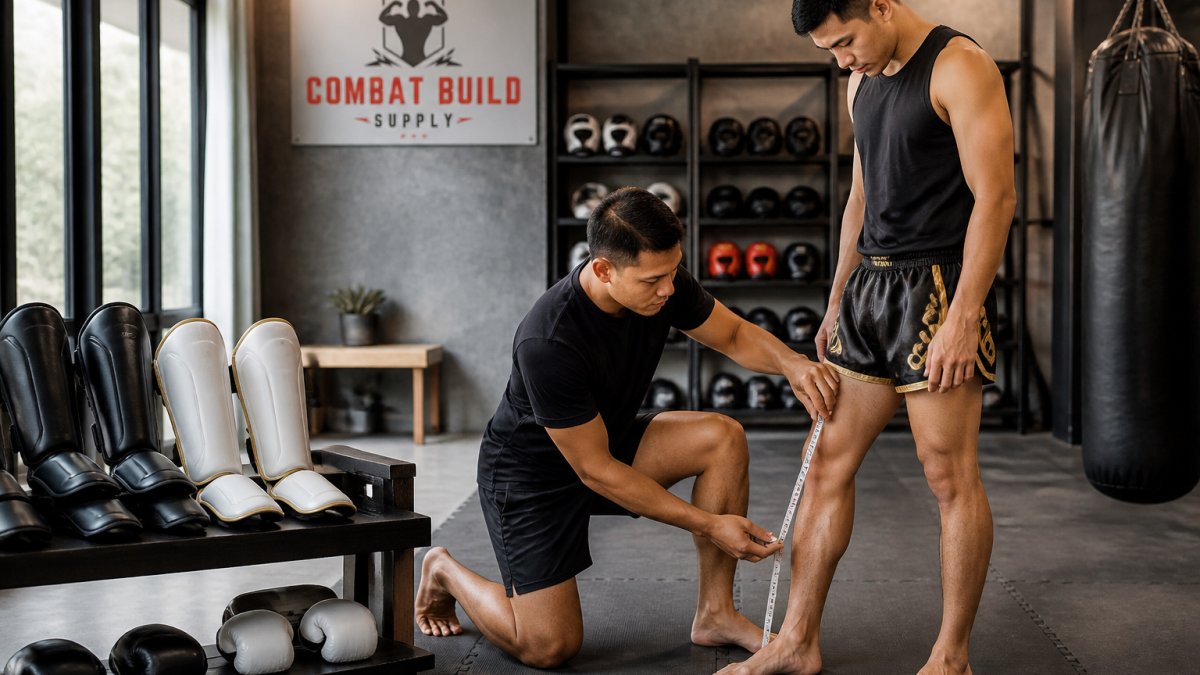
Proper fit is everything. Ill-fitting shin guards slip during kicks, bunch up, and fail to protect. What most guides skip is the actual procedure: how to measure consistently, what to do between sizes, and how to diagnose a fit that is almost right.
The Four Measurements That Matter
Measure barefoot, standing tall, with a soft tape held snug but not tight. Record each in inches to the nearest quarter inch, and measure both legs, size to the larger leg.
- Shin length. Sit with your leg extended straight and foot relaxed at 90 degrees. Measure from the top edge of your kneecap to the most prominent point of your ankle bone (the lateral malleolus). This determines whether a guard covers your knee line without crowding your ankle.
- Calf circumference. Wrap the tape around the widest part of your calf. This drives whether a guard stays put or rotates during kicks; a guard sized only to shin length will spin on a thick calf and gap on a thin one.
- Ankle circumference. Measure just above the ankle bone. This controls how the lower strap or cuff seats and whether the guard slides down during hard rounds.
- Foot length (only if you want instep protection). Stand on paper, mark heel and longest toe, and measure. Too short leaves the top of your foot exposed; too long and it bunches inside your shoe or on the mat.
Reading a Size Chart Without Getting Burned
Most manufacturers publish a size chart keyed to shin length, sometimes with a calf range as a secondary column. Two rules:
- When the two columns disagree, trust the larger size. A slightly long guard can be tightened; one that is too short leaves the bottom of your shin and ankle exposed no matter how hard you cinch it.
- Borderline sizes: size up for sparring, size down for bag work. The larger guard gives more coverage for partner drills and hard sparring; the smaller feels quicker and less bulky for solo bag and pad sessions.
The Five-Point Fit Check
Once guards are on, run this sequence before trusting them in a round:
- Knee line. The top edge should sit just below the kneecap, not on it. If it rides onto the knee, it digs in when you check a kick.
- Ankle line. The bottom edge should stop at or just above the ankle bone. Coverage stopping mid-shin leaves the most-kicked part of your leg bare.
- Strap tension. You should slide one finger under a fastened strap. Two fingers means too loose; zero means it cuts circulation.
- Rotation test. Do ten slow roundhouse kicks per side. If the guard rotates outward or slides toward your ankle, the calf or ankle measurement is off, not the strap tension.
- Footwork test. Move through steps, pivots, and a switch kick. The guard should not catch on itself or restrict ankle flex.
Troubleshooting a Fit That Is Almost Right
- Guard rotates during kicks: usually a calf-circumference mismatch. Try a wider calf panel or a second strap higher on the calf.
- Guard rides down onto the ankle: the ankle strap is too loose or the shin length too short. Tighten the lower strap first; if it still slides, you need a longer guard.
- Pinching behind the knee: the top edge sits too high. Drop the guard a half inch and re-tighten.
- Instep bunches or pinches toes: foot length is wrong for that model. Consider a shin-only design or different instep cut.
- Guard interferes with ankle supports or braces: put the brace on first, then the guard, and check the lower strap sits above the brace rather than compressing it.
Slip-On vs. Strapped Shin Guards: Which Style Works Best
The choice between slip-on and strapped guards affects speed, security, and convenience. Both work for Muay Thai but suit different situations.
Slip-on guards slide over your foot like a sock.
Strapped guards use Velcro or buckles to secure around your leg, letting you adjust fit throughout a session, loosen if swelling occurs, tighten if the guard shifts.
For most fighters, strapped guards offer more versatility, security and dialed-in fit. Slip-ons excel if speed and simplicity matter most.
Muay Thai Shin Guards with Foot Protection vs. Shin-Only Design
This choice directly impacts how much of your leg stays protected during kicks.
Shin-only guards protect just your shin and lower leg, leaving your foot and instep exposed. They're lighter, less bulky, and offer maximum freedom for footwork and agility.
Guards with foot protection extend coverage to your instep, protecting the vulnerable area where you land kicks and keeping your foot safer during sparring when partners counter-kick.
For beginners, foot protection is smart, you're still learning kick mechanics and might land awkwardly.
Best Muay Thai Shin Guards for Beginners
Starting your Muay Thai journey means prioritizing protection.
Look for substantial padding. Beginners benefit from thicker cushioning because kicks aren't yet precise, and more padding absorbs impact better while form develops.
Choose strapped designs. Beginners shift stance and reposition frequently, and straps keep guards in place through all that movement.
Foot protection matters for beginners still figuring out foot positioning on kicks; instep protection prevents injuries from poor landing angles.
Weight should be moderate, heavy guards tire your legs during long sessions, while light guards may lack padding.
Padding, Impact Absorption, and Protection Levels
Padding quality separates good guards from mediocre ones; not all padding performs the same under impact.
Foam padding is standard in most guards, compressing on impact to absorb force.
Gel padding offers superior impact absorption, distributing force across a wider area and staying responsive through many impacts without breaking down.
Check padding placement. Protection should cover your entire shin bone and the sides of your lower leg; gaps create unprotected zones.
Weight, Bulk, and Mobility: Finding Your Balance
The weight and bulk of your guards directly impact how you move. Heavier guards tire your legs faster; bulky guards restrict footwork.
Lightweight guards let you move freely, with faster, sharper kicks and crisp footwork through long sessions. The trade-off is less padding and potentially less protection.
Consider training duration: short, intense sessions work fine with heavier guards, while long sessions benefit from lighter options.
Test guards before buying if possible. Do a few kicks and feel how they affect your movement, this beats guessing based on specs.
Care, Cleaning, and When to Replace Your Shin Guards
Proper care extends the life of your guards and keeps them hygienic. Guards absorb sweat and impact repeatedly, and the inside lining is where odor, mold, and material breakdown start.
After Every Session
- Wipe the outside shell with a damp cloth to remove mat grit and dried sweat.
- Turn the guard inside out if the design allows, and wipe the lining with a fresh damp cloth. Do not soak the foam.
- Hang or lay guards flat in open air, lining facing out, until fully dry. A guard that feels dry outside can still be damp against the foam core.
- Never leave wet guards in a gym bag, which grows odor and breaks down adhesives and stitching.
Weekly and Monthly Deep Cleaning
For a deeper clean, hand wash with mild soap and lukewarm water. Work soap into the lining with your hands, not a brush, then rinse thoroughly and press out excess water with a towel. Air dry away from direct sun and heat.
For odor control, wipe the lining with diluted white vinegar (roughly one part vinegar to three parts water) and let it dry completely before the next use.
Drying Without Damaging the Foam
Airflow matters more than heat. Hang guards by the top strap or lay them flat with the lining exposed; a small fan pointed at the lining cuts drying time significantly in humid conditions. Avoid radiators, car trunks, and direct sun, which degrade foam and crack the shell.
Storage Between Sessions
Store guards in a cool, dry place, loosely arranged rather than compressed. Don't stack heavy gear on them or fold them in half, which creases the foam. If you train daily, rotate between two pairs so each has a full day to dry.
When to Replace: Wear Indicators, Not Just a Calendar
Replacement timing depends on how often and how hard you train, but the calendar is only a rough guide. Heavy training (five or more sessions per week) wears out quality guards in roughly 12 to 18 months; moderate training (two to four sessions per week) often stretches to 18 to 24 months; casual training can last two to three years. Let the gear's condition decide.
Replace when you see any of these:
- Padding feels thin or bottomed out. Press the shin panel with your thumb. If you feel your thumb through to the other side, the foam has compressed and no longer absorbs impact.
- Straps no longer hold. Hook-and-loop that lost its grip, stretched elastic, or buckles that slip under load mean the guard will shift during kicks.
- Cracks or splits in the outer shell. Once compromised, the foam underneath degrades faster and the guard can catch on itself during footwork.
- Persistent odor after cleaning. Odor returning within a session or two usually means bacteria have penetrated the lining and foam.
- Visible deformation. A guard with a permanent bend or curled edges no longer sits correctly on your shin.
With proper care, quality guards serve you reliably for years.
Frequently Asked Questions
How do I know what size shin guards to get for Muay Thai?
Measure your shin from the knee to the top of your foot, and your foot from the heel to the tip of your longest toe. Most shin guards are sized by height and weight ranges. Write down both measurements and match them to the manufacturer's size chart. A snug fit that doesn't restrict circulation or mobility is your target. Try the guards on with the socks and wraps you'll actually wear during training to ensure proper fit.
Are shin guards with foot protection better than shin guards without it?
Shin guards with foot protection (instep coverage) offer more complete protection during heavy kicking drills and sparring, especially for beginners building technique. Shin-only designs provide better mobility and lighter weight for advanced fighters who've developed bone density and precise footwork. Your choice depends on your training intensity, experience level, and whether you're doing partner drills or solo work.
What's the difference between slip-on and strapped shin guards?
Slip-on guards slide over your foot and shin, offering quick on-and-off convenience and a snug, secure fit once properly sized. Strapped guards use adjustable closures to customize fit and allow faster removal between rounds. Slip-ons tend to stay in place better during intense movement, while strapped designs work better if you're between sizes or need to adjust tightness throughout training.
What should I look for in shin guards for beginners?
Beginners benefit most from shin guards with instep protection, medium to heavy padding for impact absorption, and a secure fit that doesn't shift during kicks. Lightweight designs aren't ideal early on because they often sacrifice protection. Look for durable construction that withstands frequent training, and choose guards that balance protection with enough mobility to develop proper footwork and guard rotation.


