

Essential Gear for Muay Thai Sparring: 2026 Guide
Table of Contents
- The Essential Muay Thai Sparring Gear Checklist
- Muay Thai Sparring Glove Weight Guide: Choosing 14 oz vs 16 oz
- Sizing and Fit Guide for Different Body Types
- Safety Standards and Certifications for Sparring Gear
- Muay Thai Sparring Etiquette for Beginners
- How to Clean and Maintain Sparring Gear
- Building a Home Gym for Muay Thai Sparring
- Frequently Asked Questions
Last Updated: September 12, 2026
The Essential Muay Thai Sparring Gear Checklist
Sparring tests technique under pressure, and the right protective equipment lets you train hard without paying for it in injuries. This guide from Combat Build Supply covers the essential gear for muay thai sparring, from glove weight to shin protection.
Padding absorbs impact, and that absorption keeps you training week after week. Skimp on protection and you risk bruised shins, sore knuckles, and chipped teeth that sideline you for months. Below, we break down each piece, how to size it, and how to make it last.
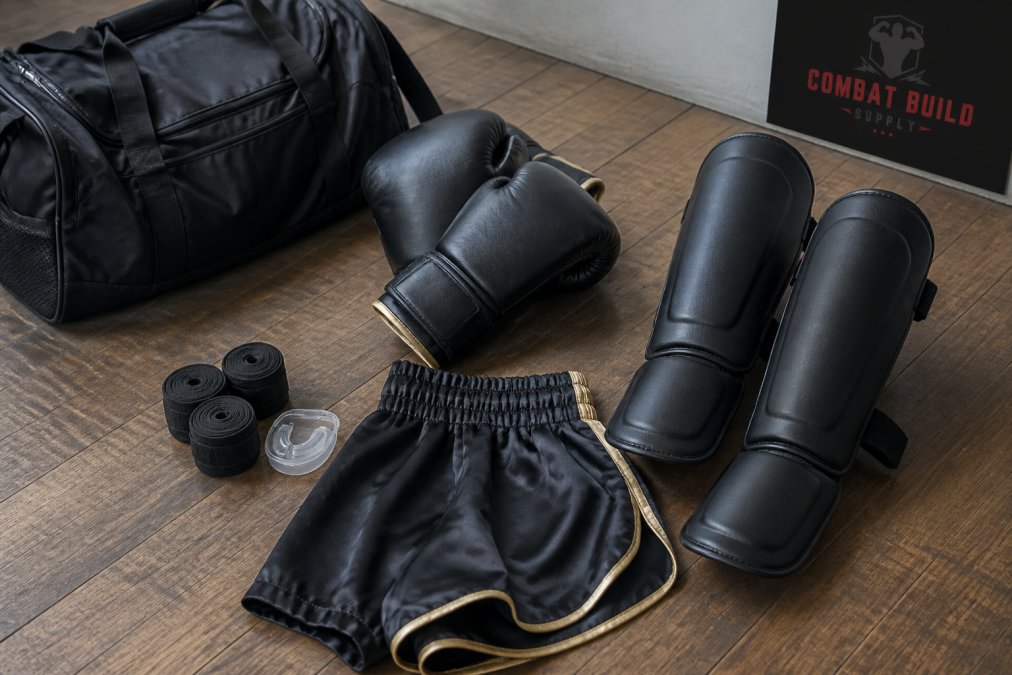
Sparring Gloves
Sparring gloves are the single most important purchase you'll make. Unlike bag gloves, they use thicker foam to disperse impact across a larger surface, protecting both your hands and your partner's face. Look for a secure hook-and-loop closure and reinforced wrist support.
Shin Guards
Shin guards protect against leg kicks, which land with the force of a baseball bat. Quality guards use layered foam and a contoured shape that stays put during clinch work and heavy exchanges. Breathability matters more than beginners expect.
Hand Wraps
Hand wraps stabilize the small bones of the hand and wrist and are non-negotiable under gloves. Wrapping too loose lets the wrap bunch and offers no support; aim for firm compression across the knuckles and wrist.
Mouthguard
A mouthguard is dental protection you'll rarely notice until you need it. Boil-and-bite models fit most people well; custom-fit guards offer better retention for frequent sparring. Replace yours every season.
Muay Thai Shorts
Shorts need full range for kicks and knee strikes. Wide leg openings and a flexible waistband let you move without restriction; avoid heavy seams that chafe during long sessions.
Ankle Supports and Groin Protector
Ankle supports add stability for fighters with a history of rolls or sprains. A groin protector is essential for anyone taking body kicks, and it's the piece beginners skip and immediately regret.
Muay Thai Sparring Glove Weight Guide: Choosing 14 oz vs 16 oz
The standard answer: 16 oz gloves for sparring, 14 oz for bag and pad work. The reason matters more than the number, because it explains why gyms enforce it.
Glove weight is mostly foam volume. A 16 oz glove carries a thicker, wider knuckle pad, so the same punch spreads its force across a larger area of your partner's face and skull. A 14 oz glove concentrates that force into a smaller contact patch. You are not hitting harder in lighter gloves, you are hitting sharper, and sharp causes cuts, black eyes, and the head snap that ends a training partnership.
The second effect is defensive. Heavier gloves make it harder to snap your hands back to guard, forcing you to keep elbows tight and chin down. Fighters who only train in 10 oz bag gloves develop lazy guard habits that show up the first time they spar.
Here's the practical breakdown:
| Glove Weight | Best For | Trade-off |
|---|---|---|
| 8-10 oz | Competition, bag work | Far too thin for sparring partners |
| 12 oz | Pad work, fast drills | Minimal partner protection |
| 14 oz | All-around training, light technical sparring | Lighter protection in hard sparring |
| 16 oz | Standard sparring, clinch work | Slower hand speed, more arm fatigue |
| 18-20 oz | Heavy sparring, bigger fighters | Exhausting for long rounds |
Most gyms require 16 oz for sparring and won't let you in the ring with anything lighter. If you train multiple disciplines, buy two pairs so your sparring gloves stay clean, dry, and intact instead of getting beaten flat on the bag.
Matching Glove Weight to Body Weight and Hand Size
Glove weight is not one-size-fits-all, and the common beginner mistake is buying the same 16 oz as a partner who outweighs them by 60 lb.
A common pattern in gyms is to scale glove weight loosely with body weight:
- Under 130 lb: 12-14 oz for sparring is often enough padding, and 16 oz can feel like swinging bricks
- 130-160 lb: 14-16 oz is the usual range, with 16 oz preferred for hard rounds
- 160-190 lb: 16 oz is the floor, and many coaches push toward 16-18 oz
- Over 190 lb: 16-18 oz, and some gyms ask heavier fighters to go up to 20 oz for partner safety
Hand size matters just as much. Measure around the widest part of your palm, just below the knuckles, with a soft tape. A glove that's too large slides on impact and exposes your knuckles; one that's too small restricts blood flow, numbs your fingers, and wears out at the seams faster.
When 14 oz Is Actually Fine for Sparring
Fourteen ounces is not automatically wrong. It's reasonable for:
- Technical sparring at low intensity, where the goal is timing and footwork rather than power
- Smaller fighters under roughly 130 lb who cannot generate the same force as a heavyweight
- Clinch-heavy rounds, where glove padding matters less than wrist support
It's the wrong choice for hard sparring, for anyone preparing for a fight, and for any round where your partner wears 16 oz and you don't. Mismatched glove weights are a leading cause of training partners getting hurt, and most coaches will stop the round if they see it.
Wrist Support and Closure
Weight is only half the equation. Look for a long hook-and-loop strap that wraps well past the wrist joint, not a short tab stopping at the base of the palm. A proper strap locks the wrist so it can't collapse when you land a hook or catch a kick.
Lace-up gloves offer the most secure wrist lock but need a partner to tie them, impractical when rotating partners every round. For most sparring, a wide hook-and-loop closure with a reinforced thumb is the better daily choice.
Sizing and Fit Guide for Different Body Types
Fit beats brand every time. A glove that's too large slides and exposes your knuckles; one that's too small restricts blood flow and wears out faster.
Measure your hand around the widest part of your palm, then match it to the manufacturer's chart. For shin guards, measure from the top of your foot to just below the knee; longer-limbed fighters often need to size up for full shin coverage.
Safety Standards and Certifications for Sparring Gear
Here's the honest starting point: there is no single government certification for combat sports protective gear the way there is for motorcycle helmets or hard hats. No agency stamps a shin guard as "approved" for Muay Thai. The safety signals you rely on come from materials, construction, and how the manufacturer tests its own product.
This is the gap most gear guides skip: they tell you which brand to buy, not what to look for when you open the box.
Foam Density and Layered Construction
The single most important safety variable in gloves and shin guards is foam density, measured in pounds per cubic foot. Low-density foam feels soft in the store, then compresses flat within months of hard training. Once packed down, it stops absorbing impact and transmits it straight through to your knuckles or your partner's face.
What to look for:
- Multi-layer foam rather than a single block. Good sparring gloves typically stack a firm outer layer for impact dispersion over a softer inner layer for comfort, sometimes with a dense core layer in between. Each layer does a different job.
- Closed-cell foam over open-cell. Closed-cell foam resists moisture absorption, which means it does not get heavy, soggy, and bacterial over time.
- Consistent thickness across the striking surface. Squeeze the knuckle pad and the back of the hand. If the padding thins out at the edges, that is where impact will find its way through.
Construction Details That Signal Quality
- Reinforced stitching at stress points. Check the seams where the thumb meets the palm, where the wrist strap attaches, and along the knuckle line. Double or bar-tack stitching at these points is a strong indicator the glove was built for contact, not for looks.
- A separate, attached thumb. An attached thumb prevents the thumb from catching an eye or getting bent backward during a clinch. A loose or detached thumb is a red flag.
- Moisture-wicking liner. A synthetic liner pulls sweat away from the foam. A bare leather or vinyl interior traps it.
- Shin guard coverage. A quality guard covers from the top of the foot to just below the knee, with a hard or dense outer shell over the shin bone and softer padding over the instep and calf.
What Certifications Actually Exist
There is no equivalent to a national safety standard for sparring gear, but a few real signals are worth knowing:
- Competition rule sets. Amateur and professional sanctioning bodies set their own equipment requirements for sanctioned bouts, typically specifying glove weight, shin guard type, and groin protector for fighters. If you plan to compete, check the rule set for the promotion or commission overseeing your event, because their requirements override gym norms.
- Mouthguard standards. Mouthguards intended for sport are sometimes labeled against a national standard for athletic mouth protectors, which specifies impact attenuation and material requirements (the American Dental Association). A boil-and-bite guard sold as a sports mouthguard is a different product from a cosmetic dental tray.
- Material disclosures. Reputable manufacturers publish foam type, density, and leather grade. If a listing gives you none of that, treat it as a signal in itself.
A Practical Buying Checklist
When you evaluate any piece of sparring gear, run through these questions:
- Is the foam layered, or a single block?
- Is the stitching reinforced at the thumb, wrist, and knuckle line?
- Does the shin guard cover the full shin and the top of the foot?
- Does the manufacturer disclose foam density or material specs?
- Does the gear meet the rule set for any competition you plan to enter?
Muay Thai Sparring Etiquette for Beginners
Etiquette keeps sparring safe and productive, starting before the first punch. Touch gloves, match your partner's intensity, and never escalate power without agreement.
- Communicate before the round: agree on intensity and target areas
- Control your power; sparring is practice, not a fight
- Respect the tap and stop immediately when your partner signals
- Keep your gear clean; nobody wants to clinch with dirty equipment
Sparring etiquette matters because intensity is a shared decision; the partner who goes too hard ruins the session for everyone.
How to Clean and Maintain Sparring Gear
Clean gear lasts longer and prevents skin infections (the CDC). Wipe gloves inside and out after every session, and air them out rather than stuffing them in a bag.
For deeper cleaning, use anti-microbial wipes on gloves and shin guards and hand-wash wraps weekly. Mouthguards need rinsing after each use and a periodic soak in cleaning solution.
Building a Home Gym for Muay Thai Sparring
A functional home setup needs less space than most people think: a heavy bag, adequate floor space, and gear storage cover the essentials.
If you're setting up at home, Combat Build Supply carries commercial-grade bags built to handle daily training. The Panama 45D Heavy Punching Bag is a solid anchor for a home setup, and the Uppercut Combination Punching Bag adds variety for angle work. Both ship free, and every order is backed by a 100% refund for defective items.


Check your ceiling height before ordering, and confirm your stand or mount is rated for the bag's weight. If you're unsure, Combat Build Supply's support team answers setup questions by live chat, email, or phone.
Frequently Asked Questions
What are the essential gear needed for Muay Thai sparring?
For safe Muay Thai sparring, you need 16 oz gloves, shin guards, hand wraps, a mouthguard, Muay Thai shorts, and a groin protector. Ankle supports are optional but can help with joint stability. These items protect you and your partner during contact drills like leg kicks and clinch work. Always check with your gym for any additional requirements.
Should I spar with 14 or 16 oz gloves?
Use 16 oz gloves for sparring. The extra padding in 16 oz gloves provides better impact absorption and knuckle protection, reducing injury risk for both you and your partner. 14 oz gloves are better for bag work or pad work where you need more speed and precision. If you're a heavier fighter, you might go up to 18 oz, but 16 oz is the standard for most adults.
Why is a mouthguard mandatory for Muay Thai sparring?
A mouthguard is mandatory because it protects your teeth, jaw, and brain from impact. Muay Thai involves punches, elbows, and knees that can cause dental damage or concussions. A properly fitted mouthguard absorbs and disperses force, reducing the risk of injury. Off-the-shelf boil-and-bite mouthguards are affordable, but custom-fit ones offer better protection and comfort.
How do I choose the right shin guards for Muay Thai?
Choose shin guards based on padding thickness, material, and fit. For sparring, look for thick foam padding (at least 1 inch) and durable synthetic leather or leather. Ensure they cover from below the knee to the top of the foot. Adjustable straps or hook-and-loop closures provide a secure fit. Try them on with shin guards over bare legs or thin socks to check mobility.
Sparring gear is an investment in staying healthy enough to keep training. Combat Build Supply helps you get it right the first time with durable equipment, free shipping on every order, and a 100% refund if something arrives defective. Sign Up Now and build a setup that supports every session.


