

Fightshop vs Generic Fitness Store Gear: 2026 Guide
Table of Contents
- Fightshop vs Generic Fitness Store Gear: What Are You Actually Paying For?
- Feature Comparison Table: Specialized Combat Gear vs General Fitness Equipment
- Key Differences in Materials and Construction Quality
- Impact of Gear Quality on Injury Prevention
- How to Choose Boxing Gloves for Beginners
- Maintenance Tips for Combat Sports Gear
- The Long-Term Cost-Benefit Analysis
- Conclusion: Making the Right Choice for Your Training
- Frequently Asked Questions
Last Updated: September 7, 2026
Fightshop vs Generic Fitness Store Gear: What Are You Actually Paying For?
The fightshop vs generic fitness store gear debate usually comes down to one question: why does similar-looking equipment cost so much more at a specialized retailer? The answer is that the two channels sell fundamentally different products, even when the photos look identical. A fightshop is a retail operation dedicated to combat sports equipment, meaning boxing gloves, MMA gear, Muay Thai shin guards, and sparring gear are its core competency rather than a side category.
The real difference is not branding. It is the gap between equipment engineered for impact absorption and protective padding versus gear designed for casual use. Generic stores prioritize volume and low price points, while specialized retailers stock professional-grade items built to safety standards that matter when you are sparring or hitting a heavy bag.
Feature Comparison Table: Specialized Combat Gear vs General Fitness Equipment
To see the fightshop vs generic fitness store gear divide clearly, compare the specifications side by side. The table below summarizes what typically separates professional-grade combat equipment from general fitness merchandise.
| Feature | Specialized Combat Gear | General Fitness Equipment |
|---|---|---|
| Materials | Genuine or high-grade synthetic leather | Vinyl, bonded leather, thin synthetics |
| Padding | Multi-layer, density-rated impact foam | Single-layer soft foam |
| Construction | Reinforced stitching, anchored thumbs | Basic seams, glued panels |
| Sizing | Weight-based (oz) and precise fit charts | Generic S/M/L sizing |
| Safety Standards | Designed for impact testing and sparring use | No combat-specific certification |
| Longevity | Years under daily training | Months under moderate use |
| Support | Expert guidance on fit and use | Limited to general staff knowledge |
This distinction matters most for protective items like boxing gloves, headgear, and shin guards, where material quality directly affects safety.
Key Differences in Materials and Construction Quality
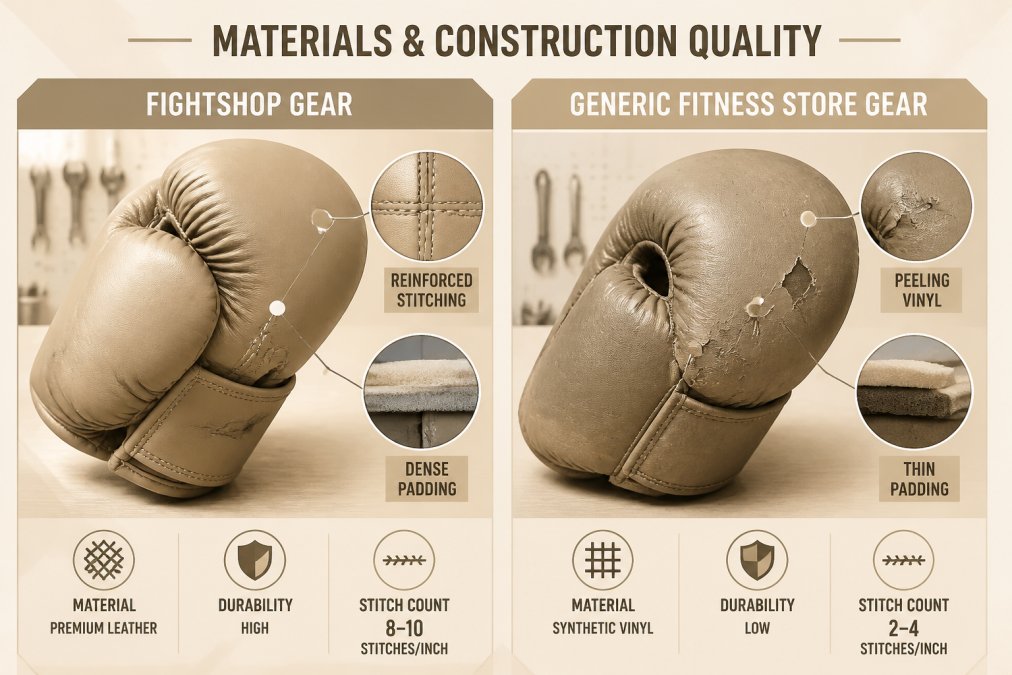
The single largest gap between a fightshop and a generic fitness store is material quality. Professional-grade boxing gloves use genuine leather or dense synthetic leather with multi-layer foam padding designed to disperse force. Generic fitness gloves often use thin vinyl with a single layer of soft foam, which compresses quickly and transfers impact to your hands and wrists.
Construction quality follows the same pattern. Specialized combat sports equipment features reinforced stitching at stress points, anchored thumbs that resist tearing, and ergonomic design shaped around a closed fist. General fitness gear typically uses basic seams and glued panels that separate under repeated impact.
Durability and Material Longevity
Durability is where the price difference justifies itself. A quality pair of sparring gear gloves from a specialized retailer can last several years with proper care (PubMed). A comparable-looking pair from a general fitness store often fails within six months of regular training. The deciding factors are leather quality, stitch density, and padding resilience, none of which are visible in online product photos.
If you train three times per week, a durable pair of boxing gloves that lasts three years costs far less per session than replacing cheap gloves every few months. This is the core of the fightshop vs generic fitness store gear value argument.
Impact of Gear Quality on Injury Prevention
Protective equipment exists for one reason: to prevent injury. Boxing gloves, shin guards, and headgear absorb force that would otherwise reach bones, joints, and soft tissue. When padding is too thin or compresses too easily, that force transfers to your body.
Hand injuries are the most common result of poor-quality gloves. Thin padding leads to broken metacarpals, wrist strain, and knuckle damage. Similarly, substandard shin guards offer little protection against impact during Muay Thai sparring.
Safety Certification Standards: What Generic Gear Lacks
Most general fitness stores do not test their combat gear against impact standards. Specialized equipment is often designed to meet voluntary consensus standards such as those referenced by the ASTM International for protective equipment, or the boxing-specific requirements used by sanctioning bodies like USA Boxing for amateur competition.
Generic fitness gloves rarely carry any such certification. They are manufactured to a price point, not to a performance threshold. The foam inside a typical $25 fitness glove is often a single layer of open-cell foam that compresses fully on impact, transferring nearly all the force to your metacarpals. Professional-grade gloves use closed-cell or multi-density foams that maintain their structure under repeated strikes, dissipating energy across a wider surface and over a longer time interval.
This distinction matters most for headgear. Concussion risk is not just about the force of a single blow but about cumulative subconcussive impacts. Headgear designed for sparring uses thicker, firmer padding over the temples and forehead, precisely where impact forces concentrate.
The Mechanism of Padding Failure
Padding failure is not always visible from the outside. When foam compresses beyond its elastic limit, it loses its ability to rebound. Over time, the padding becomes permanently flattened, and the glove or shin guard becomes a shell that transmits force rather than absorbing it.
A common pattern is that practitioners replace generic gear every few months, not because it looks worn but because their hands start hurting. The pain is the first sign that the padding has failed.
What to Look For in Protective Gear
When evaluating protective equipment, ask three questions:
- What is the padding density rating? Look for terms like "multi-layer," "high-density," or "impact-rated" rather than vague claims of "extra padding."
- What training context is it designed for? Sparring gear and bag gloves are engineered differently. Using bag gloves for sparring is unsafe, and using sparring gloves for heavy bag work degrades them faster.
- Does the manufacturer specify a safety standard? If a product page mentions ASTM, USA Boxing, or similar references, it indicates the manufacturer has considered impact testing. Silence on this topic is a red flag.
Specialized retailers can answer these questions because combat sports equipment is their core business. A general fitness store employee may not know the difference between bag gloves and sparring gloves, let alone the foam density inside each.
How to Choose Boxing Gloves for Beginners
For anyone new to combat sports, how to choose boxing gloves for beginners starts with understanding weight and purpose. Boxing gloves are measured in ounces, with 10 oz gloves for competition, 12 oz for general training, 14 oz for pad work, and 16 oz for sparring (usaboxing.org). Beginners should generally start with 16 oz gloves for sparring safety and hand protection.
Fit is the second priority. Gloves should feel snug around the hand with no excessive movement, but not tight enough to cut circulation. Always wear hand wraps underneath, as they provide wrist support and absorb sweat that would otherwise break down the glove lining.
Purpose determines your choice. If you plan to focus on bag work, a firmer glove protects your hands against repetitive impact. If you intend to spar, you need the heavier 16 oz size with adequate protective padding. Many beginners buy one pair for everything, which means compromising on both.
Maintenance Tips for Combat Sports Gear
Proper care extends the life of any equipment. Always air out gloves after training to prevent moisture buildup, which causes odor and breaks down materials. Never store damp gear in a closed bag.
Clean the exterior regularly with a damp cloth and mild soap. For genuine leather, use a conditioner every few months to prevent cracking. Synthetic leather requires less maintenance but still benefits from regular wiping. Hand wraps should be washed after every session, as they absorb the most sweat and bacteria.
Replace gear when padding compresses or materials crack. A glove that has lost its density no longer provides adequate protection, regardless of how the exterior looks.
Hygiene Protocols: The Hidden Difference Between Specialized and Generic Gear
Generic fitness stores rarely provide guidance on hygiene because their combat gear is an afterthought. Specialized retailers understand that combat sports equipment is worn against bare skin, shared in gym settings, and exposed to blood, sweat, and bacteria. Hygiene protocols are essential for preventing skin infections like staph, ringworm, and mat burn complications.
The leather vs. synthetic care divide. Genuine leather is porous and absorbs moisture deeply. It requires conditioning to maintain flexibility, but over-conditioning can soften the leather too much, reducing its protective stiffness. Synthetic leather is non-porous, but it traps moisture against your skin, creating a breeding ground for bacteria if not cleaned properly.
The interior is the problem zone. Most practitioners clean the exterior of their gloves and ignore the interior, where sweat, dead skin, and bacteria accumulate. The lining is often the first thing to degrade, not the outer shell. Use a disinfectant spray designed for sports equipment on the interior after every session, and allow it to dry completely before storage.
Hand wraps are not optional protection, they are a hygiene barrier. Wearing hand wraps underneath gloves absorbs the majority of sweat and oils from your skin. Washing them after every session is non-negotiable. Reusing unwashed hand wraps transfers bacteria directly into the glove lining.
Mouthguard care is often overlooked. A mouthguard should be cleaned with a toothbrush and mild soap after every use, not just rinsed. Store it in a ventilated case, not an airtight container, to prevent bacterial growth.
Storage and Environmental Factors
Where you store your gear matters as much as how you clean it. Extreme temperatures degrade both leather and foam. Leaving gloves in a hot car during summer accelerates foam breakdown and causes leather to crack. The ideal environment is a cool, dry, well-ventilated space at room temperature.
The drying protocol. After training, remove your gloves immediately and allow them to air dry for at least 30 minutes before storing. Do not use direct heat sources like radiators or hair dryers, they cause the leather to dry out and crack while damaging the foam structure.
The weekly deep clean. Once per week, wipe down the interior of your gloves with a diluted antimicrobial solution. For genuine leather, follow with a light application of leather conditioner to the exterior only. This weekly protocol takes five minutes and extends the usable life of your gear by months.
Why Generic Stores Do Not Teach You This
Generic fitness stores sell combat gear as an impulse category. They do not provide care instructions because their staff does not have the expertise, and their products are often not built to survive long enough for maintenance to matter. A $30 pair of fitness gloves that fails in six months does not need a care protocol, it needs replacement.
Specialized retailers like Combat Build Supply provide care guidance because their business model depends on customer satisfaction over the long term, not a single transaction.
The Long-Term Cost-Benefit Analysis
When comparing costs, look beyond the sticker price. A fightshop vs generic fitness store gear analysis must account for replacement frequency, injury risk, and performance. Cheap gear that fails in six months costs more over three years than professional-grade equipment that lasts several times longer.
The hidden cost of generic gear is injury. A broken hand or wrist strain from inadequate padding means lost training time, medical expenses, and setbacks in your fitness goals. Reliable equipment is an investment in training consistency.
Warranty and return policies also differ. Specialized retailers typically stand behind their combat sports equipment with clearer defect coverage. At Combat Build Supply, we offer a 100% refund for defective or non-functioning items and free shipping on every order.
For those building a home training space, the same logic applies to strength equipment. A folding power rack or Smith machine from a specialized supplier is built to handle daily use, whereas general fitness equipment may not withstand the intensity of regular combat training. The Consumer Product Safety Commission guidance on exercise equipment safety notes that structural failure is a leading cause of home gym injuries, reinforcing the need for durable construction.

Conclusion: Making the Right Choice for Your Training
The fightshop vs generic fitness store gear decision comes down to how seriously you train. Casual users who exercise occasionally may find generic equipment adequate. Anyone training multiple times per week, sparring, or hitting a heavy bag needs professional-grade gear that provides proper protection and lasts.
Specialized equipment wins on materials, construction, safety, and long-term value. The upfront cost is higher, but the cost per session is lower, and the injury prevention is invaluable. When you choose a dedicated source like Combat Build Supply, you get durable gear, premium customer support via live chat, email, or phone, and secure encrypted payments.
Get started with Combat Build Supply and equip your training space with gear that performs every session.
Frequently Asked Questions
Is it better to buy boxing gloves from a specialized fight shop or a general sporting goods store?
For combat training, a specialized fight shop is the better choice. Dedicated retailers source gloves built with impact absorption and wrist support in mind, using materials like genuine leather that hold up to repeated strikes. General sporting goods stores often stock gloves designed for casual fitness classes, not sparring or bag work. If you train combat sports regularly, the specialized option provides the protection and durability your sessions demand.
How does the quality of materials differ in specialized combat gear?
Specialized combat gear uses materials chosen for impact resistance and longevity. You will find genuine leather, multi-layer foam padding, and reinforced stitching in professional-grade equipment. Generic fitness gear often relies on synthetic leather and thinner foam to keep costs down. That difference shows up in how well the gear absorbs impact and how long it lasts under heavy training, which is why fight shop equipment typically outlasts general store alternatives.
Is it worth paying more for gear from a dedicated fight shop?
Yes, for regular practitioners, the extra cost translates to better safety and longer service life. A $50 pair of generic gloves may need replacing every few months, while a $150 pair from a fight shop can last years with proper care. Consider the cost per training session. For beginners unsure about commitment, a mid-range option from a specialized retailer still offers better protection than the cheapest general store alternative.
Do generic fitness stores carry authentic martial arts equipment?
Some do, but the selection is usually limited to entry-level items from a few brands. You will rarely find the full range of sizes, weights, and styles that a dedicated fight shop carries. Authentic equipment from respected martial arts brands is more likely to be found through specialized retailers who understand the specific requirements of different disciplines. For gear that fits properly and meets training standards, a fight shop is the more reliable source.
What are the primary differences in durability between professional fight gear and generic fitness equipment?
Professional fight gear is constructed with higher-grade materials and tighter tolerances. Think full-grain leather versus bonded synthetic, dense multi-layer foam versus soft single-layer padding, and bar-tacked stitching versus basic seams. This construction means professional gear maintains its shape and protective qualities through years of hard use. Generic fitness equipment often shows wear within months, with seams splitting and padding compressing, forcing more frequent replacement.


