

How to Set Up Home Martial Arts Gym: Complete Guide
Table of Contents
- Assess Your Space and Choose the Right Location
- Select the Best Martial Arts Flooring for Home Training
- Install Wall-Mounted Equipment and Heavy Bag Setup
- Organize Small Space Martial Arts Training Ideas
- Set Up Essential Training Equipment and Storage
- Implement Safety, Lighting, and Ventilation
- Maintain Your Home Martial Arts Gym
- Conclusion
Last Updated: August 22, 2026
Assess Your Space and Choose the Right Location
Your space determines everything: equipment fit, training styles, and safety. Start by measuring length, width, and ceiling height. Heavy bags need at least 8 feet of clearance; kicks and speed bags require 9-10 feet minimum. Grappling demands more floor space than striking.
Assess structural integrity before mounting equipment. Locate wall studs with a stud finder, drywall alone won't hold a heavy bag. For apartments or rentals, wall-mounted solutions like the Combat Build Supply's [Uppercut Fixed Wall Punching Bag(/products/uppercut-fixed-wall-punching-bag) | combatbuildsupply.com] offer secure mounting without ceiling work.
Consider noise impact. Heavy bags create sound with every strike. Acoustic dampening through thicker flooring, wall padding, and rubber underlayment reduces noise transmission to neighbors.
Finally, plan for ventilation and climate control. Training generates heat and sweat. Adequate airflow and humidity management protect both your comfort and equipment longevity.
Select the Best Martial Arts Flooring for Home Training
Your flooring choice affects training safety, equipment longevity, and joint protection.
Tatami mats are ideal for grappling-focused training. At 2 inches thick, they provide excellent impact absorption and grip for takedowns. They require regular cleaning to prevent mold in humid climates.
Foam tiles offer versatility and affordability in 0.5 to 2-inch thicknesses. Thicker foam absorbs more impact; thinner foam provides better stability for striking.
For mixed training, combine a 1-1.5 inch impact-absorbing foam base with athletic flooring or rubber matting on top. This protects joints during grappling while providing stable footing for striking.
Rubber flooring handles heavy equipment well and cleans easily, though it absorbs less impact than foam or tatami. Many gyms use rubber in equipment zones and foam or tatami in dedicated training areas.
Installation is straightforward. Interlocking tiles require no adhesive; larger foam sheets may need edge tape to prevent curling. Leave 1-2 inches of clearance around flooring perimeter to avoid tripping hazards.
Install Wall-Mounted Equipment and Heavy Bag Setup
Wall-mounted equipment maximizes space without consuming floor area, especially valuable in smaller homes or apartments.
Identify your strongest walls, exterior walls typically offer better support. Use a stud finder to locate studs spaced 16 inches apart, then mark them clearly. Never rely on drywall anchors alone for heavy equipment.
A full-sized heavy bag (40-70 pounds) requires serious structural commitment. You need either a ceiling joist capable of supporting 200+ pounds of dynamic load or a wall-mounted beam. If unsure about ceiling capacity, a freestanding heavy bag stand eliminates structural concerns. The Century [Martial Arts(/blogs/news/best-home-gym-gear-small-apartments) Heavy Duty 1 Bag Stand | combatbuildsupply.com] provides stable mounting without wall or ceiling work.
How to Hang a Heavy Bag in a Garage
Step 1: Verify ceiling capacity. Solid wood joists spaced 16 inches apart can typically support a mounted heavy bag. Consult a contractor if uncertain.
Step 2: Locate the optimal joist. Use a stud finder to identify a joist center in your training area's middle, leaving clearance on all sides.
Step 3: Install the ceiling mount. Drill a pilot hole and install a heavy-duty lag bolt or eye hook rated for at least 300 pounds, bolted directly into the joist.
Step 4: Add a chain and swivel. Attach heavy-duty chain to the eye hook with a ball-bearing swivel connector to prevent twisting.
Step 5: Attach the heavy bag. Connect the bag's top loop to the chain using a heavy-duty carabiner. Adjust chain length so the bag hangs at striking height (48-54 inches from floor).
Step 6: Test the installation. Apply significant downward pressure by hand. The bag and mount should not move or shift.
Organize Small Space Martial Arts Training Ideas
Small spaces require intentional layout planning. Every square foot must serve multiple purposes, with stackable or wall-mounted equipment.
Vertical storage is essential. Wall-mounted equipment racks keep dumbbells and accessories off the floor. A wall-mounted power rack like the [Major Fitness F35(/products/major-fitness-f35-all-in-one-folding-power-rack) All-In-One Home Gym Wall-Mount Folding Power Rack | combatbuildsupply.com] provides multiple training options while folding flat when not in use.
Zone your space by training type: striking, grappling, and conditioning. Your striking zone needs open space and a heavy bag. Your grappling zone needs cushioned flooring and takedown space. Your conditioning zone can be compact.
Use folding or collapsible equipment. Speed bags and double-end bags take minimal space. Resistance bands and suspension trainers hang on hooks. A doorway pull-up bar consumes no floor space.
Mirror placement expands visual space while providing real-time form feedback. Position your heavy bag where you can approach from multiple angles, place grappling areas where you have maximum floor space, and keep conditioning equipment accessible but not central to your training flow.
Set Up Essential Training Equipment and Storage
Your equipment depends on your primary training focus, but certain pieces support any martial arts practice.
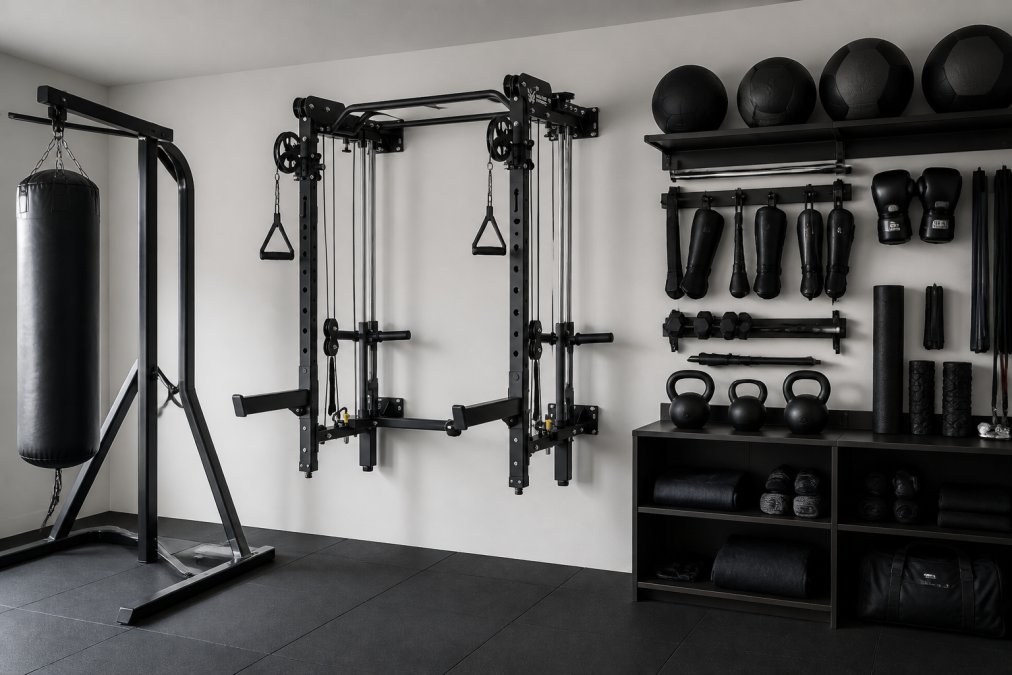
A heavy bag is foundational for most home gyms. The Sting [Panama 45D Heavy Punching Bag(/products/panama-45d-jumbo-hd-punch-bag-black) | combatbuildsupply.com] offers professional-grade construction at 45 pounds, suitable for most practitioners.
Wall-mounted bags offer space-efficient striking practice. The Uppercut Fixed Wall Punching Bag mounts directly to studs and eliminates floor space or ceiling work needs.
A heavy bag stand provides flexibility without structural modifications and accommodates various weights and heights.
Speed bags and double-end bags develop hand-eye coordination and footwork. Both are optional but valuable for strikers.
For strength and conditioning, a power rack enables weighted exercises complementing martial arts training. The Major Fitness F35 folding power rack provides complete strength training in a wall-mounted, space-saving design.
Pull-up bars develop upper body pulling strength essential for grappling. Resistance bands offer portable strength work and mobility training. Dumbbells or kettlebells provide versatile conditioning.
Organize storage with wall-mounted racks, labeled bins for hand wraps and protective gear, and dedicated shelves for recovery tools like foam rollers and massage balls.
Implement Safety, Lighting, and Ventilation
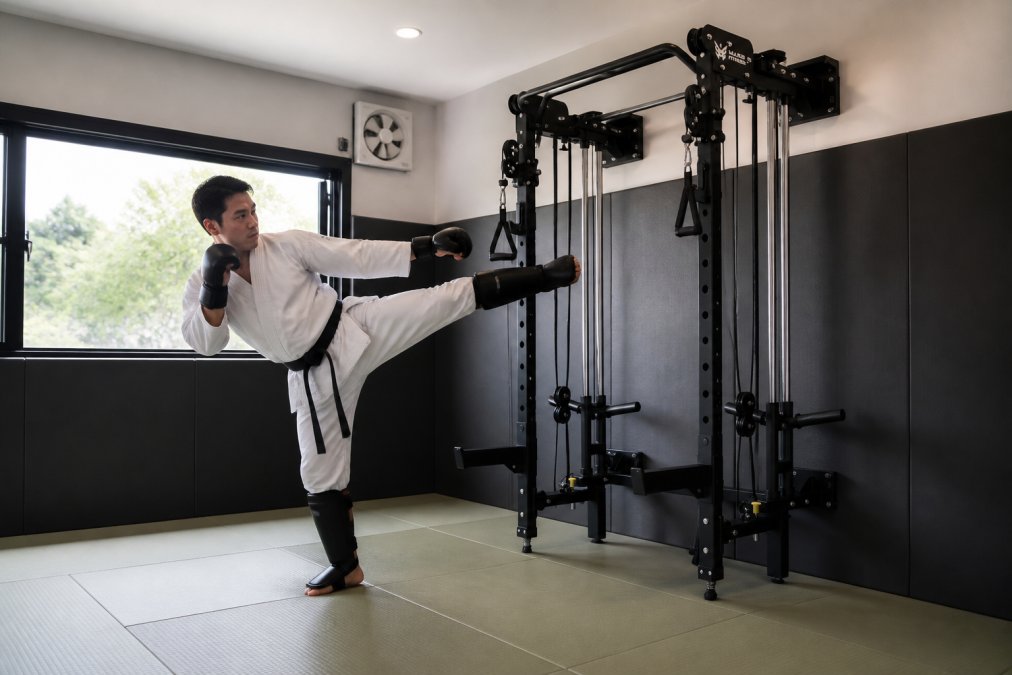
Padding protects against accidental contact with hard surfaces. Wall padding behind your heavy bag prevents striking the wall. Corner padding protects against falls during grappling. Thick foam (2-3 inches) absorbs impact effectively.
Lighting must illuminate your entire training area without creating shadows. Overhead lighting provides general illumination; supplemental wall lighting helps with technique details. LED shop lights are affordable and energy-efficient.
Ventilation prevents uncomfortable heat and humidity. A box fan in a window provides adequate airflow for small gyms. Humidity control matters, moisture encourages mold on tatami mats and rubber flooring. A dehumidifier in humid climates keeps equipment and space dry.
Ensure mats don't create tripping hazards at edges. Tape down mat seams if they curl. Keep the area around equipment clear of obstacles.
Keep a small first aid kit accessible and know how to reach emergency services quickly.
Maintain Your Home Martial Arts Gym
Regular maintenance keeps equipment functional and your space hygienic.
Clean mats regularly. Vacuum weekly and wipe with dilute vinegar solution or gym-specific cleaner monthly. Allow complete drying before rolling up.
Inspect your heavy bag and mounting hardware monthly for tears, lumps, stitching cracks, rust, loose bolts, or damage. Replace worn components before failure.
Disinfect shared equipment regularly with antibacterial wipes to prevent skin infections and illness transmission.
Organize your space monthly to keep it inviting and functional. Check flooring quarterly for compression or soft spots requiring replacement.
Building a home martial arts gym is an investment in your training consistency and long-term health. The right space, equipment, and maintenance create an environment where you can train hard safely. Combat Build Supply provides durable, reliable equipment from heavy bags designed for intense striking to wall-mounted power racks that maximize small spaces. Get started with Combat Build Supply and build the home gym that keeps your training on track, session after session.
Frequently Asked Questions
What flooring is best for a home martial arts gym?
Tatami mats, foam tiles, and rubber flooring are the top choices for home martial arts gyms. Tatami mats provide traditional support and impact absorption for grappling. Foam tiles offer cushioning for striking drills and are easy to install. Rubber flooring delivers durability and noise reduction. Avoid concrete alone, it lacks impact absorption and increases injury risk. Combine your primary flooring with safety padding in high-impact zones for striking and grappling areas.
How much space do I need for a home martial arts gym?
A minimum of 200 square feet allows basic training for striking and grappling. For a full setup with heavy bag, speed bag, and sparring area, aim for 300-400 square feet. Ceiling height should be at least 8 feet for overhead movements and bag work. If you have less space, vertical storage and wall-mounted equipment like the Major Fitness F35 power rack maximize your floor plan while maintaining functionality.
How do I mount a heavy bag in a home gym?
Locate ceiling joists using a stud finder, then secure a heavy-duty ceiling mount directly into the joist with lag bolts rated for at least 100 pounds. Install a swivel mount to reduce rope twist. Alternatively, use a freestanding heavy bag stand like the Heavy Duty 1 Bag Stand for flexibility without ceiling damage. Ensure at least 3 feet of clearance on all sides for safe striking and movement.
What equipment do I need to start training at home?
Start with a heavy bag, hand wraps, and gloves for striking. Add grappling mats, a pull-up bar, and dumbbells for conditioning. A power rack provides versatility for strength training and MMA drills. The Panama 45D Heavy Punching Bag and Uppercut Fixed Wall Punching Bag offer space-efficient options. Prioritize durability and structural integrity, quality gear prevents injury and performs consistently through intense training sessions.
This article was written using GrandRanker


