

Benefits of Wall Mounted Heavy Bags for Home Training
Last Updated: November 16, 2026
Quick Summary
Wall mounted heavy bags bolt to a wall stud or masonry surface through a steel bracket, leaving the floor beneath them open so small rooms can hold a serious training station. They also stay fixed, so every session starts from the same height and distance, though you give up the free swing of a hanging bag.
- A fixed bag absorbs force without giving much, so you feel immediately whether your mechanics are clean.
- A 100 lb bag pulls down with 100 lb of static force at rest, and punches add a multiple of that load.
- For wood-framed walls, the bracket must land on studs with lag bolts, not drywall alone.
- Set the bag's sweet spot at roughly shoulder-to-head height for boxing work.
- A rubber or neoprene pad between bracket and wall damps contact and absorbs high-frequency vibration.
Table of Contents
- Why Wall Mounted Heavy Bags Fit Small Training Spaces
- Wall Mounted vs Freestanding Punching Bag: Which Suits Your Gym
- Heavy Bag Workout Benefits for Strength, Timing, and Conditioning
- Is a 100 lb Punching Bag Too Heavy for a Wall Mount
- Wall Construction, Anchors, and Load Capacity Explained
- Installation Clearance, Bag Height, and Noise Control
- Choosing the Right Wall Mounted Heavy Bag for Your Routine
- Frequently Asked Questions
Why Wall Mounted Heavy Bags Fit Small Training Spaces
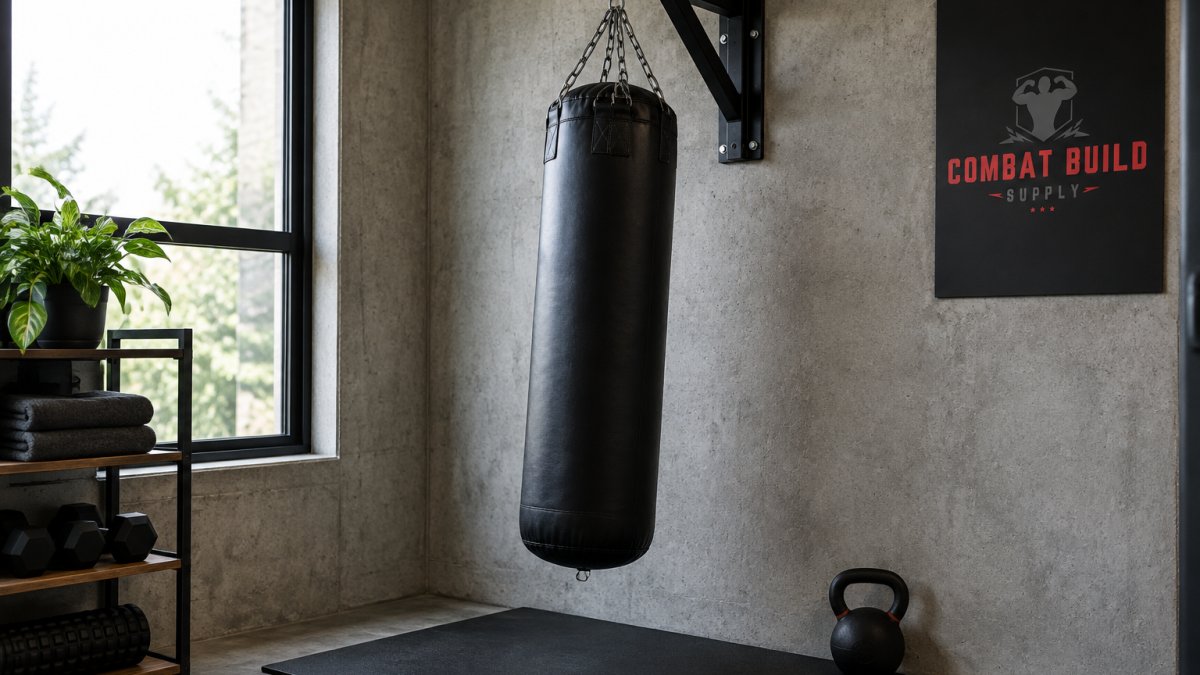
The benefits of wall mounted heavy bags start with the floor you don't lose. A wall-mounted heavy bag bolts to a vertical surface and leaves the floor beneath it open, which means a spare bedroom, garage corner, or apartment nook can hold a serious training station without becoming a gym.
Space is the obvious win, but it isn't the only one. Because the bag hangs at a fixed point, it doesn't wander across the room the way a freestanding bag can when you land a hard combination.
A wall-mounted heavy bag is a fixed training bag anchored to a wall stud or masonry surface through a steel bracket, rather than suspended from a ceiling or resting on a weighted base.
That definition matters because it sets the trade-off: you gain floor space and repeatable positioning, and you give up the free swing of a hanging bag.
Wall Mounted vs Freestanding Punching Bag: Which Suits Your Gym
A freestanding bag wins when you can't or won't modify a wall. A wall mount wins when you have a solid wall and want your floor back.
Freestanding bags suit rooms with limited wall installation options. They don't require drilling, and renters can take them to the next place. The cost is footprint: a weighted base eats floor area and needs clearance around it so it doesn't tip or slide.
Wall-mounted bags invert that. The bracket carries the load, the floor stays clear, and the bag stays put. The catch is that a fixed bag doesn't respond to your punches the way a swinging bag does. A freely swinging heavy bag reacts to punches and can expose poor form, while a wall mount doesn't move the same way. That changes how you train.
| Feature | Wall Mounted Bag | Freestanding Bag |
|---|---|---|
| Floor space used | None under the bag | Base footprint plus clearance |
| Installation | Requires drilling into stud or masonry | Assembles, no wall work |
| Bag movement | Fixed, minimal swing | Base shifts, bag sways |
| Best for | Small rooms, solid walls | Rentals, no-drill setups |
| Footwork training | Limited circling room | Room to move around base |
If you're weighing a stand instead of a wall bracket, our review of a durable heavy bag stand for home covers what holds up under repeated hard sessions.
Heavy Bag Workout Benefits for Strength, Timing, and Conditioning
Heavy bag work builds three things at once: punching power, timing, and cardiovascular capacity. A wall-mounted bag supports all three, with one adjustment.
Power comes from transferring force through your legs, hips, and torso into the bag. A fixed bag absorbs that force without giving much, so you feel immediately whether your mechanics are clean or whether you're arm-punching. That feedback is useful. It's also why a wall bag rewards deliberate power punches over flailing combinations.
Timing and accuracy improve because the target never moves. You can drill the same jab-cross-hook sequence at the same height and distance until the pattern is automatic, then layer in torso movement and head movement between punches.
Conditioning is the simplest benefit. Rounds on the bag raise your heart rate fast and keep it there, which makes heavy bag work one of the more efficient cardiovascular workouts you can do in a small space.
The honest limitation: a fixed bag won't teach you to track a moving opponent. Pair bag rounds with footwork drills and, if you can, some work on a swinging hanging bag to keep that skill sharp.
Is a 100 lb Punching Bag Too Heavy for a Wall Mount
A 100 lb punching bag is not automatically too heavy for a wall mount, but the wall, not the bag, decides. The bracket has to transfer that weight plus the dynamic force of every punch into structure that can take it.
Static weight is only half the equation. A 100 lb bag hanging still pulls down with 100 lb of force. When you land a hard cross, the bag briefly loads the mount with considerably more than its resting weight, and that repeated shock is what loosens anchors over time. A bag that's too heavy for its bracket shows it as shaking, wall vibration, or fasteners that work loose.
Before you buy, weigh three things:
- The bag's filled weight, which is what the mount actually carries
- The bracket's rated capacity, which should exceed that weight with margin
- The wall behind it, which we cover next
If you're unsure how bag weight translates once filled, our guide on how much a punching bag weighs explains the difference between shipping weight and training weight.
Wall Construction, Anchors, and Load Capacity Explained
Wall construction is the single biggest factor in whether a wall-mounted heavy bag stays put. Because the bracket and bag also claim valuable floor space, planning their placement alongside the rest of a compact training area can help keep the setup practical, as CrispNest explores.
Start with the load math. A 100 lb bag pulls down with 100 lb of static force at rest.
For wood-framed walls, the bracket must land on studs, not drywall alone. Drywall anchors are for pictures.
Masonry walls, meaning concrete block or poured concrete, hold anchors well when you use the right ones. We walk through the specifics in our guide to wall mounted heavy bag brackets for brick installation.
A backing plate or a wide steel plate behind the bracket is the single most useful upgrade on any wall.
When is a wall unsuitable?
One thing the available guidance doesn't give us is a universal load rating or installation standard for wall mounts. If you're deciding whether upgraded hardware is worth it, our breakdown of whether a heavy duty wall mount heavy bag hanger is worth it covers the trade-offs.
Watch out: a bracket that feels solid on day one can still work loose over weeks of hard sessions, so re-check bolt torque and look for wall cracking around the anchors after the first few workouts and then periodically.
Installation Clearance, Bag Height, and Noise Control
Clearance and mounting height decide whether a wall-mounted bag feels right or fights you every round. Get them wrong and you'll be adjusting your stance to the bag instead of training.
Mounting height should put the bag's sweet spot, the part you naturally strike, at roughly your shoulder-to-head height for boxing work. Kickboxers and MMA trainees often want the bag lower or an angled bag that presents surfaces at multiple heights.
Clearance matters in every direction. Leave enough room in front of the bag to step in and out of punching range, and enough to the sides to pivot.
Noise and vibration are the complaints nobody warns you about. A bag that shakes the wall sends thuds through the whole house, and in a shared building that's a problem. The mechanism is simple: each punch flexes the bracket and the wall slightly, and any looseness at a fastener or gap between bracket and wall turns that flex into a rattle or a drum-like thud. The fixes are practical and stack:
- Mount to studs or masonry rather than drywall, because drywall flexes and transmits sound.
- Use a backing plate to spread shock across a wider area and reduce point loading.
- Put a rubber or neoprene pad between bracket and wall to damp the contact and absorb high-frequency vibration.
- Check fasteners regularly, because a slightly loose bolt is what turns a dull thud into a rattle.
- Keep the bag from contacting the wall at rest, since a bag that rests against the wall transfers every punch straight into it.
Tight hardware helps more than any pad. A pad on a loose bracket still rattles; a tight bracket on a stud with a backing plate is quiet even under hard combinations. If you train in an apartment or a shared wall, combine the pad and backing plate and consider a freestanding bag for the heaviest power work.
Watch out: over-tightening a lag bolt can strip the stud or crush the pad, so tighten to snug plus a quarter turn and re-check rather than cranking down hard.
Choosing the Right Wall Mounted Heavy Bag for Your Routine
Match the bag to how you train, not to how it looks in a photo. A boxer drilling combinations needs a different bag than a kickboxer working high and low kicks.
Here's how we'd narrow it down:
- Striking style: boxers can use a straight hanging-style wall bag; kickboxers and MMA trainees benefit from an angled surface that presents targets at multiple heights
- Space: measure floor clearance in front and to the sides before choosing a mount position
- Wall type: confirm studs or masonry before buying hardware, and buy the bracket for that wall
- Construction: high-density foam cores hold their shape under repeated hard contact better than soft fill
- Mount quality: a heavy-duty steel bracket is the part that keeps the bag on the wall
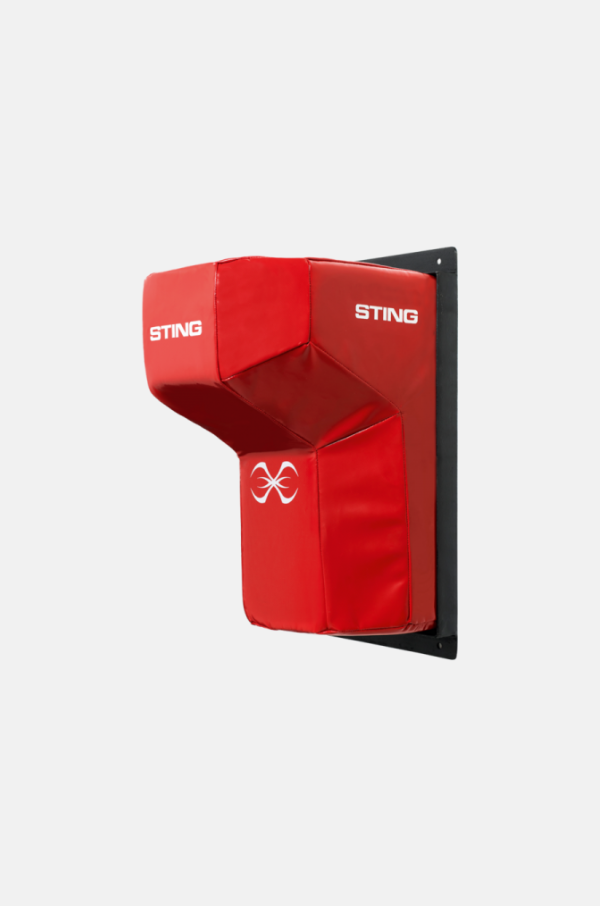
For a compact setup that covers jabs, hooks, high kicks, and low kicks, our Uppercut Fixed Wall Punching Bag is built around a single piece of high-density foam with a Panama material outer layer and a heavy-duty steel wall mount. It's designed for small gyms and home training, and it installs without ceiling hooks.
A final word on durability: inspect your mount every few weeks. Check that bolts are tight, that the wall shows no cracking around the anchors, and that the bracket isn't flexing. Five minutes of inspection is what keeps a wall bag safe for years.
The gap between a wall bag that lasts and one that rattles loose comes down to matching the bag, the bracket, and the wall.
Frequently Asked Questions
Are wall mounted heavy bags good for home training?
Yes, for most home setups they work well. Wall mounted heavy bags save floor space, stay stable during power punches, and need no ceiling hooks. They suit boxers and kickboxers training jabs, hooks, and kicks. The main trade-off is that a fixed bag does not swing like a hanging bag, so you get less practice reacting to a moving target. If your wall can carry the load and you want a compact setup, a wall mount is a practical choice.
Can a wall mounted punching bag damage a wall?
It can if the mount is fixed to drywall alone or the anchors are undersized. The bag and mount weight plus repeated impact load the wall, so you need to anchor into wall studs or masonry. Vibration can also loosen fasteners over time, which is why checking bolts monthly matters. Installed correctly into structural support, wall damage is unlikely. If your wall cannot take the load, a freestanding bag avoids the risk entirely.
Is a 100 lb punching bag too heavy for a wall mount?
A 100 lb punching bag is manageable for a wall mount when the bracket is rated for it and the wall is structural. The bag weight is only part of the load; impact force adds to it. Check the mount's load capacity, use anchor bolts into studs or masonry, and confirm your wall type before hanging. If you are unsure about the wall, a lighter bag or a freestanding stand is the safer route.
What should you check before installing a wall mounted heavy bag?
Check four things: wall type (stud, masonry, or drywall only), the mount's load capacity against your bag weight, the clearance around the bag for punches and kicks, and the mounting height so the bag's center lines up with your torso. Also plan for noise: a vibration dampener between the bracket and wall reduces shaking. If any of these are uncertain, ask before drilling.


