

Durable Heavy Bag Stand for Home: 2026 Review
Table of Contents
- What Makes a Heavy Bag Stand Durable Enough for Home Training
- Heavy Bag Stand Weight Capacity: Matching Your Bag and Training Style
- How to Stabilize a Heavy Bag Stand for Intense Workouts
- Freestanding vs Wall Mount Heavy Bag Stand: Which Fits Your Space
- Top Durable Heavy Bag Stands for Home Gyms
- Maintenance and Hardware Longevity for Your Heavy Bag Stand
- Frequently Asked Questions
Last Updated: September 19, 2026
What Makes a Heavy Bag Stand Durable Enough for Home Training
A durable heavy bag stand starts with steel gauge, a wide base, and hardware that won't rattle loose. Too many home setups fail because the frame flexes, bolts back out, and the rig walks across the floor.
Steel Gauge and Structural Integrity
Structural integrity is the frame's ability to absorb repeated impact without bending, cracking, or loosening at the joints. Thicker tubular steel and welded (not just bolted) joints make the difference.

Floor Protection and Base Weight
Every heavy bag stand needs floor protection and enough base weight to stay planted. Rubber mats under the feet prevent scratches and reduce sliding.
Heavy Bag Stand Weight Capacity: Matching Your Bag and Training Style
Weight capacity determines whether a stand survives your training. Match the rating to your bag weight plus a safety margin:
| Training Style | Typical Bag Weight | Minimum Stand Rating | Best Fit |
|---|---|---|---|
| Technique and speed work | 40-70 lbs | 100 lbs | Heavy Bag Stand - White |
| Power punching and kicks | 80-100 lbs | 100 lbs | Heavy Bag Stand - Grey |
| Boxing plus speed bag | 70-100 lbs | 100 lbs | Speed Bag Platform stand |
| Muay Thai and heavy combos | 100 lbs | 100 lbs | Cornerman |
| Multi-station gym use | 2-8 bags | 300 lbs total | Heavy Duty 2/4/8 Bag Stands |
How to Stabilize a Heavy Bag Stand for Intense Workouts
Stabilizing a heavy bag stand comes down to four things: ballast weight, tight hardware, vibration control, and understanding how the bag's swing loads the frame. Most instability complaints trace back to an unloaded stand, not a defective one.

Weight Distribution Physics: Why Stands Tip
A heavy bag stand tips when the moment force from a swinging bag overcomes the counterweight holding the base down. Two variables drive that: bag weight and how far it swings from the pivot point.
Three mechanisms reduce tipping risk:
- Lower the center of gravity. Ballast on the base pegs does this far more effectively than weight hung higher on the frame.
- Shorten the swing arc. A shorter chain or a bag hung closer to the upright reduces the lever arm and the lateral force at the top.
- Widen the base. A 48" x 48" footprint resists tipping better than a narrow pedestal, because the tipping point sits farther from the center.
Sandbag Ballast and Anchor Points
Sandbag ballast is weight added to the stand's base or pegs to lower its center of gravity. Load every weight peg with sandbags, barbell plates, or water jugs. For maximum stability, bolt the base into the floor if your stand has pre-drilled anchor points. The Heavy Duty 1 Bag Stand has a reinforced 12" x 12" square base with pre-drilled holes for exactly this.

DIY Vibration Dampening Solutions
Vibration dampening reduces the noise and shake that travels through floors and walls. Cheap fixes work well.
- Place a thick rubber horse stall mat under the base
- Cut rubber pads from an old tire or yoga mat for each foot
- Add neoprene washers under every bolt to absorb micro-movement
- Tighten all hardware every few weeks, since vibration loosens fasteners over time
A Stabilization Sequence That Works
If your stand wobbles, work through the fixes in this order:
- Tighten every bolt first. Loose hardware mimics instability and costs nothing to fix.
- Add ballast to the base pegs until total base weight meets or exceeds bag weight.
- Add a rubber mat or foot pads to kill the remaining vibration and floor noise.
- Bolt to the floor only if the stand still moves after steps 1-3 and your floor allows it.
Freestanding vs Wall Mount Heavy Bag Stand: Which Fits Your Space
The choice between freestanding and wall-mount comes down to space, ceiling height, and how much weight your structure can take. Freestanding stands need floor room but no drilling; wall and ceiling mounts save floor space but demand solid framing.
How to Calculate the Swing Radius Before You Buy
Most product pages list a footprint dimension and stop there. That tells you where the stand sits, not how much clear floor you need to train. The bag swings, and the swing arc is what hits walls and shelves.
To find your required clear space:
- Measure the stand's footprint (for a 48" x 48" base, that's 4 feet on each side).
- Add the bag's swing distance in every direction the bag can travel. For a 3-foot chain, budget about 2 to 3 feet of clearance on all sides.
- Add a buffer for your own body. You need room to circle the bag, not just to stand still and punch.
Ceiling Height and Clearance
Ceiling height is the second constraint buyers forget. A stand that's 84.25" tall needs that much vertical clearance plus room for the bag to hang below the top mount. An 8-foot (96-inch) ceiling leaves about 11 inches above an 84.25" frame, which is tight once you factor in the bag's hang length.
Structural Load for Wall and Ceiling Mounts
Wall and ceiling mounts transfer the bag's dynamic load into your home's framing. A 100 lb bag swinging generates forces well above its static weight, landing on the studs or joists you bolt into. Practical checks:
- Locate studs with a stud finder and confirm they're solid, not just drywall anchors.
- For ceiling mounts, confirm you're hitting a joist, not just the ceiling panel.
- Spread the load across multiple fasteners rather than relying on one heavy bolt.
- If you're unsure about your framing, a freestanding stand removes the risk entirely.
Which One Fits Your Situation
| Situation | Best Choice | Why |
|---|---|---|
| Renting, can't drill | Freestanding | No structural modification |
| Small room, tight floor space | Wall or ceiling mount | Frees the floor |
| Low ceiling | Freestanding | No overhead clearance needed |
| Solid framing, high ceiling | Wall or ceiling mount | Saves floor, uses structure |
| Corner space available | Cornerman | Uses dead corner, extends 7.5 ft |
| Unsure about framing | Freestanding | Removes structural risk |
Top Durable Heavy Bag Stands for Home Gyms
The best durable heavy bag stand for home depends on your bag weight, space, and how many stations you need. Here are the stands worth considering.
Heavy Bag Stand - White and Grey
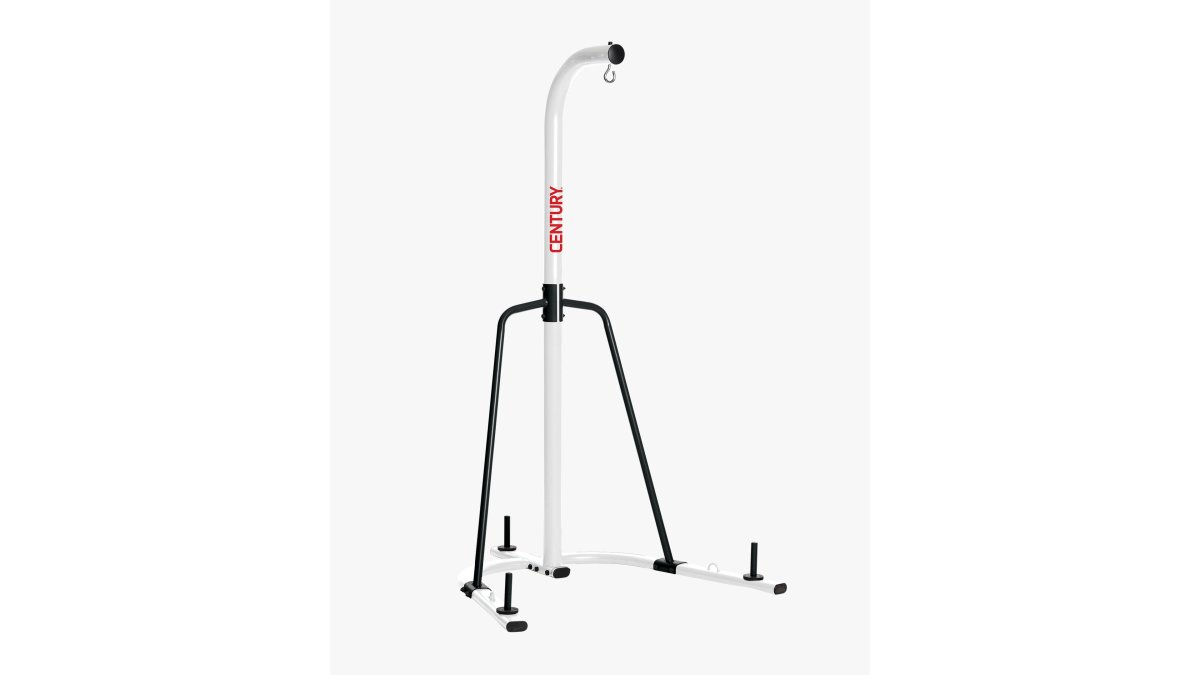
Our top pick for most home gyms is the Heavy Bag Stand - White at $179.99: 3" tubular steel, weight pegs, 100 lb capacity, 84.25" tall on a 48" x 48" footprint.
Heavy Bag Stand with Speed Bag Platform
The Heavy Bag Stand with Speed Bag Platform at $324.99 adds a dedicated speed bag station. Built from heavy-duty, heavy-gauge tubular steel, it holds up to a 100 lb bag plus a speed bag, both sold separately.
Heavy Duty 1 Bag Stand and Cornerman
The Heavy Duty 1 Bag Stand at $509.99 is built for serious training: an adjustable bolt-together single tree stand with full 360-degree bag access, a 4" x 4" square post, and two height settings at 7 ft 4" and 8 ft 6". Its reinforced 12" x 12" base has pre-drilled holes to anchor to the floor, and the vertical design takes up little floor space.
Heavy Duty 2, 4, and 8 Bag Stands
For multi-station training, the Heavy Duty 2 Bag Stand at $574.99 holds two heavy bags with a 300 lb overall capacity. Its 3" x 3" metal tubing arms and 2" x 2" stabilizer bar add strength, and a powder-coated black finish resists rust.
| Stand | Price | Capacity | Best For |
|---|---|---|---|
| Heavy Bag Stand - White | $179.99 | 100 lbs | Single-bag home gyms |
| Heavy Bag Stand - Grey | $184.99 | 100 lbs | Single-bag home gyms |
| Speed Bag Platform Stand | $324.99 | 100 lbs + speed bag | Boxing and hand speed |
| Heavy Duty 1 Bag Stand | $509.99 | 100 lbs | 360-degree access training |
| Cornerman | $549.99 | 100 lbs | Corner spaces, muay thai |
| Heavy Duty 2 Bag Stand | $574.99 | 300 lbs total | Dual-station training |
| Heavy Duty 4 Bag Stand | $1,022.99 | 4 bags | Training centers |
| Heavy Duty 8 Bag Stand | $1,034.97 | 8 bags | Commercial gyms |
Maintenance and Hardware Longevity for Your Heavy Bag Stand
A heavy bag stand lasts longer with a simple monthly check. Vibration loosens bolts, wears paint, and widens joints. Run this routine every few weeks:
- Tighten every bolt and nut with a wrench
- Inspect welds and joints for hairline cracks
- Check weight pegs and sandbags for wear
- Wipe down the frame and touch up any chipped powder coat
- Re-check the bag's attachment point and swivel
Keep a small wrench and a few spare bolts near your stand. A two-minute tighten after a heavy session prevents the slow loosening that turns into a wobbly, noisy frame.
Frequently Asked Questions
How much weight can a standard heavy bag stand hold?
Most home heavy bag stands hold between 100 and 300 pounds. For example, the Heavy Bag Stand - White and Heavy Bag Stand - Grey both support up to 100 pounds. The Heavy Duty 2 Bag Stand holds up to 300 pounds overall. Always check the specific stand's weight capacity before buying, and remember that a heavier bag demands a stand with a higher rating and solid anchoring.
Do I need to bolt my heavy bag stand to the floor?
Not always, but bolting is recommended for intense training. Freestanding stands with weight pegs or sandbag ballast can stay stable without floor anchors if you load them properly. However, the Heavy Duty 1 Bag Stand includes pre-drilled holes for anchoring directly to the floor, which eliminates movement during power shots. If you rent or have delicate flooring, use a freestanding model with adequate base weight instead.
What is the difference between a wall-mount and a freestanding heavy bag stand?
Wall-mount stands attach to wall studs and save floor space, but they require a strong wall and limit bag placement. Freestanding stands sit on the floor with a wide base, offering more flexibility and easier installation. The Heavy Bag Stand - White has a 48-inch by 48-inch footprint, so measure your space. Freestanding models often include weight pegs for stability, while wall-mounts rely on the wall's structural integrity.
How do I stabilize a heavy bag stand to prevent tipping?
Start by loading the base with sandbags or weight plates if the stand has pegs. The Heavy Bag Stand - White and Grey include weight pegs for this purpose. Place the stand on a rubber mat to reduce vibration and floor damage. For extra stability, anchor the base to the floor using pre-drilled holes, as seen on the Heavy Duty 1 Bag Stand. Check all bolts monthly and tighten as needed to maintain structural integrity.


