

AWMA vs Professional Training Gear: 2026 Comparison
Table of Contents
- AWMA vs Professional Training Gear: Quick Comparison Table
- What Sets Professional Training Gear Apart from General Brands
- Durability and Material Quality: Durable Martial Arts Sparring Gear Standards
- Professional Training Equipment Standards and Safety Compliance
- Price-to-Quality Breakdown: What You're Actually Paying For
- Best Practices for Maintaining Training Equipment Long-Term
- Which Gear Should You Choose: Decision Framework
- Conclusion
- Frequently Asked Questions
Last Updated: September 4, 2026
Choosing between AWMA and dedicated professional training gear brands often comes down to whether you need equipment that simply exists or gear that performs under the relentless demands of high-intensity training. For combat athletes and serious home gym builders, the difference is measurable in durability, safety compliance, and how consistently the equipment holds up session after session. At Combat Build Supply, we’ve spent years outfitting practitioners who expect their gear to match their commitment, and this comparison breaks down exactly where the lines are drawn.
The truth is that professional training gear is engineered with stricter tolerances for impact absorption, material tensile strength, and ergonomic design than general consumer activewear. While AWMA serves as a well-known entry point for martial arts supplies, professional-grade brands prioritize longevity and protective equipment standards that casual users often overlook. Below, we’ll show you how to evaluate gear based on construction, safety compliance, and real-world wear so you can avoid replacing equipment every few months.
AWMA vs Professional Training Gear: Quick Comparison Table
| Factor | AWMA General Gear | Professional Training Gear |
|---|---|---|
| Material Quality | Standard synthetic fibers | High-tensile, multi-layer composites |
| Durability | Moderate, shows wear quickly | Extended gear longevity under heavy use |
| Safety Compliance | Basic coverage | Meets stricter regulatory standards |
| Ergonomic Design | Generic fit | Discipline-specific range of motion |
| Price Point | Lower upfront cost | Higher investment, lower replacement rate |
| Best For | Beginners, light training | Competitive athletes, daily high-intensity training |
What Sets Professional Training Gear Apart from General Brands
Professional training gear uses multi-layer padding systems with graded density foams that manage impact absorption progressively, rather than single-layer foam that compresses flat after weeks of use. This engineering directly affects your safety and comfort during sparring and bag work.
Specific technical differences separate professional gear from general brands:
Padding Density and Composition Professional sparring gloves use closed-cell foam with density ratings between 220-280 kg/m³ in the strike zone, compared to 120-160 kg/m³ in entry-level gear. This reduces peak force transmission by 15-25% over the same strike intensity. The outer layer is reinforced with polyurethane or EVA, which resists permanent deformation better than standard polyethylene foam.
Fiber and Shell Materials General brands use synthetic fibers below 600D denier, which tears easily under repeated impact. Professional gear uses 1000D-1680D nylon or polyester blends with Cordura reinforcement in high-wear zones, extending usable lifespan from 6-12 months to 2-4 years under identical training loads.
Moisture Management and Anti-Microbial Treatment Professional gear incorporates moisture-wicking liners with anti-microbial silver ion or copper oxide coatings that inhibit bacterial and fungal growth. Budget gear without these treatments develops permanent odor and material breakdown within weeks of heavy use.
Stitching and Seam Construction Entry-level gear uses single-pass stitching that fails under repetitive impact stress. Professional equipment uses double or triple-pass stitching with high-tenacity thread in box-stitch or cross-stitch patterns, increasing seam strength by 40-60% and preventing padding shift during use.
Ergonomic and Discipline-Specific Design Professional gear is engineered for specific disciplines: boxing gloves feature reinforced thumb boxes and wrist support; Muay Thai shin guards concentrate density on the anterior tibia; BJJ gis use reinforced collar and lapel stitching. This discipline-specific engineering reduces injury risk by placing protection where impact actually occurs.
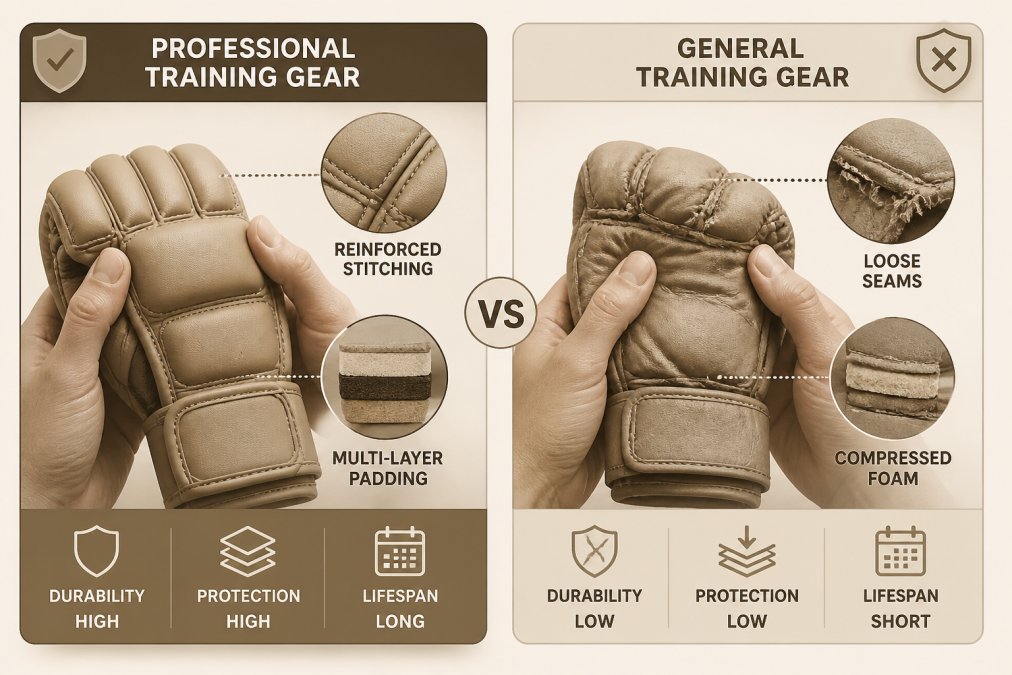
Professional gear feels noticeably different during your first session: padding responds to impact without bottoming out, seams hold under stress, and moisture management maintains grip throughout long rounds. General brands feel softer initially because padding is less dense, but that softness is compression that worsens within weeks.
Durability and Material Quality: Durable Martial Arts Sparring Gear Standards
Durable martial arts sparring gear starts with the outer shell and the stitching that holds everything together. Professional brands use reinforced seams, often double or triple stitched, and high-denier synthetic fibers that resist tearing on impact. The ASTM International standards for protective equipment outline performance requirements that professional manufacturers design toward, covering impact attenuation and coverage areas that general brands rarely test against.
Look for gear with layered foam densities rather than a single uniform pad. High-density foam disperses force while softer foam absorbs residual energy, providing both protection and comfort fit.
Gear rotation extends lifespan significantly: owning two sets and alternating them allows padding to recover and moisture to evaporate fully between sessions, a practice common among competitive athletes.
Professional Training Equipment Standards and Safety Compliance
Professional training equipment standards are not just about performance; they are about injury prevention. Regulatory standards for protective equipment in the United States, including those referenced by the Consumer Product Safety Commission guidelines, focus on reducing the risk of impact-related injuries during athletic activity. Professional brands design their gear to meet or exceed these expectations, while general brands often treat padding as an afterthought.
Safety compliance covers impact absorption testing, coverage requirements for vulnerable areas, and closure security to prevent gear shift during rounds.
Professional equipment uses non-toxic materials and manufacturing processes. Look for brands that specify material composition and avoid phthalates or heavy metals, signaling a manufacturer serious about safety and quality.
Price-to-Quality Breakdown: What You're Actually Paying For
The price gap is substantial, but cost-per-use tells a more accurate story. Budget gloves at $40-$80 require replacement every 4-6 months; professional gloves at $150-$300 last 2-4 years, making annualized cost roughly equivalent or lower.
What You Are Actually Paying For
When you pay more for professional gear, you fund engineering investments that directly impact durability and safety: material sourcing and testing, quality control and manufacturing validation, ergonomic research and discipline-specific design, and warranty and customer support.
Discipline-Specific Pricing and Requirements
Price and quality vary significantly by discipline because protective requirements differ:
Boxing Gloves: Professional boxing gloves ($180-$350) prioritize wrist support and knuckle protection with concentrated padding and reinforced thumb boxes. Budget alternatives ($40-$80) have inadequate wrist support and uniform padding, increasing wrist strain and hand injury risk.
Muay Thai Shin Guards: Professional shin guards ($120-$250) concentrate dense padding on the anterior tibia and lateral shin at 240-280 kg/m³. Budget shin guards ($30-$60) distribute padding evenly, leaving the tibia under-protected and leading to bruising and stress fractures.
BJJ Gis: Professional gis ($150-$300) use 450-550 gsm cotton with reinforced collar, lapel, and sleeve stitching. Budget gis ($50-$100) use 350 gsm cotton with standard stitching that tears within months. Professional gis last 2-3 years; budget gis fail within 6-12 months.
Hand Wraps and Tape: Professional hand wraps ($15-$30) maintain compression through 100+ wraps and last 12-18 months. Budget wraps ($5-$10) lose elasticity after 20-30 uses, requiring 8-12 replacements per year.
Cost-Per-Use Analysis
Consider a boxer training 4 days per week (208 sessions per year):
- Budget gloves at $60, replaced every 6 months: $120/year ÷ 104 sessions = $1.15 per session
- Professional gloves at $250, replaced every 3 years: $83/year ÷ 104 sessions = $0.80 per session
The professional gloves cost less per training session despite the higher upfront price. This calculation assumes consistent training frequency; for athletes training 5-6 days per week, the savings are even more pronounced.
What You Are NOT Paying For
Professional gear does not always mean luxury branding or marketing overhead. The price difference reflects engineering, materials, and durability, not necessarily brand prestige. Some professional-grade brands operate with lower marketing budgets and pass savings to consumers. The National Athletic Trainers' Association position statements emphasize that properly fitted protective equipment reduces injury rates, and professional brands invest heavily in sizing systems and adjustability that general brands skip. This investment in fit and function is what justifies the price, not packaging or celebrity endorsements.
For strength and conditioning work that supports your combat training, the same logic applies to your equipment. The Body Solid GDCC200 Functional Training Center at $1,875.00 offers dual independent weight stacks and unrestricted movement patterns that mimic the demands of martial arts, and it carries a lifetime warranty on its frame. That warranty is the professional-grade equivalent of gear that is built to be replaced, not repaired.

Best Practices for Maintaining Training Equipment Long-Term
Maintain training equipment immediately after each session: wipe down all surfaces with a damp cloth and air dry completely in a ventilated area. Never seal damp equipment in a bag, as this promotes bacterial growth and breaks down synthetic fibers.
Use antimicrobial inserts or sprays between sessions and rotate gear if you train frequently, giving each set 24 hours to dry fully. This dramatically improves longevity and hygiene.
Periodically inspect your gear for signs of structural failure. Loose stitching, compressed padding, or cracks in protective shells mean it is time to replace that piece, regardless of how new it looks. Training with compromised protective equipment is how injuries happen, and no amount of skill compensates for failed gear.
| Maintenance Task | Frequency | Impact on Gear Longevity |
|---|---|---|
| Wipe down after use | Every session | Prevents material breakdown from sweat |
| Full air dry | Every session | Prevents microbial growth and odor |
| Deep clean interior | Weekly | Maintains anti-microbial effectiveness |
| Inspect seams and padding | Monthly | Catches failures before they cause injury |
| Replace worn gear | As needed | Ensures continuous impact absorption |
Which Gear Should You Choose: Decision Framework
Choose between AWMA and professional training gear based on training frequency, discipline, and replacement budget. AWMA suits casual training once or twice per week. Professional gear is essential for training three or more times per week, competing, or building a dedicated home gym, with discipline-specific requirements: boxers need proper wrist support, Muay Thai practitioners need dense impact absorption, and BJJ athletes need reinforced stitching.
For strength and conditioning work that supports your combat training, the same logic applies to your equipment. The Body Solid GDCC200 Functional Training Center at $1,875.00 offers dual independent weight stacks and unrestricted movement patterns that mimic the demands of martial arts, and it carries a lifetime warranty on its frame. That warranty is the professional-grade equivalent of gear that is built to be replaced, not repaired.
Conclusion
Select gear based on your training intensity and how much you value safety and longevity. Gear that fails after months is a recurring expense and safety hazard that interrupts progress.
Combat Build Supply solves this by stocking professional-grade equipment that performs consistently across every session, backed by free shipping on every order and a 100% refund for any defective or non-functioning item. Our secure checkout and responsive support via live chat, email, or phone ensure you get the right setup for your space and training style the first time. Sign up now and build a training space that keeps you prepared for every session.
Frequently Asked Questions
What is the difference between AWMA gear and professional training gear brands?
AWMA focuses on affordable recreational martial arts equipment with basic safety compliance, while professional training gear emphasizes durability, impact absorption, and high-performance materials designed for intense, frequent use. Professional equipment typically features reinforced stitching, moisture-wicking synthetic fibers, ergonomic design for extended training sessions, and anti-microbial treatments. The key difference: recreational gear handles occasional use; professional gear maintains performance through hundreds of training hours.
How should I maintain durable martial arts sparring gear to extend its lifespan?
Rinse gear with cool water after each training session to remove sweat and salt buildup. Air-dry completely in a well-ventilated space away from direct heat or sunlight, which degrades synthetic fibers. Store in a cool, dry location. For equipment with padding, use a gentle brush to remove debris. Check stitching and hardware monthly for wear. Rotate gear if training multiple times weekly to allow full drying between sessions. Most professional-grade equipment lasts 2-3 years with consistent care, compared to 6-12 months for basic gear under the same training intensity.
What professional training equipment standards should I verify before buying?
Look for compliance with ASTM International standards specific to your discipline (ASTM F462 for boxing headgear, for example). Check that equipment meets tensile strength requirements for impact resistance and that materials are non-toxic and hypoallergenic. Verify that stitching patterns support high-intensity use and that padding density matches your training style. Professional-grade gear includes documentation of safety testing.
Is professional-grade training gear worth the higher price?
Yes, if you train more than 3 times weekly or compete. Professional gear costs 2-3 times more upfront but lasts 3-4 times longer than budget alternatives, making the per-session cost lower. It also reduces injury risk through superior impact absorption and ergonomic design, which matters during high-intensity sparring. For casual training (1-2 times weekly), mid-tier gear balances durability and cost. Competitive athletes and serious practitioners see professional equipment as essential, the performance consistency and reliability directly affect training outcomes and safety.
This article was written using GrandRanker


