

10 Warm-Up Exercises for Combat Athletes That Boost Performance
Last Updated: November 5, 2026
Quick Summary
The 10 effective warm-up exercises for combat athletes are arm circles and shoulder rolls, leg swings, walking lunges with a twist, inchworms, band pull-aparts, hip circles and 90/90 switches, box jumps, shadowboxing, sprawls and hip switches, and neck isometrics and grip work. A complete combat sports warm-up routine runs 12 to 20 minutes, moving from general movement to sport-specific work.
- Do 10 small and 10 large arm circles each direction plus 10 shoulder rolls forward and back.
- Keep leg swings to 10 to 12 controlled swings per direction per leg.
- Shadowbox for two to three minutes at 50 to 60 percent effort.
- The 5-minute version skips plyometrics and goes straight to band pull-aparts, hip circles, and shadowboxing.
Table of Contents
- Why Combat Athletes Need a Different Warm-Up
- 1. Arm Circles and Shoulder Rolls: Scapular Activation for Punching Power
- 2. Leg Swings: Hip Mobility for Kicking and Grappling
- 3. Walking Lunges with a Twist: Glute Engagement and Thoracic Spine Mobility
- 4. Inchworms: Full-Body Movement Patterns and Core Stability
- 5. Band Pull-Aparts: Pre-Hab for Shoulder and Ligament Health
- 6. Hip Circles and 90/90 Switches: Hip Rotation for Grapplers
- 7. Box Jumps: Plyometric Explosive Power
- 8. Shadowboxing: Sport-Specific Neuromuscular Activation
- 9. Sprawls and Hip Switches: Anaerobic Conditioning Primer
- 10. Neck Isometrics and Grip Work: The Unglamorous Essentials
- Combat Sports Warm-Up Routine: Duration, Intensity, and Equipment
- Frequently Asked Questions
Why Combat Athletes Need a Different Warm-Up
A warm-up built for a jogger will leave a fighter flat-footed. Combat sports demand rotational power, hip mobility, and shoulder durability, and the research backs a dynamic approach: research on warm-up structure suggests dynamic movements like leg swings and arm circles are a practical choice before training (review of dynamic warm-ups in athletic performance(https://pmc.ncbi.nlm.nih.gov/articles/PMC12034053/)).
That distinction matters more in fighting than in most sports. A boxer needs scapular activation before throwing combinations; a grappler needs hip rotation before shooting a takedown. A second review describes well-built warm-ups as a way to raise body temperature, stimulate the neuromuscular system, and prepare athletes for the demands ahead (analysis of warm-up purpose and structure(https://pmc.ncbi.nlm.nih.gov/articles/PMC10798919/)).
Fighters building home training spaces often ask which warm-up exercises actually carry over to combat performance. We put together this list of 10 effective warm-up exercises for combat athletes, organized by the quality each one builds. If injury prevention is your priority, our guide to preventing common martial arts training injuries covers the recovery side in more depth.
1. Arm Circles and Shoulder Rolls: Scapular Activation for Punching Power
Start with the joint that throws every punch. Small to large arm circles, forward and backward, wake up the shoulder girdle before you load it. Add slow shoulder rolls and a few band-free scapular retractions to cue the shoulder blades down and back.
The goal is scapular activation, not fatigue. Keep the reps light and the range controlled. Most fighters rush this one and pay for it later with cranky shoulders.
How to do it: 10 small circles each direction, 10 large circles each direction, 10 shoulder rolls forward and back.
2. Leg Swings: Hip Mobility for Kicking and Grappling
Leg swings open the hips through a full range of motion without the static-hold problem. Front-to-back swings prep the hip flexors and hamstrings for kicking; lateral swings prep the adductors and glutes for grappling stance work.
Keep your torso tall and let the leg travel, not your lower back. Ten to twelve controlled swings per direction per leg is plenty.
Once the hips are open, our martial arts kick drills you can do at home make a natural next step in the session.
3. Walking Lunges with a Twist: Glute Engagement and Thoracic Spine Mobility
Walking lunges build glute engagement and single-leg control, and adding a twist at the bottom opens the thoracic spine, the segment that drives rotational power in every punch and kick.
Step forward into a lunge, rotate your torso toward the front leg, then step through. Keep the movement smooth rather than jerky. Eight to ten steps per side works well as a primer.
If you want to build on this movement, our strength training exercises for martial artists extend the same patterns into a full program.
4. Inchworms: Full-Body Movement Patterns and Core Stability
Inchworms connect the shoulders, core, and hips in one continuous movement pattern. From standing, hinge forward, walk your hands out to a plank, hold for a beat, then walk back and stand.
The plank hold is where core stability gets trained. Keep the ribs down and the glutes tight rather than letting the low back sag. Six to eight reps gets the whole chain firing.
5. Band Pull-Aparts: Pre-Hab for Shoulder and Ligament Health
Band pull-aparts are the simplest pre-hab tool a fighter can own. They target the rear delts and mid-back, the muscles that balance out all the pressing and punching volume combat athletes accumulate.
Hold a light band at shoulder height, arms straight, and pull it apart until it touches your chest. Squeeze for a second, return slow. Fifteen to twenty reps is a good warm-up dose.
Watch out: using a band that's too heavy turns this into a strength exercise and recruits the wrong muscles. Start light.
6. Hip Circles and 90/90 Switches: Hip Rotation for Grapplers
Hip rotation decides who wins the scramble. Hip circles, done standing or on all fours, move the joint through its full arc. 90/90 switches train the internal and external rotation grapplers need for guard work and takedown defense.
Sit with both knees bent at 90 degrees, then rotate both legs to the other side without using your hands. Five to eight switches per side.
Panama 45D Heavy Punching Bag →
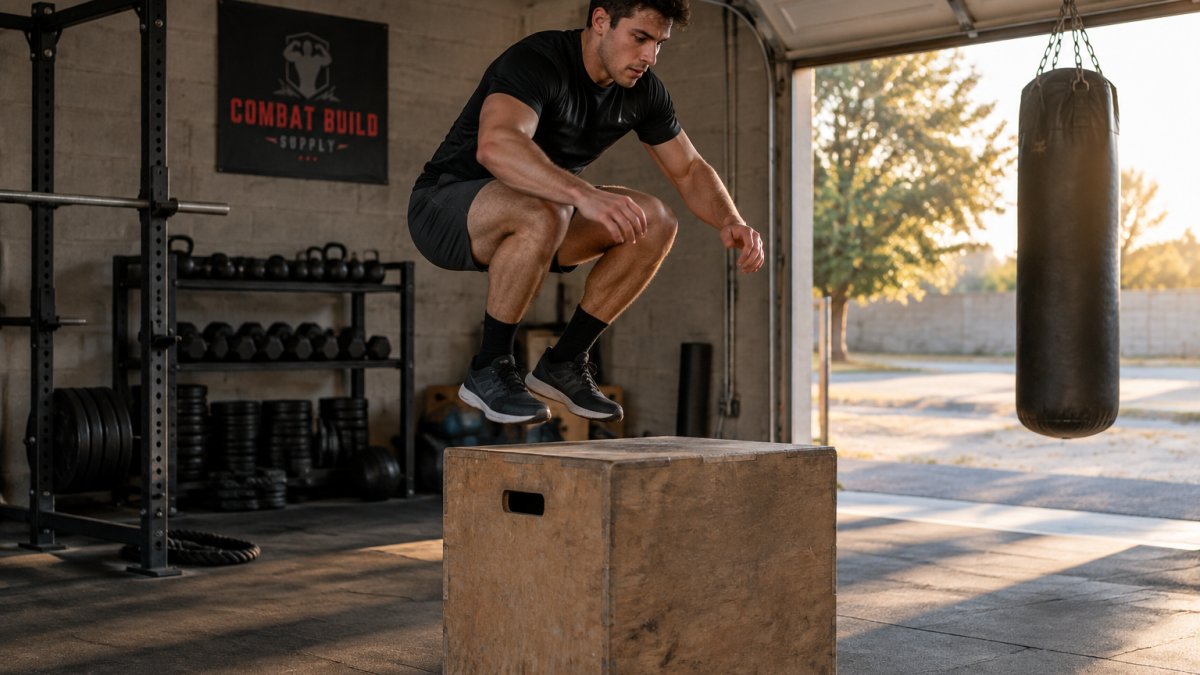
7. Box Jumps: Plyometric Explosive Power
Box jumps build explosive power through the hips and legs, the same quality behind a fast level change or an explosive shot. Step down between reps rather than jumping down to protect the knees and Achilles.
Start with a low box and focus on a soft, quiet landing. Five to six reps is enough in a warm-up; this is a primer, not a conditioning block. Our guide to rotational power training for fighters pairs well with this plyometric work, and our speed and agility drills for fighters cover the footwork side.
The man is American.
8. Shadowboxing: Sport-Specific Neuromuscular Activation
Shadowboxing is the bridge between general warm-up and actual fighting. Light rounds at 50 to 60 percent effort groove movement patterns, sharpen coordination, and prime the nervous system for the specific rhythm of your sport. As the rounds become more specific to your sport, pairing crisp combinations with controlled footwork can make shadowboxing a useful bridge to kickboxing conditioning.
Two to three minutes of relaxed shadowboxing, focusing on footwork and clean technique, beats ten minutes of generic cardio for combat readiness.
9. Sprawls and Hip Switches: Anaerobic Conditioning Primer
Sprawls and hip switches train the exact movement a fighter needs when a shot comes in. They also raise the heart rate into the range you'll fight at, which is why they belong late in the warm-up.
Keep the volume modest: five to eight controlled sprawls, then hip switches for 20 to 30 seconds. This is neuromuscular activation, not a burnout.
10. Neck Isometrics and Grip Work: The Unglamorous Essentials
Neck isometrics and grip work rarely make highlight reels, but they protect the areas combat athletes injure most. Light manual resistance on the neck in four directions, plus a few sets of grip squeezes or towel hangs, prepare the body for clinch work and grappling.
Combat Sports Warm-Up Routine: Duration, Intensity, and Equipment
A complete combat sports warm-up routine runs 12 to 20 minutes, moving from general movement to sport-specific work. Intensity climbs as the body warms: start easy on the joint work, build through the plyometrics, and finish with shadowboxing at close to fight pace.
The woman is American.
A full camp warm-up can be sequenced as follows:
| Phase | Exercises | Time | Purpose |
|---|---|---|---|
| General movement | Arm circles, leg swings, inchworms | 3-4 min | Raise temperature, open joints |
| Mobility and activation | Walking lunges with twist, hip circles, band pull-aparts | 4-5 min | Joint mobility, scapular and glute activation |
| Power primer | Box jumps, sprawls | 3-4 min | Explosive power, neuromuscular activation |
| Sport-specific | Shadowboxing, grip and neck work | 3-5 min | Movement patterns, fight readiness |
The 5-minute time-crunched routine. Some days you're squeezing in a session before work or after a late shift. On those days, cut the general movement phase to 90 seconds (arm circles and leg swings only), do one round of inchworms, then go straight to band pull-aparts and hip circles for 90 seconds, followed by two minutes of shadowboxing. Skip the plyometrics entirely, box jumps and sprawls need a proper ramp-up to be safe.
Age-specific modifications. Older athletes often benefit from a longer general warm-up phase and more joint prep before plyometrics. Adding 2-3 minutes of easy movement before the arm circles and leg swings, and substituting step-ups for box jumps when the knees or Achilles feel sensitive, are common adjustments.
Equipment-free vs. equipment-based. Every exercise in the full routine can be done with no equipment except a band and a box. The equipment you use after the warm-up matters too: a heavy bag for post-warm-up rounds needs to hold up to daily punishment, A heavy bag can serve for post-warm-up rounds; the Panama 45D Heavy Punching Bag at $449.00 is a commercial-grade option. For uppercut and combination work, the tapered Uppercut Combination Punching Bag at $375.00 is designed for uppercut and freestyle combination training.


Psychological priming. Most warm-up guides stop at the physical. A short breathing reset before shadowboxing, four seconds in, four seconds out, for five rounds, sharpens focus and lowers the startle response that makes fighters tense up in the first round. Pair that with two minutes of visualization: see the first exchange, the first takedown defense, the first time you check a kick. It costs nothing and takes less time than a water break.
Frequently Asked Questions
What is a good warm-up before combat sports training?
A good warm-up before combat sports training combines dynamic movements that raise body temperature and activate key muscle groups. Start with five minutes of light cardio like jumping jacks or jump rope, then move through arm circles, leg swings, walking lunges with a twist, and band pull-aparts. Finish with sport-specific drills like shadow boxing or agility ladder work. Warm-ups are generally used to increase body temperature and stimulate the neuromuscular system, preparing you for the demands of combat sports.
How long should a warm-up be before boxing or martial arts?
Aim for 10 to 15 minutes total. Spend the first 3 to 5 minutes on general aerobic activity to raise your heart rate, then 5 to 7 minutes on dynamic mobility and activation exercises, and the final 2 to 3 minutes on sport-specific movements like shadow boxing or footwork drills. Warm-up protocols are often described as combining general exercises, specific exercises, and conditioning activities. Adjust duration based on intensity: longer and more thorough before sparring, shorter before light technique sessions.
Should combat athletes stretch before sparring?
Static stretching before sparring is not recommended. Prolonged static holds may reduce muscle performance, while dynamic movements promote flexibility and joint mobility without that drawback. Save static stretches for after training or separate sessions. Before sparring, use dynamic warm-up exercises like leg swings, arm circles, and walking lunges to prepare your joints and muscles for action while maintaining power output.
What exercises prepare your shoulders for punching?
Arm circles, shoulder rolls, band pull-aparts, and scapular push-ups are effective for preparing your shoulders for punching. These movements activate the scapular stabilizers and rotator cuff, which support shoulder health during repeated strikes. Dynamic movements like arm circles are commonly used to promote flexibility and joint mobility. Add light medicine ball throws or shadow boxing to reinforce proper mechanics. For home training, a resistance band anchored at shoulder height works well for pull-aparts.
How should beginners warm up before martial arts practice?
Beginners should follow the same structure as advanced athletes but with lower intensity and simpler movements. Start with 3 to 5 minutes of light cardio, then perform arm circles, leg swings, walking lunges, and inchworms at a comfortable pace. Focus on learning the movement patterns rather than pushing for speed or depth. Warm-ups are commonly grouped into general aerobic, dynamic mobility, stretching-based, and sport-specific drills, so beginners can progress through each category gradually. Keep the entire warm-up to 10 minutes initially.
Building a warm-up that actually transfers to fighting takes consistency, and the right gear makes it easier to show up every session. Combat Build Supply stocks durable equipment for home training, with free shipping on every order, a 100% refund on defective or non-functioning items, and premium support by live chat, email, or phone. Get started with Combat Build Supply and train smarter from the first minute of every session.


