

Which Speed and Agility Drills Work Best for Fighters?
Last Updated: October 27, 2026
Quick Summary
The best speed and agility drills for fighters combine footwork ladders, cone change-of-direction work, reactive drills with partner cues, and resistance sprints. Program them early in training sessions, keep them fresh, and train agility in context through sparring.
- Speed, agility and quickness training aims to improve speed, agility and reaction time.
- Start footwork with stance shuffles for 10 seconds, then lateral steps and pivot reps.
- Use reactive drills with a partner providing cues to build reaction time.
- Sprint variations are best done two or three times a week with full rest between reps.
- Keep speed work fresh and avoid conditioning immediately after agility sessions.
Table of Contents
- Why Speed and Agility Matter for Fighters
- Fighter Footwork Drills for Stance and Movement
- Cone Drills for Combat Sports Movement
- Reaction Time Drills for Fighters Under Pressure
- Boxing Speed and Agility Workouts to Combine
- Programming, Progression, and Recovery
- Building Your Speed and Agility Training Setup
- Frequently Asked Questions
Speed and agility drills can be part of fighter conditioning alongside heavy bag rounds and sparring. Below, we break down drills for fighters, ways to program them, and gear that supports the work at home.
Why Speed and Agility Matter for Fighters
Speed, agility and quickness training is aimed at improving an athlete's speed, agility and reaction time, according to a 2025 review published through the National Library of Medicine's Effects of speed, agility, and quickness training on athletic performance. Those three qualities map directly onto a fight. Speed gets you in and out of range, agility lets you slip and reposition, and reaction time determines whether you respond to a strike or get caught by it.
Agility is the ability to change direction while keeping control of your body.
Fighter Footwork Drills for Stance and Movement
Shuffle forward and back, step laterally, and pivot on the lead foot.
A simple progression looks like this:
- Stance shuffles: Move forward and back for 10 seconds, then reset. Keep your knees bent and your hands up.
- Lateral steps: Step left and right in a line, pushing off the trailing foot each time.
- Pivot reps: Rotate on the lead foot and return to stance without crossing your feet.
The Trigon Sports Pro Agility Ladder ALPRO has adjustable spacing for short steps, longer strides, or more complex foot patterns.
Cone Drills for Combat Sports Movement
Set up three to five cones in a zig-zag or square and sprint between them, touching or stepping around each one.
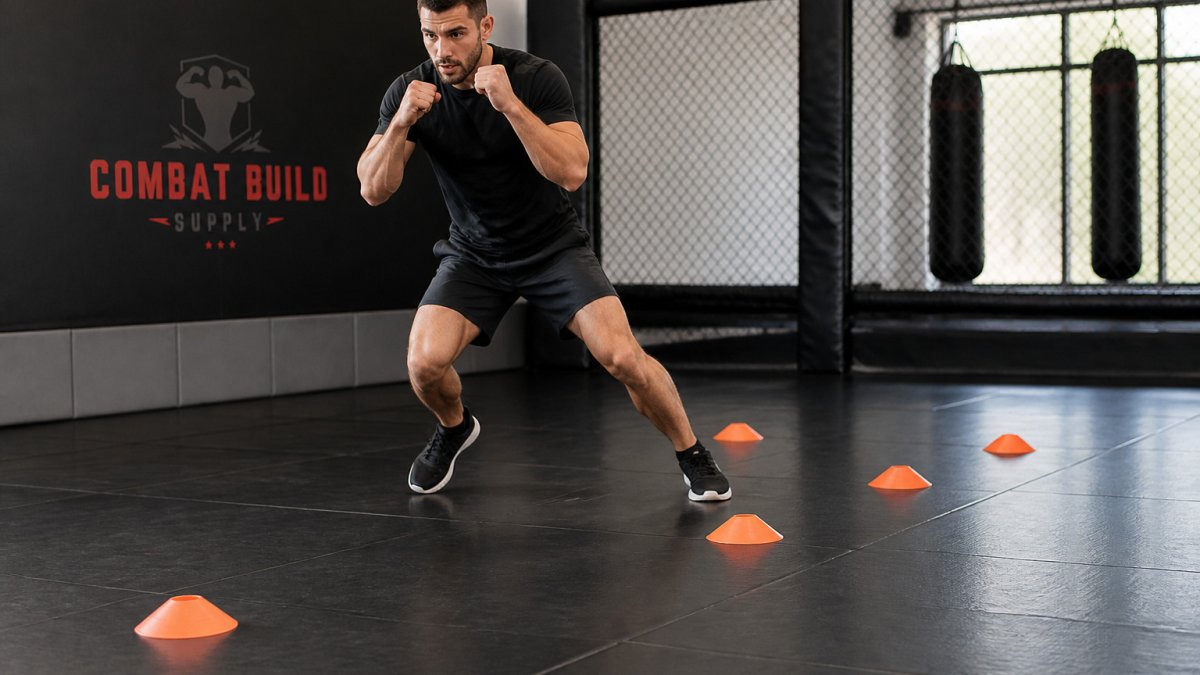
The Trigon Sports Speed And Agility Kit AGKIT includes twelve saucer cones in two colors for mapping routes and marking changes of direction.

The Trigon Sports Multi-Height Agility Hurdles (Set of 4) AH612 adjust between 6 and 12 inches with a twist-lock design.

Reaction Time Drills for Fighters Under Pressure
Pre-planned agility drills and reactive drills use different approaches: reactive drills involve choosing a movement after a cue appears.
Trigon Sports Pro Agility Ladder ALPRO →
A partner can provide cues for reactive drills.
Boxing Speed and Agility Workouts to Combine
Boxing-specific speed work usually breaks into a few categories: foot speed, ladder or cone drills, reaction-based work and resistance-band movement. KO Studio's guide, The Best Boxing Speed and Agility Workouts, groups these the same way, which is a useful framework for building a weekly plan. Integrating heavy bag resistance into these sessions bridges the gap between stationary speed and functional boxing footwork drills that translate directly to the ring.
Sprint variation also belongs in the mix. The Trigon Sports 40" Speed Chute ASC40 adds resistance to sprints, while the Trigon Sports Speed Sled ASLED builds acceleration under load. Use these two or three times a week, not every day. Hard sprinting with little rest can turn into conditioning rather than focused speed work, as TrainHeroic explains in The Truth About Speed and Agility Training.

The Trigon Sports 24" Plyometric Box PLYO24 is 24 inches high, and the Trigon Sports 30" Plyometric Box PLYO30 is 30 inches high.
Programming, Progression, and Recovery
The framework below is one example of a weekly structure for a fighter training 4-6 days per week with at least one sparring day.
Weekly template (adjust to your camp calendar):
| Day | Speed/Agility Focus | Volume | Notes |
|---|---|---|---|
| Monday | Footwork + ladder (pre-planned) | 15-20 min | After warm-up, before strength |
| Tuesday | Reactive drills (partner cues) | 8-12 min quality | Keep fresh; no conditioning after |
| Wednesday | Cone change-of-direction + low hurdles | 15 min | Moderate intensity |
| Thursday | Rest or mobility | , | Full recovery day |
| Friday | Sprint variations (short, full rest) | 6-10 reps | 20-40 yd; rest 60-90 sec |
| Saturday | Sparring or live work | , | Agility is trained in context |
| Sunday | Plyometrics (low volume) | 3-5 sets | Land softly; stop if form breaks |
Building Your Speed and Agility Training Setup
The table below lists equipment and uses described in the product listings.
| Equipment | Primary Use | Best Phase |
|---|---|---|
| Pro Agility Ladder ALPRO | Footwork and foot speed | Warm-up and skill work |
| Multi-Height Agility Hurdles AH612 | Hurdle steps and rhythm | Skill work |
| Speed and Agility Kit AGKIT | Full set of cones, hurdles and ladders | Skill and change-of-direction work |
| 40" Speed Chute ASC40 | Resistance sprints | Speed work |
| Speed Sled ASLED | Acceleration under load | Speed or strength work |
| 24" Plyometric Box PLYO24 | Jumps and landings | Power work |
Browse the full range at Combat Build Supply and pick the pieces that fit your training space and your schedule.
Frequently Asked Questions
What are the best speed and agility drills for fighters?
Drills can include short sprints, lateral shuffles, ladder footwork, and cone patterns. A partner or cue can determine the direction in reactive drills.
How can fighters improve footwork and movement?
Footwork drills can include repeatable movement patterns, ladder work, hurdles, and cone patterns.
Are cone drills useful for boxing and MMA?
Cone drills can be set up for forward, backward, and side-to-side movement patterns.
How often should fighters do speed and agility training?
Training frequency and session structure depend on the individual program.


