

How to Build Martial Arts Conditioning at Home
Last Updated: November 6, 2026
Quick Summary
Martial arts conditioning is vital for home athletes because no coach is there to manage your gas tank, spot tight hips, or pace your sessions, so you must build strength, stamina, mobility, and durability yourself. A 2022 review found aerobic training helps fighters hold intensity and recover faster between hard efforts.
- Conditioning stacks eight qualities, including strength, power, core control, endurance, stamina, flexibility, mobility, and injury resilience.
- Run three to four conditioning sessions per week, with two as the floor for steady progress.
- Baseline week 1 with a 60-second push-up test, plank hold capped at 120 seconds, and a 3 x 2-minute bag interval.
- Progress one variable at a time: add reps before rounds, rounds before sessions, and sessions before intensity.
- Keep at least one full rest day between hard conditioning sessions and pair hard days with easy mobility.
Table of Contents
- Why Martial Arts Conditioning Is Vital for Home Athletes
- The 8 Conditioning Benefits That Change Your Training
- Martial Arts Conditioning Exercises You Can Do Without a Gym
- Your Martial Arts Conditioning Workout at Home: A Progressive Plan
- How Often Should Martial Artists Do Conditioning?
- Home Martial Arts Training Equipment Worth Owning
- Staying Safe and Tracking Progress While Training Solo
- Gear Up Your Home Conditioning Setup
- Frequently Asked Questions
Why Martial Arts Conditioning Is Vital for Home Athletes
Martial arts conditioning is the training that builds the engine behind your technique: strength, stamina, mobility, and the durability to keep throwing clean reps when you are tired.
Here is the problem. When you train alone, no coach calls out your gas tank. No one notices your hips getting tight or your shoulders rounding.
That is why conditioning matters more at home, not less. A 2022 review of mixed martial arts research found that building the aerobic system helps fighters hold intensity through a bout and recover faster between hard efforts (Exploratory Systematic Review of Mixed Martial Arts(https://pmc.ncbi.nlm.nih.gov/articles/PMC9227211/)).
At Combat Build Supply, we see this every day: athletes who buy great gear but skip the boring work.
The 8 Conditioning Benefits That Change Your Training
Conditioning is not one thing. It is a stack of eight qualities that feed each other.
- Strength to hold your guard and drive through strikes
- Power to turn hip rotation into real force
- Core control to stay balanced when you miss
- Cardiovascular endurance to keep pace late in a round
- Stamina to repeat hard efforts without fading
- Flexibility to reach positions your technique needs
- Mobility to move through those positions under load
- Injury resilience to train tomorrow, not sit out
A 2026 cross-sectional study of 268 martial arts and combat-sports participants looked at self-rated health and perceived training benefits (Perceived health benefits of martial arts and combat sports(https://www.frontiersin.org/journals/psychology/articles/10.3389/fpsyg.2026.1774069/full)). The takeaway for solo trainees: the benefits people report are real, but they come from consistent work, not one heroic session.
Strength, Power, and Core Control
Strength is the base. Power is strength applied fast. Core control is what connects the two.
- Strength: push-ups, pull-ups, squats, and bag work under load
- Power: explosive push-ups, jumps, and fast punch combinations
- Core control: planks, anti-rotation holds, and controlled kicks
A 2018 study on short-term sport-specific strength and conditioning described programs built to improve several fitness qualities at once, including aerobic and anaerobic fitness (The Effect of Short-Term Sport-Specific Strength and Conditioning(https://pmc.ncbi.nlm.nih.gov/articles/PMC6090403/)). That is the model to copy at home: train qualities together, not one at a time.
Endurance, Mobility, and Injury Resilience
Endurance keeps your technique from falling apart in round three. Mobility keeps your joints moving through full range. Resilience keeps small issues from becoming layoffs.
A 2024 systematic review on martial arts, combat sports, and mental health in adults found health-related outcomes tied to participation (EXTERNAL_LINK: Martial arts, combat sports, and mental health in adults | https://pmc.ncbi.nlm.nih.gov). The physical side supports the mental side.
Martial Arts Conditioning Exercises You Can Do Without a Gym
You do not need a rack of equipment. You need a floor, a wall, and a plan.
Bodyweight strength circuit (3 rounds):
- 12 push-ups
- 10 split squats per leg
- 8 pull-ups or band rows
Bag and shadow work (4 rounds, 2 minutes on, 1 minute off):
- Round 1: jab-cross, focus on form
- Round 2: add kicks
- Round 3: fast combinations
Mobility finisher (5 minutes):
- Hip openers
- Shoulder circles
- Ankle rocks
Resistance bands make the strength work scale up without a full gym. Our Pull Up Assist Band Resistance Power Bands add load to pull-ups and rows, which matters when bodyweight stops being enough.

Your Martial Arts Conditioning Workout at Home: A Progressive Plan
Most conditioning advice stops at "do circuits and bag work." A home athlete needs a starting point, a weekly structure, and rules for adding work. The plan below is three sessions per week, about 45 minutes each, assuming a floor, a wall, a bag or shadow space, and optional resistance bands.
Step 1: Establish a Baseline in Week 1
Before you train hard, measure where you are. Use four simple tests and record the numbers:
- Push-up test: max strict push-ups in 60 seconds.
- Plank hold: time to form failure, capped at 120 seconds.
- Bag or shadow interval: 3 rounds of 2 minutes on, 1 minute off; record output quality and average round pace.
These four numbers give you a repeatable snapshot of strength, core endurance, stamina, and recovery. Retest in week 8 under the same conditions: same time of day, same rest, same equipment.
Step 2: Run an 8-Week Block
| Week | Focus | Sessions | Strength Work | Bag/Shadow Work | Progression Rule |
|---|---|---|---|---|---|
| 1 | Baseline and form | 3 | 2 rounds of the circuit | 3 x 2 min on, 1 min off | Learn movements; stop 2 reps shy of failure |
| 2 | Base | 3 | 3 rounds | 3 x 2 min | Add 1 round only if form held in week 1 |
| 3 | Build | 3 | 3 rounds, +2 reps per exercise | 4 x 2 min | Add reps before adding rounds |
| 4 | Build | 3-4 | 3 rounds, +2 reps | 4 x 2 min | Add a fourth session only if sleep and soreness are stable |
| 5 | Intensity | 4 | 3 rounds, shorter rest (60 sec between exercises) | 4 x 2 min, faster pace in round 3 | Shorten rest before adding volume |
| 6 | Intensity | 4 | 3 rounds, add power variation (explosive push-ups, jump squats) | 5 x 2 min | Keep power work early in the session |
| 7 | Deload | 2 | 2 rounds at week-2 reps | 3 x 2 min easy | Cut volume roughly in half; keep form sharp |
| 8 | Retest | 3 | Retest push-ups and plank | Retest bag interval | Compare to week 1; adjust next block |
Step 3: Use a Repeatable Session Template
Each 45-minute session follows the same shape so you can compare weeks:
- Warm-up (5-8 minutes): joint circles, 20 bodyweight squats, 10 arm swings, 30 seconds of easy shadow movement.
- Strength circuit (20 minutes): 3 rounds of 12 push-ups, 10 split squats per leg, 8 pull-ups or band rows, and a 30-second plank. Rest 90 seconds between rounds in weeks 1-4 and 60 seconds in weeks 5-6.
- Bag or shadow work (12-15 minutes): 2-minute rounds with 1 minute rest. Round 1 is form, round 2 adds kicks, round 3 is speed, later rounds are power.
Step 4: Apply Progression Rules
Progress one variable at a time. This is the same logic used in sport-specific strength and conditioning programs that train several fitness qualities together rather than one at a time (The Effect of Short-Term Sport-Specific Strength and Conditioning(https://pmc.ncbi.nlm.nih.gov/articles/PMC6090403/)).
Watch out: adding a fourth session and shortening rest in the same week is the most common way home athletes turn a good block into a stalled month. Change one variable, hold it for a week, then reassess.
Panama 45D Heavy Punching Bag →
Step 5: Track the Numbers That Matter
Log four things after every session: total rounds completed, reps per strength exercise, average bag round pace (or a simple 1-5 quality rating), and next-morning soreness. A rising rep count with stable soreness is progress. Rising reps with rising soreness is a warning to hold volume steady for a week.
How Often Should Martial Artists Do Conditioning?
Three to four conditioning sessions per week is the sweet spot for most home athletes. Two is the floor for steady progress. Five or more only works if sleep and food keep up.
The risk is not doing too little. It is doing too much. Because every energy system is taxed, a measured progression matters from the moment you start martial arts training.
Balance the week like this:
- 2-3 skill sessions
- 3 conditioning sessions
- 1-2 full rest days
Home Martial Arts Training Equipment Worth Owning
A heavy bag is the centerpiece. It lets you train power, timing, and conditioning in one tool, and it never cancels on you.
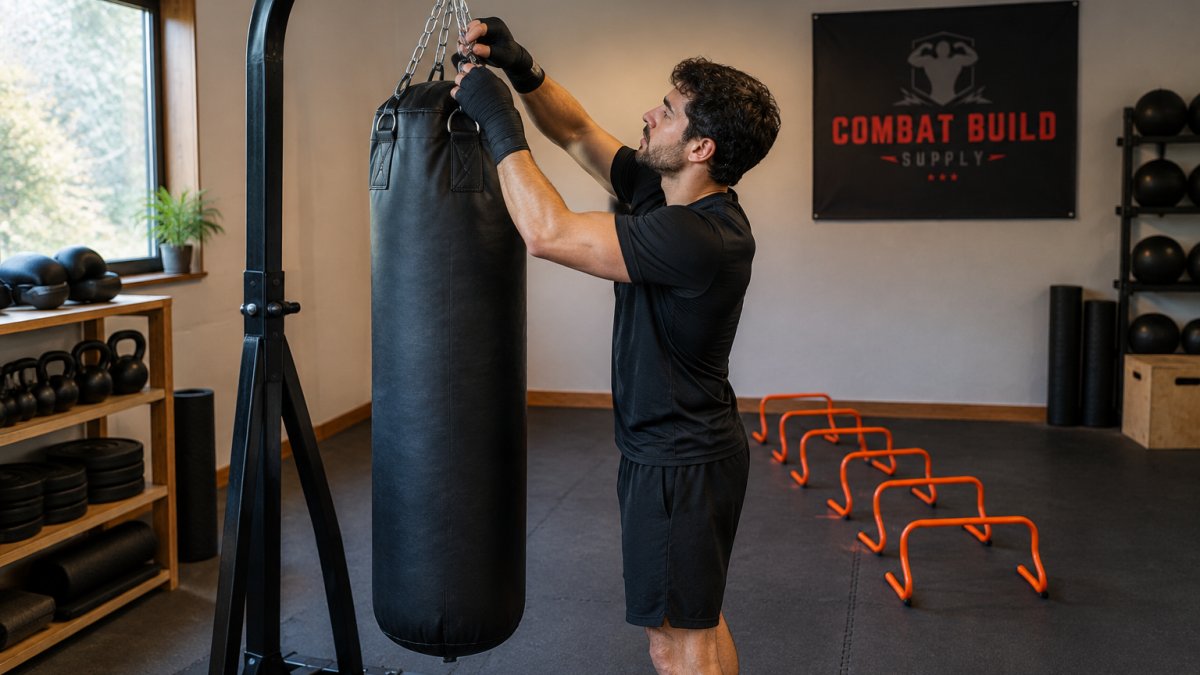
Our Panama 45D Heavy Punching Bag is built for exactly this. It features heavy-duty D rings and premium sandwich belt reinforcements for stable installation during hard sessions.

Short on space? The wall-mounted Uppercut bag skips ceiling hooks entirely. Agility hurdles add footwork and coordination work.
Staying Safe and Tracking Progress While Training Solo
Training alone removes the coach who would normally spot a rounding back, a tight hip, or a session that is too hard too soon. Beginners can also check these protective gear recommendations for MMA beginners to reduce injury risk. Before buying anything, read this guide on how to choose durable martial arts gear. Safety at home is a set of checks you run yourself, every session, in the same order.
Pre-Session Safety Checklist
Run this in under two minutes before every conditioning session:
- Space: at least 6 feet of clear floor in every direction for bag work and shadowboxing; check that the bag or stand is stable and the chain or mount is tight.
- Surface: non-slip flooring or a mat; keep water and towels out of the striking path.
- Equipment: wraps and gloves on for bag work; bands inspected for nicks or fraying before use.
Warm-Up and Cool-Down Structure
A warm-up is not optional at home because there is no coach to ease you in. Use a fixed 5-8 minute sequence: 30 seconds of easy shadow movement, 20 bodyweight squats, 10 arm swings each direction, 10 hip circles each way, and 30 seconds of easy bag or shadow work at half speed. Finish every session with 5 minutes of mobility: hip openers, shoulder circles, and ankle rocks, holding each for 20-30 seconds.
Modifications for Different Abilities
Conditioning should scale to the athlete, not the other way around. Use these substitutions rather than skipping the session:
- Push-ups: incline push-ups against a wall or bench if floor push-ups break form; move to floor push-ups when 12 clean reps are easy.
- Pull-ups: band-assisted pull-ups or band rows if unassisted reps are not yet clean.
- Split squats: reduce range of motion or hold a wall for balance; add load only when 10 clean reps per leg are pain-free.
Watch out: training through sharp joint pain because "conditioning is supposed to be hard" is the fastest way to lose a month. Muscle soreness is expected; joint pain is a signal to modify, not push.
Recovery and Load Management
Conditioning taxes the same systems that skill work does, and a review of strength and conditioning for mixed martial arts notes that the sport stresses all energy systems and that overreaching is possible (EXTERNAL_LINK: Strength and conditioning considerations for mixed martial arts | https://pmc.ncbi.nlm.nih.gov). At home, the practical rule is to keep at least one full rest day between hard conditioning sessions and to pair hard days with easy mobility or skill days rather than stacking them.
- 2-3 skill sessions
- 3 conditioning sessions
- 1-2 full rest days
Measuring Progress and Interpreting It
- Reps up, soreness stable: progress; hold the plan and add one variable next week.
- Reps up, soreness rising: hold volume steady for a week before adding more.
- Reps flat for two weeks, soreness stable: add reps or a round, not both.
Film one round per week to check technique against the same round the following week. Progress you cannot measure is progress you cannot trust, and at home the log is the coach.
Gear Up Your Home Conditioning Setup
Building a home conditioning space is a series of small, smart choices.
Our article on durable equipment for intense home training walks through what holds up under daily solo work.
Combat Build Supply helps you train smarter with gear that performs session after session.
Get started with Combat Build Supply and build a home conditioning setup that keeps you ready for every session.
Frequently Asked Questions
How can you improve martial arts conditioning at home?
Build a weekly plan that mixes strength work, cardio, and mobility. Bodyweight circuits, shadowboxing rounds, heavy bag work, and agility drills cover most of what you need. Aerobic development supports holding intensity through a bout and recovering faster between exchanges, so include steady-state cardio alongside high-intensity intervals. Progress by adding rounds, reps, or resistance every couple of weeks, and keep one full rest day.
How often should martial artists do conditioning workouts?
Two to three dedicated conditioning sessions per week works for most home athletes, layered on top of skill practice. Combat sports tax every energy system, and overreaching and overtraining are real risks, so more is not automatically better. If you train skills four or more days a week, keep conditioning to two focused sessions and treat recovery as part of the program.
Can martial arts conditioning help prevent injuries?
It can reduce your risk when it targets the qualities that protect joints and tissue. Strength work on the legs, hips, and trunk, plus mobility drills for ankles, hips, and shoulders, prepares your body for the forces of striking and grappling. Consistent conditioning supports physical resilience, which is why warming up before every session and scaling volume gradually matter. Warm up before every session and scale volume gradually.
What equipment do you need for martial arts training at home?
Start with a heavy bag, a mat, and enough floor space to move. A wall-mounted bag like the Uppercut Fixed Wall Punching Bag ($375.00) needs no ceiling hooks, while the Panama 45D Heavy Punching Bag ($449.00) comes in 120 cm, 150 cm, and 180 cm sizes for full-power work. Agility hurdles such as the Trigon Sports set ($100.10) add footwork and conditioning drills. Add gear as your routine grows.


