

7 Best Strength Exercises for MMA Fighters
Table of Contents
- 7 Best Strength Exercises for MMA Fighters
- 1. Barbell Back Squat: Building Lower Body Power and Clinch Strength
- 2. Barbell Hip Thrust: Explosive Power for Takedowns and Core Stability
- 3. Deadlift: Posterior Chain Development and Force Production
- 4. Medicine Ball Rotational Throws: Rotational Strength for Striking
- 5. Farmer's Carries and Grip Conditioning: Forearm Endurance and Clinch Control
- Designing Your MMA Strength and Conditioning Program
- Explosive Power Exercises for Fighters: Plyometrics and Rate of Force Development
- Strength Training Frequency for Combat Sports: Balancing Volume and Recovery
- Summary: Integration Into Your Fight Training
- Frequently Asked Questions
Last Updated: September 24, 2026
7 Best Strength Exercises for MMA Fighters
Building real strength for combat sports demands more than generic gym routines. MMA requires explosive power, rotational force, clinch strength, and the ability to generate force from unstable positions. This guide from Combat Build Supply breaks down the seven strength training exercises for MMA fighters that directly translate to performance in the cage.
Most fighters treat strength training as an afterthought to striking and grappling work. The difference between a fighter who stuffs takedowns and one who gets taken down comes down to posterior chain development and rate of force development. Rotational strength and core stability determine striking power.
This guide integrates strength exercises for MMA fighters into a periodized program that complements your fight training. Equipment recommendations from Combat Build Supply make each movement safer and more effective in a home gym.

1. Barbell Back Squat: Building Lower Body Power and Clinch Strength
The barbell back squat builds the quads, glutes, and hamstrings needed to drive through takedowns, defend against clinch pressure, and maintain a strong stance under load.
The squat develops posterior chain hypertrophy, builds maximal strength, and teaches force generation from the ground up, all critical for clinch strength and takedown defense.
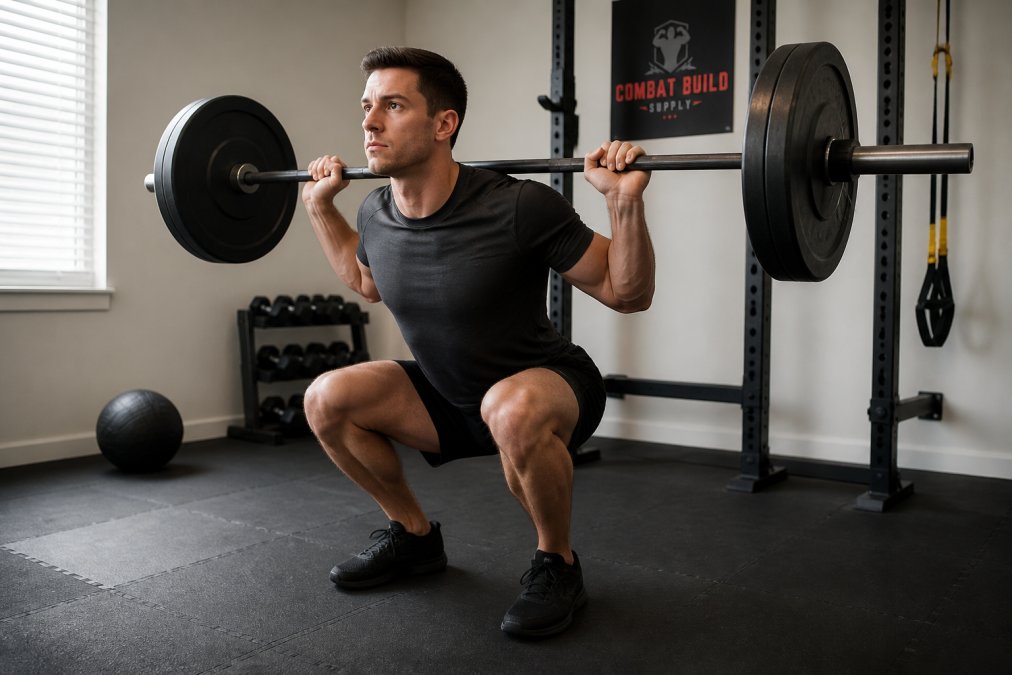
Program recommendations:
- Off-season: 3-4 sets of 4-6 reps at 80-85% of your one-rep max
- In-season: 2-3 sets of 6-8 reps at 70-75% to maintain strength without excessive fatigue
- Rest 2-3 minutes between heavy sets to allow CNS recovery
The Major Fitness Leg Press Hack Squat Machine AH1 ($2,019.99) offers a guided squat variation that reduces injury risk for fighters who don't have perfect squat mechanics yet. The machine's adjustable foot plates let you fine-tune your stance width and angle, which is valuable when you're learning proper form or recovering from a previous injury.

2. Barbell Hip Thrust: Explosive Power for Takedowns and Core Stability
The barbell hip thrust builds explosive power for takedowns by isolating the glutes and posterior chain, directly transferring to shooting takedowns and driving through clinch pressure.

Hip thrusts build glute hypertrophy and teach force generation through hip extension.
Program recommendations:
- Off-season: 3 sets of 5-6 explosive reps with moderate weight
- In-season: 2 sets of 6-8 reps to maintain explosiveness without excessive volume
- Rest 90-120 seconds between sets
3. Deadlift: Posterior Chain Development and Force Production
The deadlift builds total body strength and posterior chain development, essential for resisting clinch pressure and generating force through your entire posterior chain.
Program recommendations:
- Off-season: 3 sets of 3-5 reps at 85-90% of your one-rep max
- In-season: 2 sets of 5-6 reps at 75-80% to maintain strength without excessive fatigue
- Deadlift once per week to allow adequate CNS recovery
4. Medicine Ball Rotational Throws: Rotational Strength for Striking
The medicine ball rotational throw builds the core stability and rotational force needed to generate striking power and defend against rotational clinch pressure.
Program recommendations:
- 3 sets of 8-10 explosive reps per side
- Perform rotational throws 1-2 times per week
- Rest 60-90 seconds between sets to allow nervous system recovery
5. Farmer's Carries and Grip Conditioning: Forearm Endurance and Clinch Control
Farmer's carries build grip strength and forearm endurance for clinch control and submission defense. Load heavy dumbbells and walk.
Major Fitness Leg Press Hack Squat →
Program recommendations:
- 3 sets of 40-60 meter walks with heavy dumbbells
- Perform 1-2 times per week
- Rest 2-3 minutes between sets
Designing Your MMA Strength and Conditioning Program
The seven strength exercises for MMA fighters work best in a periodized program that matches your fight schedule, varying intensity, volume, and focus across training phases.
Off-season phase (8-12 weeks before fight):
- Prioritize heavy compound movements: squats, deadlifts, hip thrusts
- Train strength 3 times per week with 3-4 days of fight-specific training
- Use heavier loads (80-90% of max) for lower reps (3-6)
- Focus on building maximal strength and hypertrophy
Pre-fight phase (4-8 weeks before fight):
- Reduce strength volume slightly but maintain intensity
- Train strength 2-3 times per week
- Use moderate loads (70-80% of max) for moderate reps (6-8)
- Add more sport-specific conditioning
In-season phase (fight week and during active fight schedule):
- Maintain strength with minimal volume
- Train strength 1-2 times per week
- Use lighter loads (60-70% of max) for higher reps (8-10)
- Prioritize recovery and fight-specific training
Explosive Power Exercises for Fighters: Plyometrics and Rate of Force Development
Plyometric training builds rate of force development, the speed at which muscles generate force. This separates fighters who generate power quickly from those who generate it slowly.
Box jumps: Develop lower body explosive power
- 3-4 sets of 3-5 reps with maximum effort
- Rest 2-3 minutes between sets
- Use a box height that allows you to land softly and stick the landing
Depth jumps: Advanced plyometric that builds reactive strength
- 3 sets of 3-4 reps
- Step off a box, land softly, and immediately jump as high as possible
- This teaches your body to absorb force and redirect it upward
Medicine ball throws: Build rotational explosive power
- Already covered above, but worth emphasizing: explosiveness over load
Strength Training Frequency for Combat Sports: Balancing Volume and Recovery
The biggest mistake fighters make is training strength too frequently while training fight-specific skills. Your central nervous system has limited recovery capacity; training strength 5 days per week plus daily striking and grappling prevents adequate recovery.
Recovery and CNS fatigue management:
- Strength training depletes your nervous system, not just your muscles
- Heavy compound movements (squats, deadlifts, hip thrusts) are more CNS intensive than isolation work
- Perform heavy compound movements first in your session when your nervous system is fresh
- Rest 2-3 minutes between heavy compound sets to allow CNS recovery
- Avoid training strength on days immediately after high-intensity fight training
| Training Phase | Strength Sessions | Session Focus | Rest Between Sessions |
|---|---|---|---|
| Off-season | 3 per week | Heavy compound, hypertrophy | 48 hours minimum |
| Pre-fight | 2-3 per week | Moderate intensity, power | 48-72 hours |
| In-season | 1-2 per week | Maintenance, light volume | 72+ hours |
Summary: Integration Into Your Fight Training
The seven strength exercises for MMA fighters work best when integrated into a periodized program that complements your fight training, not competes with it. Start with the barbell back squat and deadlift as your primary lower body movements. Add the hip thrust for explosive power and the medicine ball rotational throws for striking strength. Build grip and forearm endurance with farmer's carries.
Frequently Asked Questions
What strength exercises are most effective for MMA fighters?
The most effective strength exercises for MMA fighters are compound movements that build functional power: barbell squats develop lower body force production and clinch strength, deadlifts strengthen the posterior chain for takedown defense, and barbell hip thrusts create explosive power for striking and grappling. Add medicine ball rotational throws for sport-specific rotational force, farmer's carries for grip and forearm endurance, and plyometric training to develop rate of force development. These exercises target the muscle groups and movement patterns fighters use in competition.
How often should a fighter perform strength training sessions per week as part of an MMA strength and conditioning program?
Most MMA fighters benefit from 2-4 dedicated strength training sessions per week, depending on training phase and fight proximity. During off-season, 3-4 sessions allow for higher volume and hypertrophy work. In-season, reduce to 2-3 sessions focused on maintaining maximal strength and explosive power while managing CNS recovery and preventing overtraining. Space sessions 48 hours apart when possible to allow adequate neuromuscular fatigue recovery between heavy compound lifts.
What's the difference between training for hypertrophy versus explosive power for fighters?
Hypertrophy training (8-12 reps, moderate weight, 60-90 second rest) builds muscle size and work capacity but takes longer to produce force. Explosive power training (3-6 reps, heavy weight, 2-3 minute rest, or plyometrics) develops rate of force development and anaerobic capacity, critical for striking speed and takedown explosiveness. Fighters need both: use hypertrophy phases in off-season to build a strength base, then shift to explosive power work 8-12 weeks before competition to maximize fighting performance.
How do I balance strength training with technical fight practice without overtraining?
Manage training volume by prioritizing quality over quantity: perform 3-4 compound lifts per strength session rather than 8-10 exercises, and keep total weekly training volume (strength plus technical) below levels that compromise recovery. Schedule strength training on separate days from intense technical sessions when possible. Monitor for signs of overtraining, persistent fatigue, declining performance, elevated resting heart rate, and reduce volume immediately. Include 1-2 complete rest days weekly and prioritize sleep to support CNS recovery.


