

Strength Training Exercises for Martial Artists
Table of Contents
- Why Strength Training Matters for Martial Artists
- Foundational Bodyweight Exercises
- Compound Barbell Lifts for Maximum Strength
- Explosive Power Exercises for Martial Arts
- Core Strength and Rotational Movement
- Weight Training for Martial Arts: Progressive Programming
- Strength Training Workout for Martial Artists: Integration with Skill Work
- Martial Arts Strength and Endurance Workout: Building Stamina
- Frequently Asked Questions
Last Updated: October 21, 2026
Why Strength Training Matters for Martial Artists
Martial arts demands more than technique. Your body must absorb impact, generate power, and sustain performance through multiple rounds. Strength training exercises for martial artists build the foundation technique alone cannot provide.
Strength training exercises for martial artists create resilience, prevent injuries, and unlock gains that show up in sparring.
The challenge is knowing which exercises transfer to fighting, how to program them alongside skill work, and how to recover.
Foundational Bodyweight Exercises
Bodyweight movements form the foundation of martial arts strength training because they teach movement quality and build work capacity without equipment, scaling from beginner to elite.
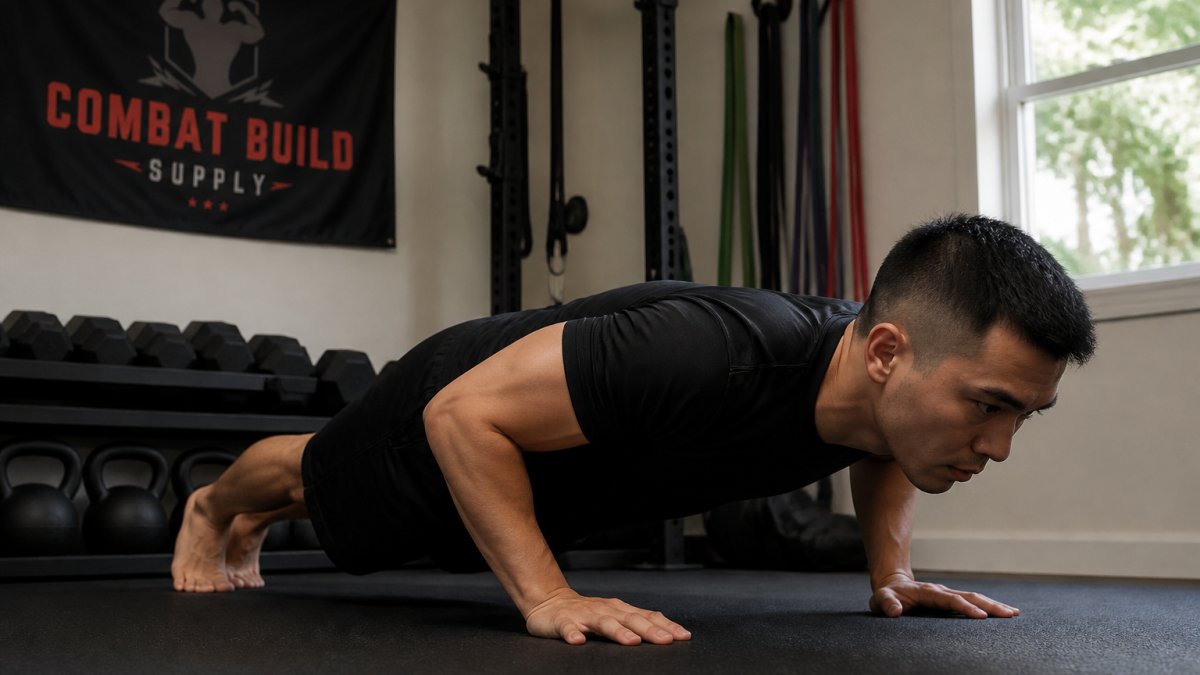
Push-Ups for Upper-Body Striking Power
Push-ups build upper-body pressing strength that transfers to punching power and takedown defense, strengthening chest, shoulders, and triceps while teaching core stability under load.
For strength training exercises for martial artists, standard push-ups work, but progression matters.
Progress by increasing reps, then move to harder variations: archer push-ups shift weight to one arm, pseudo-planche push-ups elevate your feet and shift weight forward, and diamond push-ups emphasize triceps.
For serious upper-body development, combine bodyweight push-ups with loaded pressing. The BodyKore CF2106 Elite Series Multi-Adjustable Bench ($836.00) lets you perform incline, decline, and flat bench pressing with dumbbells or a barbell.
Pull-Ups and Chin-Ups for Grappling Strength
Chin-ups use a palms-facing-you grip and emphasize biceps; pull-ups use a palms-facing-away grip and emphasize lats. Both belong in your program.
Most martial artists start with assisted pull-ups. The Major Fitness Pull-Up Assist Band Resistance Power Bands ($55.99) use natural latex for consistent, joint-friendly resistance in three levels.
Start with assisted pull-ups for 3 sets of 5-8 reps, reducing band resistance every 2-3 weeks.
Advanced variations include archer pull-ups, muscle-ups, and weighted pull-ups with dumbbells held between your feet.
Squats for Lower-Body Kicks and Movement
Squats build the lower-body strength that powers kicks, footwork, and takedown explosiveness, while strong legs absorb impact and stabilize grappling exchanges.
Bodyweight squats teach proper movement patterns.
Progress to loaded squats. Goblet squats (dumbbell at chest height) suit beginners because the load encourages proper positioning. Front squats build quad strength; back squats allow heavier weights.
For serious lower-body development, the Troy USA Sports Iron Hex Dumbbell Set with Rack ($1,458.00) provides dumbbells from 5 lbs to 50 lbs in 5 lb increments.
Compound Barbell Lifts for Maximum Strength
Compound barbell lifts build maximum strength efficiently, recruiting multiple muscle groups simultaneously and allowing progressive loading week after week.
Deadlifts and Squats
Deadlifts build total-body pulling strength, posterior chain development, and explosive power, strengthening back, hamstrings, glutes, and core while teaching hip hinge mechanics essential for takedowns and kicks.
Start with the bar empty (a standard Olympic barbell weighs 20 kg or 44 lbs). The Major Fitness 7ft 20kg Home Gym Barbell ($259.99) uses alloy steel construction and fits all standard Olympic plates.

Most martial artists can deadlift 1.5x their bodyweight within 3-6 months of consistent training; advanced lifters often reach 2x or more.
Barbell squats follow similar principles: load the bar onto your shoulders, step back, descend by bending knees and hips to parallel depth, then drive upright.
Bench Press and Overhead Press
Bench press builds upper-body pressing strength and chest development; overhead press builds shoulder strength and core stability.
Overhead press requires more stability and core engagement. Stand with the bar across your shoulders, press upward until arms fully extend, lower to shoulder height, and repeat.
Both pressing movements should progress linearly, adding weight every session or week. Intermediate targets: bench press 1.25x bodyweight and overhead press 0.75x bodyweight.
Explosive Power Exercises for Martial Arts
Explosive power determines how fast you can strike, how high you can jump, and how quickly you can transition between positions. Plyometric and ballistic exercises build this quality.
Plyometric Push-Ups and Jump Squats
Plyometric push-ups teach explosive upper-body power. From a standard push-up position, lower yourself quickly, then explode upward with enough force that your hands leave the ground. Land softly, absorb the impact, and repeat.
Jump squats build explosive lower-body power. The Trigon Sports 12" Plyometric Box ($120.12) provides a stable platform for box jumps.

Box jumps progress by height. Start with a 12-inch box, perform sets of 3-5 reps, then progress to higher boxes as your ability improves.
Medicine Ball Slams and Kettlebell Swings
Medicine ball slams build explosive core and shoulder power. Hold a medicine ball overhead, then explosively slam it into the ground with maximum force. The ball bounces back; catch it and repeat.
Kettlebell swings build explosive hip power and posterior chain strength.
The Trigon Sports Speed And Agility Kit ($131.56) includes tools for building explosive movement patterns. The kit features hurdles in 6, 9, and 12-inch heights for footwork progressions, plus 5-meter ladders for coordination drills.
Core Strength and Rotational Movement
Core strength stabilizes your spine during grappling exchanges and enables powerful rotational movements for striking. The core isn't just your abs, it includes your obliques, back muscles, and deep stabilizers.
Rotational movements matter for martial artists. Your power in kicks and punches comes partially from rotating your torso.
The BC Strength 45-Degree Hyper ($499.00) targets the posterior chain and core. Perform bodyweight hyperextensions, add dumbbells for load, or loop resistance bands around the upper back for varying resistance curves.
Anti-rotation exercises matter equally.
Weight Training for Martial Arts: Progressive Programming
Random exercise selection produces random results. Strategic programming means systematically increasing the demands on your muscles over time. This principle, called progressive overload, drives continuous strength gains.
Sets, Reps, and Rest Periods
The relationship between sets, reps, and rest periods determines what quality of strength you build.
For maximum strength (building raw power), use 3-5 sets of 1-5 reps with heavy weight.
For hypertrophy (muscle growth), use 3-4 sets of 6-12 reps with moderate weight. Rest 60-90 seconds between sets.
For muscular endurance, use 2-3 sets of 12-20 reps with lighter weight. Rest 30-60 seconds between sets.
Most martial artists benefit from combining all three.
| Rep Range | Sets | Rest Period | Primary Benefit | Best For |
|---|---|---|---|---|
| 1-5 reps | 3-5 | 2-3 min | Maximum strength | Raw power, striking force |
| 6-12 reps | 3-4 | 60-90 sec | Muscle growth | Foundation, injury resilience |
| 12-20 reps | 2-3 | 30-60 sec | Muscular endurance | Work capacity, conditioning |
Tracking Progress and Adjusting Load
Progressive programming requires tracking what you lift. Record the weight, sets, and reps for every exercise in every session.
Add weight when you complete all prescribed reps for all sets.
When progress stalls, change the stimulus. If you've been performing 5 reps, switch to 8 reps with the same weight. If you've been resting 2 minutes, reduce rest to 90 seconds.
Strength Training Workout for Martial Artists: Integration with Skill Work
Strength training must complement skill work, not compete with it. A martial artist who prioritizes strength over technique will be strong but ineffective. A martial artist who neglects strength will be technically sound but physically dominated. Maintaining this delicate equilibrium becomes even more critical when adjusting body composition, as the nuances of strength training for cutting ensure that hard-earned power remains intact while weight drops.
Training Around Sparring and Technique Practice
Schedule heavy strength work on days when you're not doing intense sparring.
Light skill work can happen on the same day as heavy strength training. Drilling technique for 30 minutes before a strength session works fine.
Save explosive power work for days when you're fresh. Plyometrics, medicine ball slams, and kettlebell swings demand full nervous system capacity.
A typical weekly schedule might look like:
- Monday: Sparring + light technique drilling
- Tuesday: Heavy barbell strength (deadlifts, squats, bench press)
- Wednesday: Technique practice + light conditioning
- Thursday: Intense sparring + light technique drilling
- Friday: Heavy barbell strength + light skill work
- Saturday: Explosive power (plyometrics, medicine ball, kettlebell)
- Sunday: Rest or light mobility work
This schedule keeps strength training consistent while respecting the demands of skill development and sparring intensity.
Recovery and Injury Prevention
Recovery determines whether your training produces progress or breaks you down. Sleep 7-9 hours nightly (the CDC). Eat enough protein (0.7-1 gram per pound of bodyweight daily). Stay hydrated. Warm up properly before every session.
Mobility work prevents injuries that derail training. Spend 10 minutes daily on stretching and mobility drills. The Nordic Ham Curl ($449.00) from Combat Build Supply builds eccentric hamstring strength while lengthening the hamstrings, both critical for injury prevention.

Listen to pain signals. Soreness (muscle fatigue) is normal. Sharp pain or pain that worsens during a set signals injury. Stop, rest, and reassess before continuing.
Martial Arts Strength and Endurance Workout: Building Stamina
Endurance separates fighters who maintain intensity for three rounds from those who fade in round two.
Incorporate conditioning work 1-2 times weekly: 10-20 minutes of moderate-intensity cardio (running, cycling, rowing) or high-intensity interval training (HIIT).
Combine strength and conditioning by performing circuits.
The Thruster Plates (set of 2) ($249.00) from Combat Build Supply serve multiple purposes in conditioning work.
Strength training exercises for martial artists produce results only when combined with consistent skill practice, proper recovery, and intelligent programming.
Strength training for martial artists isn't optional, it's foundational to performance and injury resilience. Our durable gear performs consistently through intense sessions, and our responsive support ensures you stay prepared to reach your goals. Sign Up Now! to explore our full equipment catalog and start building the strength that transfers directly to your fighting performance.
Frequently Asked Questions
What is a good strength training workout for martial artists?
A balanced strength training workout for martial artists combines compound lifts (squats, deadlifts, bench press), upper-body work (pull-ups, rows), explosive movements (plyometrics, kettlebell swings), and core training. Perform 3-4 sessions per week with 48 hours rest between sessions targeting the same muscle groups. Pair strength work with your regular martial arts skill training, leaving adequate recovery time to prevent overtraining and injury.
How often should martial artists strength train per week?
Martial artists benefit from 3-4 dedicated strength training sessions per week, spaced at least 48 hours apart for the same muscle groups. This frequency builds strength and power without interfering with technique work and sparring. If you're in fight camp or competing, reduce to 2 sessions weekly focusing on maintenance and injury prevention. Always prioritize recovery and listen to your body.
Which exercises build the most explosive power for martial arts?
Explosive power exercises for martial arts include plyometric push-ups, jump squats, box jumps (using a 12-inch plyometric box), medicine ball slams, kettlebell swings, and resistance band punches. These movements train your fast-twitch muscle fibers, directly translating to punching speed, kicking power, and takedown explosiveness. Perform 3-5 sets of 3-8 reps with full recovery between sets to maintain movement quality.
Can I build strength for martial arts without a full gym?
Yes. Bodyweight exercises like pull-ups, push-ups, squats, and burpees build substantial strength. Add resistance bands or dumbbells to scale difficulty as you progress. A barbell, adjustable bench, and a few key pieces like a plyometric box or Nordic ham curl station expand your options significantly. Combat Build Supply offers compact, durable equipment designed for home training spaces, including resistance bands starting at $55.99 and plyometric boxes at $120.12.
How do I prevent injury while strength training for martial arts?
Prioritize proper exercise technique before adding weight. Include mobility work and dynamic stretching before sessions and static stretching after. Build training volume gradually, don't jump to heavy loads. Include injury prevention exercises like Nordic ham curls for hamstring strength and rotational core work. Rest adequately between sessions and listen to pain signals. If an area feels compromised, reduce intensity or skip that movement and consult a professional before returning.


