

Heavy Bag Training Without Gloves: Risks and Safer Alternatives
Table of Contents
- Can You Use a Heavy Bag Without Gloves? The Short Answer
- Anatomical Impact of Bare-Knuckle Heavy Bag Training
- Common Hand Injuries From Punching Bags
- How to Wrap Hands for Boxing Before Heavy Bag Work
- Best Boxing Gloves for Heavy Bag Work
- Alternative Protection Methods Beyond Traditional Gloves
- Progressive Conditioning Plans for Safe Bag Training
- Proper Punching Technique for Beginners
- Frequently Asked Questions
Last Updated: October 2, 2026
Can You Use a Heavy Bag Without Gloves? The Short Answer
Training on a heavy bag without gloves is possible but carries significant risks to your hands, wrists, and long-term joint health. While some combat athletes train bare-knuckle for conditioning, doing so without proper technique, progressive conditioning, and protective alternatives exposes you to acute injuries and chronic damage that can sideline your training for weeks or months.
The question we hear most often is whether skipping gloves saves money or builds toughness. The answer is clear: bare-knuckle training without proper preparation almost always leads to injury, not resilience.
Your hands weren't designed to absorb repeated impact against a dense object. This guide breaks down what happens when you train without protection, how to wrap hands properly, and safer conditioning approaches that build toughness without injury risk.
Anatomical Impact of Bare-Knuckle Heavy Bag Training
Training without gloves changes the forces moving through your hands and wrists in ways most people don't anticipate.
Knuckle Abrasion and Skin Integrity
Without gloves, the skin over your metacarpal heads compresses directly against the bag's surface. Repeated strikes cause abrasion, callusing, and open wounds that bleed and risk infection. Calluses develop unevenly and offer minimal shock absorption compared to proper padding.
Common patterns: raw, bleeding knuckles after 10-15 minutes of work, infection risk from bacteria, uneven callus formation, and permanent scarring. But the deeper problem is what happens to the bones and joints underneath.
Joint Impact and Metacarpal Support
When your fist strikes a heavy bag, force travels through your knuckles into your metacarpal bones, then up through your wrist. Without gloves, there's no padding to absorb that force. Each strike compresses the cartilage in your knuckle joints, causing joint degeneration, inflammation, and arthritis over time.
Your wrist is a complex joint with multiple small bones and ligaments. Without gloves, the impact travels up your arm with no shock absorption, leading to repetitive strain, sprains, tendonitis, and chronic pain. A quality boxing glove provides structural reinforcement that keeps your hand aligned and distributes force across a wider surface area.
| Impact Component | With Gloves | Without Gloves |
|---|---|---|
| Force absorption | Distributed across padding | Concentrated on knuckles |
| Wrist stability | Supported by glove structure | Unsupported, full strain on ligaments |
| Skin protection | Covered, minimal abrasion | Direct contact, rapid damage |
| Joint compression | Reduced by padding | Full force on cartilage |
| Injury timeline | Weeks to months of heavy training | Days to weeks before pain |
Common Hand Injuries From Punching Bags
The injuries that develop from bare-knuckle bag training fall into two categories: the ones that happen immediately, and the ones that build up over weeks and months.
Acute Injuries vs. Long-Term Damage
Acute injuries happen fast: metacarpal fractures, knuckle contusions lasting 2-3 weeks, wrist sprains, and skin lacerations. These sideline you immediately, with recovery taking weeks.
Chronic injuries develop over months or years: osteoarthritis, tendonitis, chronic wrist pain, and joint instability. By the time you notice them, the damage is significant and often permanent.
Athletes who train bare-knuckle without proper conditioning typically experience their first acute injury within 2-4 weeks, with chronic injuries developing within 3-6 months.
How to Wrap Hands for Boxing Before Heavy Bag Work
Hand wraps are non-negotiable for heavy bag work. They're inexpensive protection that makes a massive difference in injury prevention.
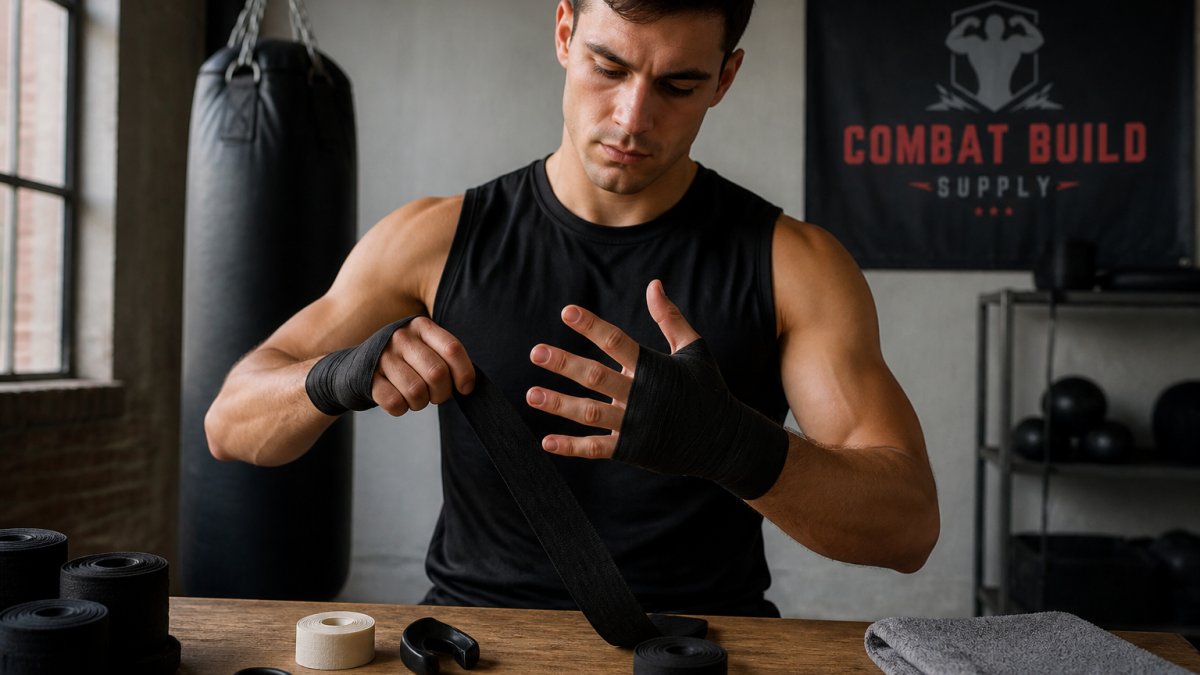
Step-by-Step Hand Wrapping Technique
Step 1: Position the wrap correctly
Start with the loop around your thumb.
Step 2: Secure your wrist
Wrap around your wrist 2-3 times, moving from the inside of your wrist to the outside.
Step 3: Cover your knuckles
Cross the wrap diagonally across the back of your hand, from your wrist toward your knuckles.
Step 4: Protect between your fingers
Weave the wrap between your fingers, starting between your pinky and ring finger.
Step 5: Final wrist security
Wrap around your wrist 2-3 more times to lock everything in place.
Step 6: Secure the closure
Most hand wraps have velcro at the end. Press it firmly around your wrist.
The whole process takes 2-3 minutes once you get the hang of it.
Common Wrapping Mistakes to Avoid
Too tight across the knuckles: This restricts blood flow and causes numbness. Your fingers should feel full sensation, not tingly.
Wrapping only the wrist: Many people skip knuckle coverage to save time. This defeats the purpose.
Leaving gaps between layers: Gaps create pressure points and reduce protection. Each wrap should overlap the previous layer by about half.
Not securing between fingers: If you skip the finger-weaving step, your fingers can spread too far on impact, stressing the joints.
Loose wrapping: A loose wrap shifts during your set, leaving areas unprotected. It should feel snug but not painful.
Best Boxing Gloves for Heavy Bag Work
Wraps are essential, but gloves are what actually absorb impact. Not all gloves are created equal. For heavy bag training, you need gloves with proper padding, wrist support, and durability.
Panama 45D Heavy Punching Bag →
Combat Build Supply carries professional-grade heavy bags designed to withstand serious training. Pairing them with quality gloves ensures your hands stay protected through months of consistent work.

When selecting boxing gloves for heavy bag training:
- Padding thickness matters: Look for at least 1 inch of padding around the knuckles. This absorbs impact without being so thick that you lose feel.
- Wrist support is critical: The glove should extend at least 4-5 inches up your forearm, with internal support structures that keep your wrist aligned.
- Weight should match your training: Heavier gloves (14-16 oz) are better for heavy bag work because they distribute force more effectively. Lighter gloves (8-10 oz) are for speed work and sparring.
- Closure system matters: Velcro closures are faster and easier than laces, and they're less likely to loosen during a set.
That's cheaper than dealing with a hand injury that sidelines you for months.
Alternative Protection Methods Beyond Traditional Gloves
Not everyone wants to use traditional boxing gloves. Some athletes prefer minimalist approaches or want options for different training phases.
Heavy bag mitts: These are lighter and more flexible than boxing gloves, offering less wrist support.
Hand conditioning wraps with gel padding: Some wraps include built-in gel padding for extra shock absorption.
Tape-only approach: Some fighters use athletic tape wrapped tightly around their hands and wrists.
Bare-knuckle with progressive conditioning: This involves gradually increasing training intensity over weeks, allowing your hands to adapt.
The reality: none of these alternatives match the protection of quality boxing gloves.
Progressive Conditioning Plans for Safe Bag Training
If you're new to heavy bag training, jumping in with maximum intensity guarantees injury.
Week 1-2: Light contact, technical focus
Train with hand wraps and gloves. Focus on proper technique, not power.
Week 3-4: Moderate intensity
Increase to 5 rounds of 3 minutes. You can throw harder, but stay controlled.
Week 5-6: Increased volume
Move to 6-8 rounds of 3 minutes. This is where you start building real conditioning. Intensity stays moderate to high, but you're not going all-out.
Week 7+: Full training
Once you've adapted, you can train at full intensity.
This progression takes about 2 months. Rushing it is the primary reason people develop hand injuries.
If you're considering bare-knuckle training for conditioning, the same progression applies.
Proper Punching Technique for Beginners
Technique matters more than power. Poor technique concentrates force on vulnerable parts of your hand.
The jab: Your lead hand throws a straight punch.
The cross: Your rear hand throws straight down the middle. Same knuckle contact, same wrist alignment.
The uppercut: Your arm bends sharply, and you drive upward from your legs.
The common mistake beginners make is dropping their wrist on contact.
Another mistake is leading with your pinky or ring finger knuckles. These aren't designed to take impact.
Proper technique protects your hands and makes your punches more effective.
Training on a heavy bag is one of the best ways to build cardio conditioning and reflex speed. But it demands respect for the forces involved. Your hands are complex, and injury sets you back months. Wrapping properly, using quality gloves, and progressing gradually aren't shortcuts, they're the foundation of sustainable training.
At Combat Build Supply, we've helped thousands of athletes build home training spaces that support long-term progress. Our commercial-grade heavy bags, like the Panama 45D Heavy Punching Bag, are built to handle serious training year after year. Pair that durability with proper hand protection, and you've got a setup that keeps you training hard without the injury risk. Start with wraps and gloves. Master your technique. Progress gradually. Your hands will thank you.
Frequently Asked Questions
Can you hit a heavy bag with just hand wraps, or do you need gloves too?
Hand wraps alone provide wrist stability and some cushioning, but they do not protect your knuckles from the full impact of striking a heavy bag. Boxing gloves are necessary to distribute impact force across a larger surface area and reduce injury risk. Hand wraps should always be used under gloves for maximum wrist alignment and support, not as a substitute for them.
Does punching a heavy bag without gloves actually toughen your knuckles?
Repeated impact without protection can cause calluses to form, but this is not the same as building strength. Bare-knuckle training damages skin integrity, causes knuckle abrasion, and increases risk of fractures and tendonitis. Professional fighters use gloves and hand wraps precisely because conditioning skin does not prevent serious joint injuries or long-term damage to metacarpal bones.
What are the long-term risks of hitting a heavy bag without gloves?
Long-term bare-knuckle heavy bag training can result in arthritis, stress fractures in the hand bones, chronic wrist pain, and permanent joint damage. The cumulative impact force without proper cushioning and wrist support accelerates bone density loss and cartilage breakdown. Even experienced fighters avoid this practice because the injury risk far outweighs any perceived benefit.
What type of boxing gloves should I use for heavy bag work?
Heavy bag gloves typically range from 10 to 16 ounces, with 12-14 oz being ideal for most home gym training. Look for gloves with adequate padding, secure wrist support, and reinforced knuckle protection. Quality matters: commercial-grade gloves with proper impact foam and multiple reinforced straps will protect your hands better and last longer during intense bag work.


