

Is Professional Combat Gear Worth the Cost? 2026 Guide
Table of Contents
- The Real Cost of Cheap Combat Gear
- Durability of Professional Boxing Gloves and Protective Gear
- Injury Prevention and Impact Absorption: What Safety Standards Matter
- When to Upgrade Your Combat Sports Equipment
- Maintenance Tips for Combat Gear That Extend Lifespan
- Cost-Per-Use: The Financial Case for Professional-Grade Gear
- Hygiene, Breathability, and the Psychological Impact of Quality Gear
- Frequently Asked Questions
Last Updated: September 14, 2026
The Real Cost of Cheap Combat Gear
Ask anyone who has trained seriously for a few years, and they'll tell you the same story: the cheap gloves fell apart first. This guide from Combat Build Supply asks is professional combat gear worth the cost, because the honest answer isn't "yes, always" or "no, it's marketing." It depends on how you train, how often, and what a failure costs you.
Cheap gear isn't cheaper. It just bills you in installments.
A $40 pair of gloves replaced three times a year costs more than one $180 pair that lasts three years. Add the sessions you lose waiting for replacements, and the math gets worse. Below, we break down durability, injury prevention, maintenance, and cost-per-use so you can decide with numbers instead of guesswork.
Durability of Professional Boxing Gloves and Protective Gear
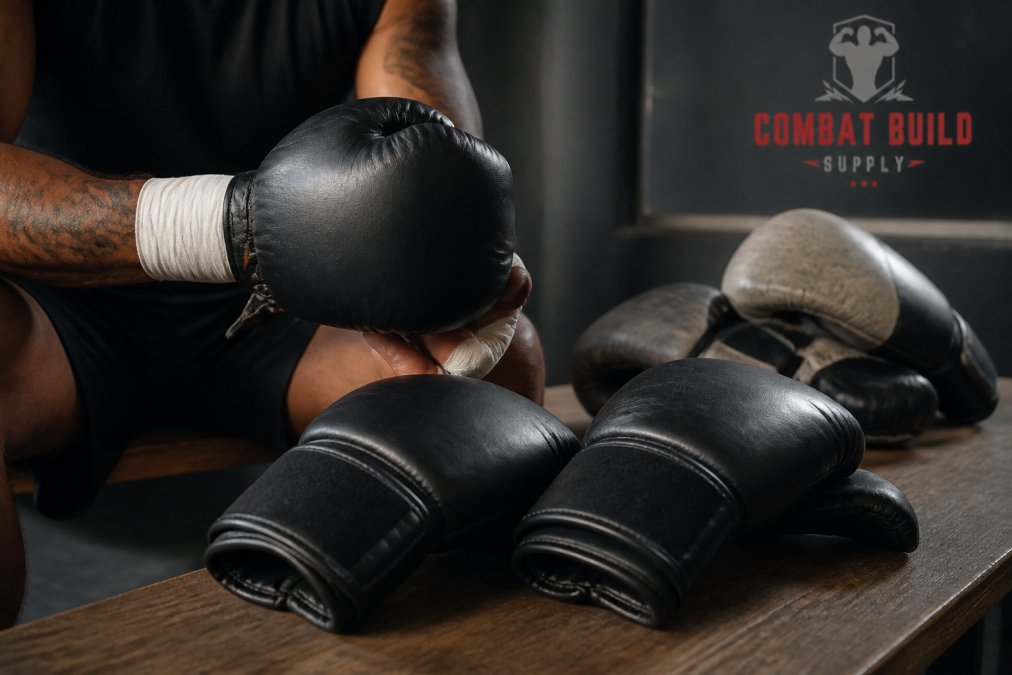
The durability of professional boxing gloves comes down to three things: material integrity, stitching quality, and how the foam core holds up under repeated impact. Entry-level gloves typically fail at the seams first, then the foam compresses into a flat pad that no longer absorbs force.
Material Integrity: Synthetic Leather vs. Genuine Hide
Synthetic leather is a polyurethane or PVC coating over a fabric backing (pubmed.ncbi.nlm.nih.gov). It resists moisture well and costs less, but the coating cracks where the glove creases, usually at the knuckle line and wrist flex point.
Genuine hide, typically full-grain or top-grain cowhide, moves with the hand instead of cracking against it. It scuffs, darkens, and softens, but it rarely splits. That's the difference between a glove that looks worn and a glove that has failed.
What most guides miss is the lining. A premium glove with a cheap nylon liner will still blow out at the thumb seam. Look for locked stitching and reinforced palm seams, not just a leather outer shell.
Injury Prevention and Impact Absorption: What Safety Standards Matter
Impact absorption is the entire point of protective gear, and it's the first thing cheap construction sacrifices. When foam compresses permanently, your knuckles and wrists absorb force the glove was supposed to dissipate. That force doesn't vanish, it travels up the metacarpals, into the wrist, and sometimes into the elbow.
In the United States, competition gloves are typically certified against ASTM standards for boxing and martial arts equipment. The ASTM Committee F08 on Sports Equipment maintains the standards manufacturers reference for impact attenuation and material testing. Certification isn't mandatory for home training gear, so a manufacturer that voluntarily tests to a published standard is telling you something about how seriously it treats the product.
What Certification Actually Tests
Impact-attenuation testing measures how much force passes through a sample after a controlled strike, essentially, how much energy the foam absorbs versus transmits (Sports Standards and Recreation Standards - Standards Products - Standards & Publications). A certified glove has been struck repeatedly under lab conditions and still meets a threshold. A generic glove has not.
For training gear specifically, the useful markers of good impact absorption are:
- Multi-layer foam (typically a firm outer layer over a softer inner layer, so the outer layer spreads force and the inner layer cushions)
- A dense, molded core rather than loose shredded filling, which shifts and packs down
- A wrist wrap that locks the hand in neutral alignment, so force travels through the forearm instead of bending the wrist
- Padding that rebounds after compression instead of staying flat
Why Joint Support Is Half the Equation
Joint support matters as much as knuckle protection. A bag glove with a weak wrist closure lets your hand bend on heavy hooks, and that's how wrists get hurt. The mechanism is simple: when the wrist flexes at impact, the force vector no longer runs straight down the arm, and the ligaments on the outside of the wrist take a load they weren't built for. A locked wrist keeps the vector aligned.
That's also why a glove that fits loosely is a safety problem, not just a comfort problem. If your hand slides inside the glove, you grip harder to compensate, your forearm fatigues early, and your form degrades as the session goes on, which is exactly when injuries happen.
The Standardization Gap
Here's what most buying guides skip: there is no single mandatory certification for training gloves the way there is for, say, motorcycle helmets. That means the burden falls on you to read the spec sheet. A manufacturer that lists a tested standard, a foam density, or a layer count is giving you something to compare. A manufacturer that lists only a color and a size is not. When two gloves cost the same, the one with published testing is almost always the better bet, not because the test guarantees performance, but because the company was willing to be measured.
When to Upgrade Your Combat Sports Equipment
Upgrade when your current gear stops doing its job, not when a new colorway drops. The clearest signals are compressed padding, split seams, a stretched wrist closure that no longer locks, and persistent hand or wrist soreness after sessions that used to feel fine.
Replacement Cycle by Training Frequency
Replacement cycles depend on training intensity and frequency far more than on calendar time. Light technical work wears gear slowly. Heavy bag work and sparring wear it fast.
| Training Frequency | Typical Glove Lifespan | Typical Bag Lifespan | Upgrade Trigger |
|---|---|---|---|
| 1-2 sessions/week | 18-24 months | 3-5 years | Loose stitching, minor compression |
| 3-4 sessions/week | 10-14 months | 2-3 years | Flat padding, worn wrist strap |
| 5+ sessions/week | 6-9 months | 12-18 months | Any seam failure, visible core |
Treat those as planning estimates, not rules. A glove used mostly for pad work will outlast an identical glove used mostly on a heavy bag.
Maintenance Tips for Combat Gear That Extend Lifespan
Maintenance tips for combat gear are simple, and almost nobody follows them. Air your gloves out after every session, wipe the outer shell with a damp cloth, and never leave gear in a sealed bag overnight. Moisture is what kills linings, stitching, and foam.
A few habits that add months to equipment lifecycle:
- Stuff gloves with newspaper or cedar inserts after training to pull moisture out
- Rotate two pairs if you train most days, so each pair dries fully
- Wipe leather with a light conditioner every few months to keep it supple
- Check bag straps and ceiling mounts monthly for wear and tear
- Keep gear out of direct sun, which degrades both hide and synthetics
Gear maintenance is also a safety practice. A frayed strap or a cracked mount is an injury waiting to happen, and inspecting takes two minutes.
Cost-Per-Use: The Financial Case for Professional-Grade Gear
When asking is professional combat gear worth the cost, cost-per-use is the only pricing comparison that matters. Divide what you paid by the number of sessions the gear survives, and the "expensive" option usually wins. The reason is that cheap gear doesn't fail linearly, it fails early and often, and each replacement resets the clock.
Running the Numbers
Take a pair of gloves. A budget pair at a low price point might last six months of three-session-a-week training before the padding flattens. A professional pair at several times the price might last three years under the same load. Divide each by the sessions it survives and the gap narrows dramatically, and that's before you count the sessions you lose waiting for a replacement to arrive.
The same logic applies to a heavy bag. A budget bag that needs replacing every 18 months costs more per year than a commercial-grade bag that lasts five years or more, especially once you count the labor of rehanging a new bag, the hardware you replace, and the training weeks you lose while the new one ships.
The Hidden Line Items
Cost-per-use math gets more favorable to professional gear when you add the costs that don't show up on a price tag:
- Downtime. Every week without a working bag or gloves is a week of lost conditioning you don't get back.
- Injury cost. A compressed glove that transfers force to your hand can sideline you for weeks. That's the most expensive line item of all.
- Replacement friction. Cheap gear rarely fails at a convenient time. You buy the next pair in a hurry, often at full retail, often the wrong size.
- Consumables. Cheap gloves often need more tape, more wraps, and more liner replacements to stay usable.
Resale Value and Investment Recovery
Resale value is the angle nobody talks about, and it's the strongest financial argument for professional gear. Quality gloves and bags from recognized manufacturers hold a meaningful share of their value on the used market, because buyers know the materials and the construction. A no-name budget glove has essentially no resale market, you can't give it away.
That recovery changes the true cost. If you can sell professional-grade gear later, your net cost-per-use drops again, and the gap between cheap and professional narrows to almost nothing. In some cases, a well-maintained professional glove that sells for a fraction of its purchase price after two years ends up costing less per session than a budget glove that was thrown away.
A Simple Framework
Before you buy, ask three questions:
- How many sessions per week will this gear see? Under three, budget gear may genuinely be enough. Over three, the math tilts toward professional.
- What does a failure cost me? If a blown seam means missing a week of training, cheap gear is expensive.
- Can I resell it? If the answer is no, you're paying full price for a disposable product.
At Combat Build Supply, the Panama 45D Heavy Punching Bag is built for exactly this math. It's a commercial-grade bag designed for high-volume training, available in 120 cm, 150 cm, and 180 cm lengths, and it holds up under the kind of repeated impact that destroys consumer bags. For a small apartment setup, the Uppercut Fixed Wall Punching Bag mounts without ceiling hooks, which solves the space problem that stops a lot of home gyms before they start.

Hygiene, Breathability, and the Psychological Impact of Quality Gear
Breathability and hygiene are why cheap gear smells. Synthetic shells trap sweat against the liner, and a non-breathable glove becomes a bacterial culture within weeks. Moisture-wicking liners and antimicrobial treatments aren't luxuries; they're the difference between gear that dries overnight and gear that never fully dries.
There's a psychological layer too, and it's real. Gear that fits properly and absorbs impact cleanly lets you commit to a punch instead of pulling it. Practitioners who trust their equipment train with more intent, and intent is what drives skill development.
Gear fitment ties both together. A glove that's too loose slides, forces you to grip harder, and fatigues your forearms early. A bag that swings unpredictably makes you hesitant. Neither problem shows up on a spec sheet, but both show up in every session.
Frequently Asked Questions
How much should a beginner expect to spend on quality combat gear?
Beginners can expect to spend $300 to $500 on a quality heavy bag alone, plus $80 to $150 for gloves and $50 to $100 for hand wraps and protective padding. While entry-level gear costs less upfront, it often needs replacing within 6 to 12 months under regular training. Professional-grade equipment typically lasts 3 to 5 years, making the cost-per-use lower over time.
What are the safety risks of using low-quality combat equipment?
Low-quality gear often lacks proper impact absorption and structural reinforcement, increasing risk of joint strain, bruising, and long-term injury. Gloves with thin padding or poor wrist support can lead to sprains during heavy bag work. Bags with weak seams may burst under repeated strikes, causing falls or equipment failure mid-session. Investing in gear that meets safety standards reduces these risks and supports training longevity.
Does expensive combat gear actually improve performance?
Professional-grade gear improves performance through better fitment, ergonomic design, and consistent impact dissipation. Gloves with proper wrist alignment and padding let you strike harder without compromising form. Heavy bags with structural reinforcement absorb punches predictably, so you can focus on technique rather than adjusting for bag sway. These factors matter most at higher training intensities and frequencies.
How often should professional combat gear be replaced?
Replacement depends on training frequency and gear type. Boxing gloves used 3 to 4 times weekly typically need replacing every 12 to 18 months. Heavy bags with commercial-grade durability can last 3 to 5 years with proper maintenance. Protective padding and wraps should be replaced every 6 to 12 months. Signs like compressed foam, cracked leather, or loose stitching indicate it is time to upgrade.
The hard part isn't deciding that quality gear costs more; it's knowing which upgrades actually change your training. Combat Build Supply stocks commercial-grade equipment built for repeated impact, with free shipping on every order, a 100% refund for defective or non-functioning items, and premium support by live chat, email, or phone if you need help matching gear to your space. Get started with Combat Build Supply and train on equipment that holds up session after session.


