

Why Professional Gear Lasts Longer: The Real Difference
Table of Contents
- The Engineering Behind Professional Gear Durability
- Commercial vs Residential Gym Equipment: What Changes
- How to Maintain Fitness Equipment for Maximum Lifespan
- Average Lifespan of Gym Equipment: Consumer vs Professional
- Environmental Stress Testing and Real-World Durability
- Lifecycle Cost Analysis: Why Professional Gear Saves Money
- Conclusion
- Frequently Asked Questions
Last Updated: September 10, 2026
The Engineering Behind Professional Gear Durability
Professional gear lasts longer because it is engineered with tighter tolerances, denser steel, and higher-grade components that resist mechanical wear far better than consumer-grade alternatives. This guide from Combat Build Supply breaks down the material science, maintenance requirements, and lifecycle costs that separate equipment built to last decades from equipment built to last a season.
Walk into any commercial gym and you'll find machines that have survived a decade of daily abuse from hundreds of users. The difference isn't luck. It's engineering.
The gap starts at the steel mill. Consumer equipment typically uses thinner gauge tubing and lower-grade alloys that flex under load. Professional gear uses thicker walls, higher carbon content, and precision-machined components that hold their shape under repeated stress. That's the foundation of drivetrain longevity in any mechanical system, whether it's a car transmission or a cable column.

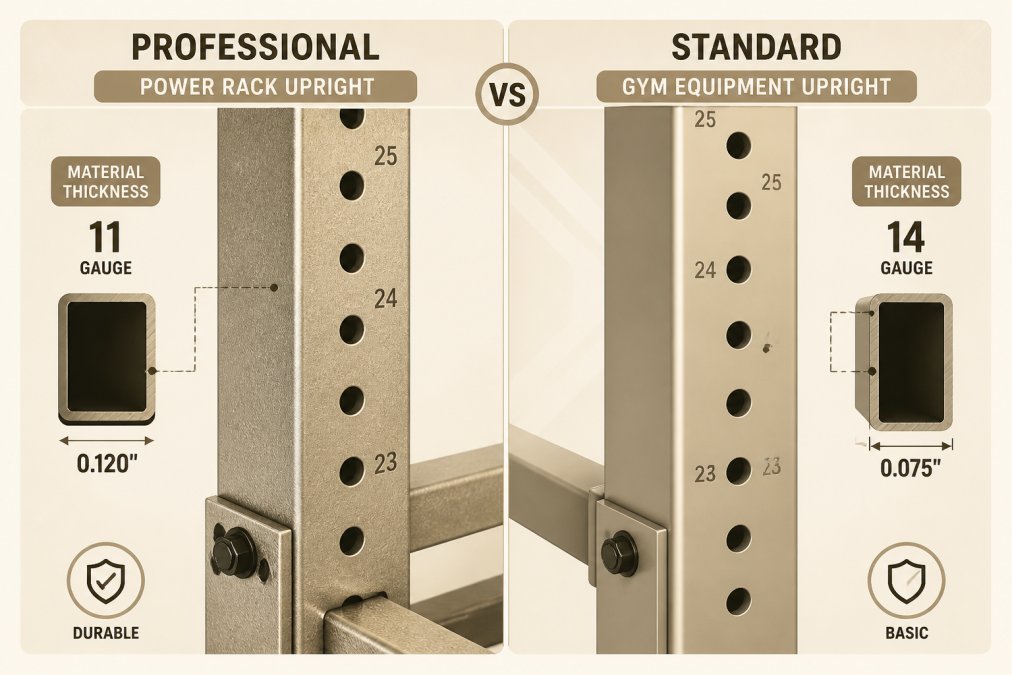
Material Science: Steel Grades and Gear Teeth
The steel grade determines how a component handles mechanical stress over time. Professional equipment uses higher carbon steel with tighter engineering tolerances, often 11-gauge or thicker, while consumer gear frequently drops to 14-gauge or lighter (astm.org). That difference in wall thickness translates directly to load capacity and resistance to deformation.
Gear teeth in professional machines are cut, not stamped. Cut gears mesh more precisely, which reduces friction, heat buildup, and the mechanical wear that eventually causes component failure. Stamped gears are cheaper to produce but wear faster under heavy loads.
Commercial vs Residential Gym Equipment: What Changes
Commercial vs residential gym equipment comes down to three factors: duty cycle, material grade, and serviceability. Commercial gear is designed for continuous daily use by dozens of people. Residential gear is designed for occasional use by one or two.
The duty cycle rating matters more than most buyers realize. A cable machine in a commercial setting might see 200+ pull repetitions per day. The same machine in a home gym sees maybe 30. But the home user who trains intensely five days a week will wear through residential-grade cables and pulleys in a fraction of the time a commercial unit would last.
Serviceability is the hidden advantage. Professional equipment uses standard bolts, replaceable bushings, and modular components. When something wears out, you swap the part. Consumer gear often uses proprietary fittings or sealed assemblies that can't be repaired, only replaced entirely.
Engineering Tolerances and Component Failure Points
The most common failure points in any strength training equipment are cables, pulleys, bushings, and welds. Professional gear addresses each one differently. Cables are rated by tensile strength, not just diameter. Pulleys use sealed bearings instead of plastic bushings. Welds are full-penetration rather than spot welds.
Those engineering choices cost more upfront. They also determine whether a machine survives five years or twenty.
How to Maintain Fitness Equipment for Maximum Lifespan
Learning how to maintain fitness equipment is straightforward: inspect wear points monthly, lubricate moving parts on schedule, and replace consumable components before they fail. Most equipment breakdowns trace back to neglected maintenance, not manufacturing defects.
Here's a practical maintenance checklist you can follow:
- Inspect cables for fraying or flat spots every 30 days
- Lubricate guide rods and bushings monthly with silicone spray
- Check and tighten all frame bolts quarterly
- Clean upholstery weekly to prevent cracking
- Test pulley smoothness and listen for grinding sounds
- Verify weight stack pin engagement and cable tension
- Inspect welds and connection points every 6 months
Service Intervals and Preventative Maintenance
Preventative maintenance follows a simple rule: the harder the equipment works, the more often it needs attention. Home gyms used daily need monthly inspections. Commercial facilities need weekly checks.
Transmission oil and lubrication efficiency matter here just as they do in automotive applications. Dry guide rods create friction, friction creates heat, and heat accelerates thermal breakdown of bushings and cables. A five-minute lubrication routine can add years to a machine's operational lifespan.
Average Lifespan of Gym Equipment: Consumer vs Professional
The average lifespan of gym equipment varies dramatically by grade. Consumer-grade home equipment typically lasts 3 to 7 years with regular use (cpsc.gov). Professional-grade equipment often exceeds 15 to 20 years in commercial settings with proper preventative maintenance.
| Equipment Grade | Typical Lifespan | Duty Cycle | Repair Frequency |
|---|---|---|---|
| Consumer (budget) | 3-5 years | Light, 1-2 users | Frequent part replacement |
| Consumer (mid-range) | 5-8 years | Moderate, 1-3 users | Occasional repairs |
| Professional (home) | 10-15 years | Heavy, daily use | Rare, modular parts |
| Commercial | 15-20+ years | Continuous, many users | Scheduled maintenance only |
That lifespan gap isn't just about durability. It's about how the equipment handles mechanical stress over thousands of cycles. Professional gear is tested against load capacity standards that consumer equipment never sees.
Environmental Stress Testing and Real-World Durability
Environmental stress testing separates marketing claims from engineering reality, and it is one of the clearest dividing lines between professional and consumer equipment. Professional manufacturers test frames and drivetrains under cyclic loading, humidity exposure, and temperature swings before a product reaches the market. Consumer gear often skips this step entirely, which is why a machine that feels solid in a climate-controlled showroom can develop creaks, rust, and cable stretch within a single humid summer.
What Professional Stress Testing Actually Looks Like
The core test is cyclic loading, applying and releasing a rated load thousands of times to simulate years of use in a compressed timeframe. A commercial cable column might be cycled through hundreds of thousands of pull repetitions at or near its rated capacity. A power rack might be loaded and unloaded to simulate repeated heavy squats and bench presses. The goal is not to prove the equipment survives one hard session; it is to prove it survives the ten-thousandth.

Torque testing is the companion protocol. Components are subjected to twisting forces beyond their rated load to see where they yield, and the failure point becomes the safety margin. Professional gear is typically designed with a wider margin between working load and failure load than consumer gear, which is why a commercial rack rated for 1,000 pounds can often handle significantly more before deformation.
Environmental chambers add the second dimension: heat, cold, and humidity. Steel expands and contracts with temperature, and lubricants thicken in cold and thin in heat. Professional bushings and bearings are selected to maintain smooth operation across that range. Cheaper friction materials soften in heat and wear faster, which is why a cable column in a garage gym during summer will run hotter and wear sooner than one in a climate-controlled room.
Corrosion and Humidity
Humidity is the quiet killer of consumer-grade equipment. Powder coat protects the frame, but it does nothing for cables, pulleys, bolts, and bushings. Professional gear uses galvanized or stainless cables, sealed bearings, and plated hardware that resist rust even in unconditioned spaces. Consumer gear often uses bare or lightly coated steel that begins to pit within a season of exposure to sweat and humid air.
The Same Principle in Mechanical Systems
The same logic applies to shifting performance in mechanical systems: consistent input under varying conditions is what separates reliable components from fragile ones. Equipment that maintains smooth operation across temperature extremes and humidity levels will outlast gear that only performs well in ideal conditions. That is why professional-grade equipment is specified for unconditioned commercial floors, unheated garages, and high-traffic training rooms, environments where consumer gear fails early and often.
Lifecycle Cost Analysis: Why Professional Gear Saves Money
Lifecycle cost analysis reveals the real economics of equipment purchases. A $500 consumer cable machine replaced every 4 years costs $2,500 over 20 years. A professional unit at $3,750 that lasts 20 years costs $3,750 total, with minimal repair costs along the way.
The math gets even better when you factor in downtime. Every broken cable or stripped bolt means missed training sessions. For someone on a structured strength program, consistency is the entire point.
Consumer Product Safety Commission guidance on exercise equipment safety notes that equipment failures contribute to thousands of home gym injuries annually, many involving equipment that was never rated for the loads being applied.
Combat Build Supply carries professional-grade equipment built to these higher standards. The Body Solid Pro Clubline SDC2000G Dual Cable Column fits within a 3' x 4' footprint, uses commercial-grade cables and pulleys, and is rated for continuous heavy use. For lifters who want a rack that matches that durability, the Hydra Collegiate Power Rack uses true 3" x 3" uprights with a 1,000-pound capacity and precision ⅝" holes that hold up to years of daily squat and bench sessions.
Conclusion
The choice between consumer and professional equipment isn't about brand loyalty or budget alone. It's about understanding what you're actually buying: a machine designed to survive thousands of high-stress cycles, or one designed to hit a price point.
Combat Build Supply stocks equipment built to the higher standard, with free shipping on every order, a 100% refund policy for defective items, and live chat, email, or phone support to help you match gear to your space and training style. If you're tired of replacing equipment every few years, get started with Combat Build Supply and invest in gear that stays ready for every session.
Frequently Asked Questions
Why do manual transmissions last longer than automatic transmissions?
Manual transmissions last longer because they have fewer moving parts and simpler mechanical wear patterns. Without a torque converter or complex valve body, there are fewer components to fail. The clutch assembly is the primary wear item, but it's replaceable. Professional-grade manual gearboxes in heavy-duty applications often exceed 150,000 miles with proper service intervals and fluid changes.
Is professional gear worth the higher price point for home use?
Professional gear costs more upfront but delivers lower lifecycle costs. A commercial-grade power rack like the Hydra Collegiate Power Rack at $1,199.99 has a 1,000-pound capacity and outlasts multiple consumer replacements. When you factor in repair costs, replacement cycles, and downtime, professional equipment often costs less per year of use than budget alternatives that fail under heavy loads.
What materials are used in professional-grade fitness equipment?
Professional gear uses higher-grade steel with tighter engineering tolerances. For example, true 3-inch by 3-inch uprights (76.2mm x 76.2mm) instead of the typical 75mm x 75mm imported racks. This extra material thickness improves load capacity and resists mechanical stress. Friction materials in bearings and bushings are also upgraded for better lubrication efficiency and heat dissipation.
How does manufacturing quality affect the lifespan of training gear?
Manufacturing quality determines how well components handle mechanical stress. Precision-welded frames, properly torqued bolts, and quality friction materials reduce component failure. Consumer-grade equipment often cuts corners on welds and uses thinner steel, leading to premature failure under heavy-duty application. Professional gear undergoes environmental stress testing to verify durability before it reaches you.


