

Heavy Bag Gloves for Small Hands: A Fitting Guide
Table of Contents
- Understanding Hand Measurements vs. Glove Weight
- How to Wrap Hands for Boxing Before Glove Fitting
- Measuring Your Hand: Palm Width and Finger Slot Length
- Boxing Glove Size Chart by Weight and Hand Size
- Wrist Support and Closure Systems for Secure Fit
- Material and Padding: Synthetic vs. Genuine Leather
- Finding Quality Heavy Bag Gloves at a Boxing Equipment Store Near You
- Common Mistakes When Buying Gloves for Small Hands
- Frequently Asked Questions
Last Updated: September 26, 2026
Understanding Hand Measurements vs. Glove Weight
Choosing heavy bag gloves small hands requires understanding how two different measurements work together. Hand size and glove weight (measured in ounces) are independent specifications. A 12-ounce glove doesn't automatically fit a small hand. What matters is the internal volume and how the glove's padding sits against your knuckles and wrist.
Many boxers assume lighter gloves fit smaller hands, backwards. A 10-ounce glove designed for average hands will still be too roomy for a narrow palm. Weight indicates padding thickness, not fit.
Buying by ounces alone leads to poor fit: your fist moves around inside the glove, causing hand fatigue and reducing impact absorption.
The real decision comes down to three things:
- Palm width (how wide your hand is at the knuckles)
- Finger slot length (how deep the glove needs to be for your fingers)
- Internal volume (total space inside the glove)
Once you measure these three, ounce weight becomes a secondary choice. A 12-ounce glove with a snug internal fit beats a 10-ounce glove that's too loose every single time.
How to Wrap Hands for Boxing Before Glove Fitting
Hand wraps change glove fit significantly, different wrap types add different amounts of volume. A thin wrap (0.5 inches compressed) adds minimal volume; a thick wrap (1 inch compressed) can add a full size's worth of internal space.
Common wrap types and their volume impact:
Mexican-style cloth wraps (traditional 180-inch fabric rolls): Compress to 0.75-1.0 inches at medium tension, mold to hand shape after 3-5 uses, and add roughly 0.5-0.75 inches of internal volume. Best for small hands because they conform gradually without creating pressure points.
Gel wraps (pre-formed with gel padding): Compress to 0.5-0.6 inches, maintain consistent thickness, and add roughly 0.4-0.5 inches of internal volume. They don't mold to hand shape and can create pressure points on small hands if gel pads misalign with knuckles.
Hand wrap tape (athletic tape or self-adhesive wraps): Compress to 0.3-0.4 inches with minimal volume addition and less wrist support than cloth or gel.
Why this matters for small hands: If you try gloves with gel wraps but train with Mexican-style cloth wraps, you'll buy gloves that feel tight during fitting but loose during training, causing hand fatigue. The opposite problem occurs if you fit with cloth and train with gel, the glove will feel roomy during fitting but tight during training.
The right process: Identify your actual training wrap type, wrap your hands snugly (fingers move freely, one finger slides under the wrap at the wrist), let the wrap settle for 2-3 minutes, then try on gloves for an accurate fit assessment.
For most small-handed boxers, Mexican-style cloth wraps are standard for heavy bag training, so fit gloves with cloth wraps at medium tension. After 5-10 training sessions, padding compresses and molds to your hand shape, if gloves feel slightly tight initially, they'll feel perfect by session five.
Measuring Your Hand: Palm Width and Finger Slot Length
Palm width is the distance across your knuckles when your hand is flat. Finger slot length is how far your fingers extend into the glove.
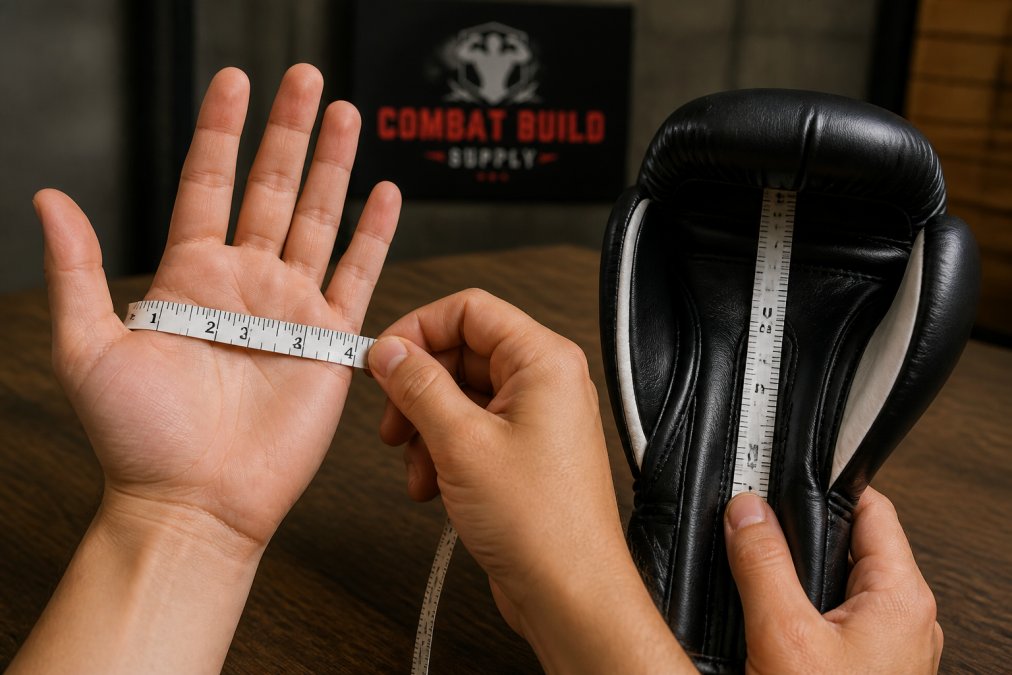
To measure palm width:
- Lay your hand flat on a table, fingers straight
- Place a soft tape measure across your knuckles (the widest point)
- Record the measurement in inches
- Repeat three times and use the average
Small hands typically measure 2.75 to 3.25 inches across the knuckles.
To measure finger slot length:
- Make a relaxed fist
- Measure from your wrist crease to the tip of your middle finger
- Record in inches
- This tells you how deep the glove's finger compartment needs to be
Finger slot length typically ranges from 6.5 to 7.5 inches for adults with small hands.
Hand Circumference and Internal Volume
Hand circumference (distance around your knuckles when your fist is closed) predicts whether a glove will feel snug or loose. Small hands typically measure 7.5 to 8.5 inches.
When you try on a glove, your fist should fill the space with no more than a quarter-inch of movement in any direction. If you can move your hand side-to-side, the internal volume is too large.
Boxing Glove Size Chart by Weight and Hand Size
This chart connects hand measurements to glove weight recommendations. Use your palm width and finger slot length to find your starting point.
| Hand Size | Palm Width | Finger Slot | Recommended Ounces | Best Use |
|---|---|---|---|---|
| Small | 2.75-3.0" | 6.5-6.75" | 10-12 oz | Heavy bag, speed work |
| Small-Medium | 3.0-3.25" | 6.75-7.0" | 12 oz | Heavy bag, light sparring |
| Medium-Small | 3.25-3.5" | 7.0-7.25" | 12-14 oz | Heavy bag, general training |
| Medium | 3.5-3.75" | 7.25-7.5" | 14-16 oz | Heavy bag, sparring |
This chart is a starting point, not a rule. Brand-to-brand variation exists. For heavy bag training, fit matters more than weight, a well-fitting 10-ounce glove protects better than a loose 14-ounce glove.
Wrist Support and Closure Systems for Secure Fit
Wrist support determines how stable your hand feels inside the glove during impact. A loose wrist connection causes your hand to shift during heavy bag work. That shift creates fatigue and reduces punch power.
Two main closure systems exist: lace-up and hook and loop (velcro).
Lace-up closures:
- Provide maximum wrist customization
- Let you tighten gradually from the wrist up
- Take longer to put on and remove
- Best for people with small wrists who need precise adjustment
- More durable long-term
Hook and loop closures:
- Quick to fasten and remove
- Provide consistent wrist support if sized correctly
- Harder to fine-tune fit
- Work well for standard wrist sizes
- Easier for repeated on-and-off during training
For small hands, lace-up closures often work better. Small wrists need precise tightening. A hook and loop closure designed for average wrists may be too loose even at maximum tightness.
When testing a glove, the wrist support should feel snug but not painful. You should be able to fit one finger between the glove and your wrist. Any more space means the glove is too loose. Any less space restricts blood flow.
Material and Padding: Synthetic vs. Genuine Leather
Material choice affects durability, comfort, and how the glove molds to your hand over time. For small hands, understanding padding behavior during break-in is as important as the outer shell material.
Outer shell material:
Genuine leather: Molds to hand shape after 10-15 sessions, more breathable, costs $80-$150, lasts 2-3 years with proper care, requires occasional conditioning.
Synthetic leather (polyurethane or PVC): Requires less break-in (5-8 sessions), more affordable ($40-$80), lasts 1-2 years, easier to clean but doesn't conform to hand shape like genuine leather.
Padding material and break-in behavior:
For heavy bag gloves, padding material matters more than outer shell for small hands. Different padding types compress and mold at different rates, directly affecting how the glove fits after your first few sessions.
Foam padding (most common): Density 1.2-2.0 inches, compresses 10-15% during first 5 sessions, molds to hand contours. Best for small hands because it conforms to narrow palm shapes, a snug glove on day one feels perfect by session five.
Horsehair padding (traditional, premium): Density 1.5-2.2 inches, compresses 5-8% during break-in, takes 15-20 sessions to mold fully. Provides superior impact distribution but requires patience. Lasts 2-3 years, costs $120-$200.
Gel-infused padding (newer technology): Density 1.3-1.8 inches, minimal compression (3-5%), maintains consistent feel from day one. Good for small hands if sized correctly initially, but offers no "growing room" if fit is slightly off.
What this means for small hands: Foam-padded gloves that feel snug initially will loosen during break-in, plan for 5-10 sessions. Gel-padded gloves show no break-in adjustment, so initial fitting must be precise. Horsehair-padded gloves require the longest break-in but offer the best long-term hand conformity.
For heavy bag gloves small hands during heavy bag work, aim for at least 1.3 inches of compressed padding.
Finding Quality Heavy Bag Gloves at a Boxing Equipment Store Near You
Local boxing equipment stores let you try gloves on before buying, fit is impossible to judge from photos alone. Bring your hand wraps, wrap your hands as you would for training, then try on multiple gloves for at least five minutes each. Tell the employee you need gloves for heavy bag training specifically. Before buying anywhere, verify the return policy, you need the option to return gloves after training in them.
Common Mistakes When Buying Gloves for Small Hands
Most people with small hands repeat the same three mistakes.
Frequently Asked Questions
What size heavy bag gloves do I need if I have small hands?
Glove size depends on hand circumference and oz weight combined. Measure your hand around the knuckles, if it's under 7 inches, look for 8-10oz gloves with internal padding designed for smaller hand volumes. Don't rely on oz weight alone; check the glove's internal dimensions and palm width to ensure a snug fit without excess space that causes hand fatigue during training.
How do I know if my boxing gloves are too big for heavy bag training?
Your fist should close naturally inside the glove with the thumb in its slot and fingers filling the finger compartments. If your hand shifts inside the glove, padding compresses unevenly, or your wrist feels unstable, the glove is too large. Excess internal volume forces your hand to work harder to maintain a proper fist closure, reducing impact absorption and increasing injury risk during heavy bag work.
Do hand wraps affect how boxing gloves fit on small hands?
Yes, hand wrap thickness directly impacts internal glove volume. Thicker wraps (like Mexican-style) add bulk that can make a snug glove feel cramped. Use medium-thickness wraps (typically 180 inches) and wrap consistently the same way every session. If your gloves feel tight after wrapping, you may need a slightly larger oz weight or a glove with more internal volume designed for wrapped hands.
Are youth-sized boxing gloves a good option for adults with small hands?
Youth gloves can work if your hand circumference is genuinely small (under 6.5 inches), but they often have thinner padding and lower wrist support than adult gloves. Adult gloves in 8-10oz with ergonomic design and proper wrist closure systems provide better impact absorption and durability for serious heavy bag training. Check the glove's internal dimensions rather than the age label to make the right choice.


