

AWMA Alternatives for Home Gyms: 2026 Guide
Table of Contents
- Why AWMA Alternatives Matter for Home Training
- Best Martial Arts Home Gym Equipment Options
- How to Set Up a Home Dojo: Equipment Selection and Layout
- Professional vs Consumer Grade Gym Equipment: What You're Paying For
- Comparison Table: AWMA Alternatives at a Glance
- Digital Resistance vs. Traditional Weight: Which Works Better
- Subscription-Free Hardware: Training Without Monthly Fees
- Conclusion
Last Updated: August 27, 2026
Why AWMA Alternatives Matter for Home Training
The traditional martial arts equipment market has been slow to evolve, leaving practitioners searching for systems that deliver professional-grade functionality without consuming entire living spaces or requiring massive budgets. This guide breaks down real alternatives to standard AWMA setups, focusing on equipment that delivers versatility, durability, and progressive overload for long-term strength development.
The shift toward home-based training has forced manufacturers to rethink equipment design. Space-saving power racks, multi-function Smith machines, and cable-based trainers now deliver what used to require entire commercial gyms. The difference between choosing the right system and settling for less comes down to understanding what features actually matter for your training goals, space constraints, and long-term investment.
Best Martial Arts Home Gym Equipment Options
When evaluating martial arts home gym equipment, you're looking for systems that provide full-body strength development without sacrificing floor space or workout versatility. Modern equipment now consolidates five different training modalities into single footprints.

Space-Saving Power Racks for Compact Spaces
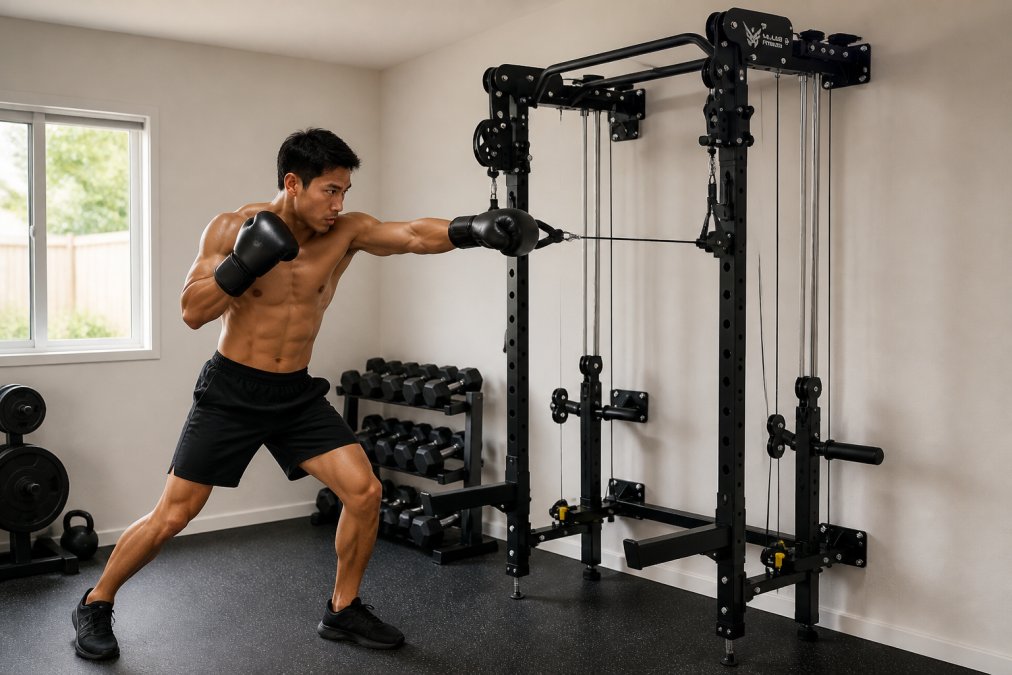
A quality power rack forms the foundation of most effective home gyms, and modern designs have solved the footprint problem that made them impractical for apartments. The Major Fitness F35 All-In-One Home Gym Wall-Mount Folding Power Rack exemplifies this shift, it folds to just 22 inches deep when not in use, expanding to a full training station with integrated cable systems and landmine attachments. Seven adjustable folding angles let you customize rack depth for different exercises, and the 1:1 cable pulley ratio gives smooth resistance without mechanical complexity.
For lifters who've progressed beyond entry-level training, the Major Fitness F22 All-In-One Home Gym Power Rack delivers structural rigidity and attachment versatility that serious strength work demands. At 277.8 pounds of frame weight, this rack stays planted under heavy loads. The dual independent pulley system with a 2:1 ratio gives 17 adjustable cable positions, enough range to program everything from heavy squats to isolation cable work.

The Residential Power Rack at $439.99 delivers solid construction at an entry point without compromising durability. UHMW plastic on the J-cups protects your bar from damage, a detail that matters when making a long-term equipment investment.
Multi-Function Smith Machines for Versatile Training
A Smith machine adds guided bar path stability to heavy compound movements while enabling cable work, landmine exercises, and functional training. The Major Fitness B52 All-In-One Home Gym Smith Machine consolidates five distinct training modalities: Smith machine, free weight rack, cable pulley system, independent dual pulleys, and landmine attachment. The 410-pound frame stays rock-solid through heavy lifts, and the independent dual pulley system enables single-arm cable exercises that build unilateral strength.

The 2:1 pulley ratio with 17 adjustable cable positions provides full-body training range without supplementary equipment. For martial artists, you get heavy compound strength from the Smith machine plus cable resistance that builds stabilizer strength and functional power translating to combat performance.
For practitioners with space and budget for a commercial-grade solution, the Major Fitness Heritage Series B17 Flying Fortress All-In-One Functional Trainer with Smith Machine represents the top tier of home gym consolidation. At 879.8 pounds, this machine functions like a complete commercial gym in one footprint. The interchangeable 1:1 and 2:1 pulley ratios let you switch resistance profiles to match exercises and training goals. The expandable weight stack system goes up to 260 pounds per side, providing serious progressive overload capacity. Reinforced safety arms ensure equipment reliability under real-world stress.
How to Set Up a Home Dojo: Equipment Selection and Layout
Building an effective home dojo requires thinking beyond individual pieces and understanding how they integrate into a cohesive training space. The goal is creating an environment where you can progress through strength phases and develop compound movement patterns that translate directly to combat performance.
Footprint Efficiency and Installation Requirements
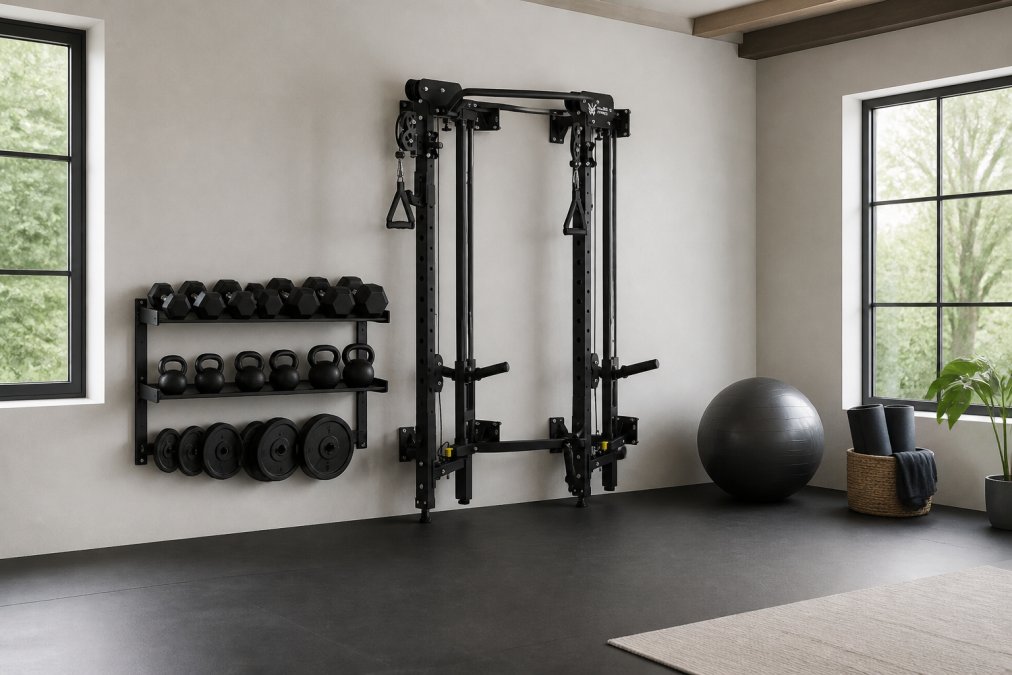
Most home training spaces fail because practitioners underestimate the floor space needed for actual training. A power rack needs clearance around it for movement, accessory work, footwork drills, and exercise transitions. The folding power rack design solves this by creating a footprint that disappears between sessions. The F35 folds to 22 inches deep, transforming a dedicated training wall into usable living space.
Wall-mounted folding racks require solid wall structure anchored to studs with appropriate hardware. Freestanding power racks offer flexibility since they can sit on any floor, though they require more square footage. Cable-based trainers and Smith machines typically need roughly a 10-foot by 8-foot area to operate safely, accounting for bar path clearance and functional training space (acsm.org).
Integration with Free-Weight Setups
Most effective home gyms combine equipment types. Barbell work from the rack builds raw strength. Cable work from the Smith machine builds stabilizer strength and movement quality. Free weights add unilateral training and functional patterns.
Integration works best with clear zones: a power rack in one corner, a Smith machine in another, and open floor space for kettlebells and dumbbells. Most quality racks include attachment points for barbell hangers. The B17 Flying Fortress includes two barbell hangers as standard, letting you store barbells on the machine and transition between barbell and Smith machine exercises without leaving your training station. This workflow matters when time is limited, you're not walking between different areas of the gym between exercises.
Professional vs Consumer Grade Gym Equipment: What You're Paying For
The price difference between consumer-grade and professional-grade equipment reflects fundamental differences in materials, engineering, stability, and long-term durability.
Durability, Repairability, and Long-Term Value
Consumer-grade equipment often uses lighter gauge steel and simpler pulley systems that show wear quickly under heavy, consistent use. Professional-grade equipment uses heavier gauge steel and reinforced attachment points engineered for years of intense training (astm.org).
The B52 Smith machine at $1,499.99 costs significantly more than basic models, but the 410-pound frame weight and reinforced construction reflect equipment designed to handle serious training stress. Professional-grade equipment uses standard, replaceable components, pulleys, bearings, attachment pins, so minor issues don't require replacing the entire machine.
The B17 Flying Fortress at $4,099.99 represents the highest tier of home gym consolidation. The linear-bearing Smith system uses precision components that maintain smooth bar path through thousands of lifts. The expandable weight stack system uses standard pin-and-plate construction that's easily serviceable.
Hardware Durability and Maintenance Considerations
Hardware durability directly impacts how long equipment performs before maintenance becomes necessary. Professional-grade systems use heavier gauge steel in critical areas, reinforced welds, and attachment mechanisms designed for repeated stress.
The Residential Power Rack uses solid steel spotter arms with secondary steel pipe covering, a detail that prevents damage when you miss a heavy lift. Cable-based systems require periodic cable inspection and pulley maintenance. Professional-grade machines come with documentation and support for these tasks. Cable maintenance becomes a regular consideration when training hard multiple times per week.
Comparison Table: AWMA Alternatives at a Glance
| Equipment | Price | Best For | Key Features | Space Requirement |
|---|---|---|---|---|
| Major Fitness F35 | $949.99 | Small spaces, apartment training | Folds to 22" deep, 4 functional systems, 1:1 cable ratio | 54"W × 22"D folded |
| Major Fitness F22 | $929.99 | Intermediate/advanced lifters | Dual independent pulleys, 2:1 ratio, 14 upright positions | 64"W × 58"D |
| Residential Power Rack | $439.99 | Budget-conscious training | Solid steel construction, UHMW J-cups, pull-up bar included | 54"W × 48"D |
| Major Fitness B52 | $1,499.99 | Serious strength training | 5-in-1 system, 410 lb frame, independent dual pulleys | 79"W × 67"D |
| Major Fitness B17 | $4,099.99 | Commercial-grade home gym | Expandable weight stacks, 1:1 and 2:1 ratios, 31 cable positions | 79"W × 68"D |
Digital Resistance vs. Traditional Weight: Which Works Better
The distinction between digital resistance systems and traditional weight-based resistance matters for specific training goals. Traditional weight resistance, barbells, dumbbells, plates, cable systems with weight stacks, provides consistent, predictable resistance that scales linearly with load. This simplicity is why it's remained the standard for strength training. The resistance is mechanical, requiring no batteries, software updates, or connectivity.
Digital resistance systems offer advantages for specific protocols like velocity-based training, where resistance adjusts based on bar speed (peer-reviewed research). For most home training focused on strength development and martial arts conditioning, traditional weight resistance delivers better results. The simplicity is an advantage, you're not dependent on software, connectivity, or battery life.
The B52 and B17 use traditional weight stacks with mechanical cable systems, providing cable resistance versatility without electronic complexity. You get full-body training capability and functional movement patterns without depending on digital systems requiring maintenance and updates.
Subscription-Free Hardware: Training Without Monthly Fees
One of the clearest advantages of building a home gym with traditional equipment is eliminating recurring subscription costs. You buy the equipment once, own it completely, and train without monthly fees or software subscriptions.
Cable-based trainers like the B52 and B17 operate entirely without subscriptions. The cable systems, weight stacks, and mechanical resistance work the same way on day one and year five. You're not paying for app access or worrying about discontinued software support.
This matters practically. A subscription-based system might cost $50-150 monthly, $600-1,800 annually. Over five years, that's $3,000-9,000 in recurring costs on top of equipment purchase. A traditional system costs the same whether you train once per week or twice daily. The Residential Power Rack at $439.99 exemplifies this approach, straightforward equipment with no electronics, no app, and no subscriptions that functions the same way in 2026 as it will in 2031.
Building an effective home gym around AWMA alternatives means prioritizing equipment that delivers durability, versatility, and progressive overload supporting long-term strength development. Whether you're starting with a basic power rack or consolidating your entire training program into a multi-function Smith machine, the equipment you choose should reflect your training intensity, space constraints, and long-term commitment to skill development.
Combat Build Supply specializes in equipment designed for serious practitioners. Our power racks, Smith machines, and functional trainers are built for durability, offer cable-based resistance that develops functional strength, and eliminate recurring subscription costs. Free shipping with every order and a 100% refund guarantee on defective equipment means you're making a risk-free investment in your training space. Sign Up Now!
Frequently Asked Questions
Q: What are the best AWMA alternatives for home gyms?
A: The best AWMA alternatives depend on your space and training style. Power racks like the Major Fitness F35 ($949.99) offer folding designs for compact spaces, while the F22 ($929.99) provides dual independent pulleys for cable-based training. For multi-function needs, the B52 Smith machine ($1,499.99) combines five training systems in one footprint. All include complete attachment packages and avoid subscription fees, making them practical alternatives for serious home training.
Q: How do I choose between professional and consumer-grade gym equipment for my home dojo?
A: Professional-grade equipment prioritizes hardware durability, repairability, and long-term value over initial cost. Consumer-grade options are cheaper but often require replacement sooner. For a home dojo, professional-grade makes sense if you train intensely and frequently. The Residential Power Rack ($439.99) offers entry-level durability, while the B17 ($4,099.99) provides commercial-grade features for serious athletes.
Q: Can I integrate cable-based training with my existing free-weight setup?
A: Yes. Power racks with integrated cable pulley systems like the F22 and F35 work alongside traditional barbells and dumbbells. The dual independent pulley systems enable cable exercises like lat pulldowns, rows, and flys without requiring separate machines. This integration maximizes versatility in smaller spaces and allows progressive overload through both free weights and cable-based training in a single footprint.
Q: Are subscription-free home gym alternatives actually effective for strength training?
A: Absolutely. Subscription-free hardware using traditional resistance (weights, cables, or magnetic resistance) delivers measurable strength gains through progressive overload and eccentric loading. Unlike app-dependent systems, these alternatives work offline and require no ongoing fees. Major Fitness equipment uses 2:1 cable pulley ratios and weight stack systems that enable serious strength training metrics and full-body workouts without monthly subscriptions.
This article was written using GrandRanker


