

Kettlebell Training for MMA Fighters: A Complete Guide
Table of Contents
- Why Kettlebell Training Works for MMA Fighters
- Kettlebell Exercises for Punching Power
- Best Kettlebell Weight for Beginners
- Kettlebell Endurance Training for Fighters
- Sample Kettlebell Workout Plan for MMA
- Kettlebell Training vs. Barbell for Combat Sports
- Common Mistakes in Kettlebell Training for MMA
- Building Your Home Gym for Kettlebell Training
- Frequently Asked Questions
Last Updated: September 23, 2026
Why Kettlebell Training Works for MMA Fighters
Kettlebell training MMA bridges raw strength and the explosive, dynamic movements that define fighting. Unlike barbells, kettlebells demand stability, core engagement, and rapid force production in multiple planes of motion, exactly what happens inside the cage.
The offset load of a kettlebell forces your stabilizer muscles to work harder. When you swing a kettlebell, your posterior chain fires explosively. When you press one overhead, your core locks down to prevent rotation. This translates directly to punching power, takedown defense, and the ability to maintain position under pressure. According to research on functional strength training, movements that challenge stability across multiple planes produce superior carryover to sport-specific tasks compared to isolated, single-plane exercises.
High-intensity kettlebell circuits elevate your anaerobic threshold, the point where your body switches from aerobic to anaerobic energy. A five-round fight demands maximum force when glycogen is depleted and lactate builds. Kettlebell training conditions your CNS and work capacity for fight camp intensity.
Fighters who dismissed kettlebells as "functional fitness" equipment reported noticeable improvements in clinch control, hip drive on takedowns, and final-round output within four weeks, the result of training a pattern that demands stability, explosive power, and metabolic resilience. Integrating these movements into a broader regimen of functional fitness training ensures that the structural integrity developed under load translates directly into the chaotic demands of a live sparring session.
Kettlebell Exercises for Punching Power
Punching power comes from generating force in your hips and transferring it through your core. Kettlebell exercises excel at this by demanding explosive hip extension, core stability, and load deceleration. The following three movements form the foundation of kettlebell training MMA for strikers.
Turkish Get-Up for Rotational Torque
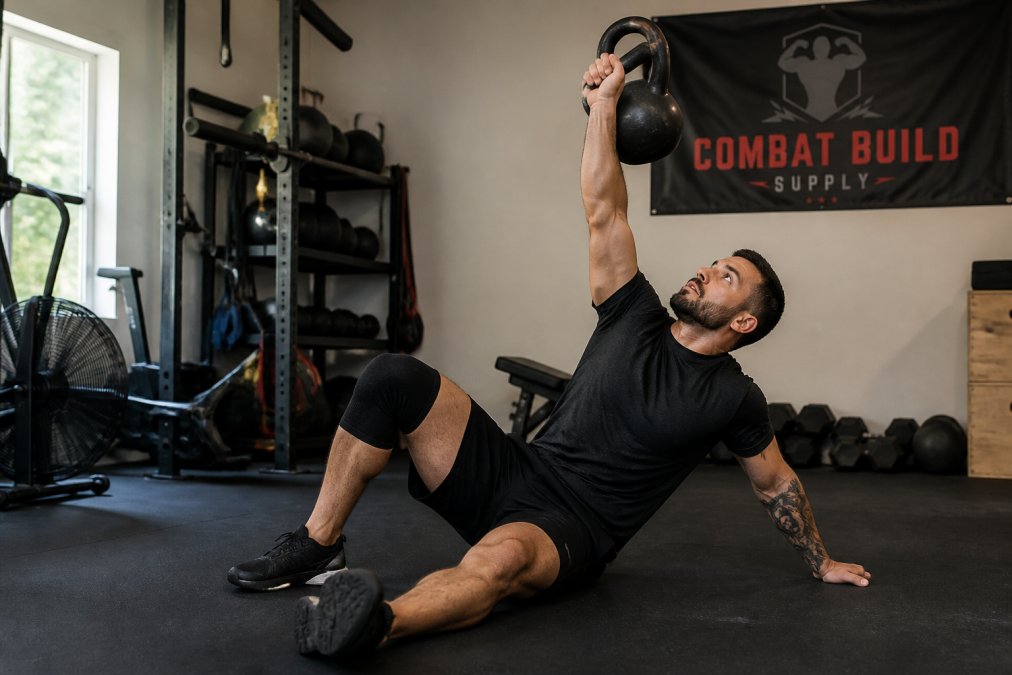
The Turkish get-up builds rotational control and shoulder stability. Start lying on your back with a kettlebell pressed overhead. Roll onto your elbow, post your hand, drive your knee under your hip, and stand while maintaining the overhead position. Reverse back down. One complete rep takes 60-90 seconds.
Rotational torque is everything in striking. The Turkish get-up trains your shoulders to stay stable while your core rotates, the exact demand when defending a clinch or circling your opponent.
Perform 3-5 reps per side, once or twice per week. The Turkish get-up isn't about volume, it's about movement quality and neural adaptation. Heavy loads work better than light ones because the stability demand increases.
Kettlebell Swing for Hip Drive
The kettlebell swing is the foundational power movement. Stand shoulder-width apart, hinge at the hips (not a squat), and let the kettlebell swing back between your legs. Explosively extend your hips to drive it to shoulder height. Your hips do the work, not your arms.
This translates to takedown power and explosive hip extension for jumping knees, kicks, and clinch work.
Perform 15-20 reps per set, 3-4 sets, 2-3 times per week. The swing should feel explosive but controlled. If you're gasping for air after a set, you're doing it right, that's the anaerobic demand you need.
Kettlebell Snatch for Explosive Force
The kettlebell snatch combines hip drive with explosive pulling power. From the hip hinge, explosively extend your hips and pull the kettlebell up. Punch your hand through and catch it overhead in a quarter-squat. Lower and repeat on the same side before switching.
The snatch builds explosive pulling power and shoulder stability under load, translating to collar tie control for grapplers and combination stability for strikers.
Perform 5-8 reps per side, 3-4 sets, 1-2 times per week. The snatch is technically demanding, form breaks down quickly when you're fatigued, so prioritize quality over volume.
Best Kettlebell Weight for Beginners
Choosing the right weight is critical. Too light and you won't create neural adaptation; too heavy and form collapses, increasing injury risk.
Male beginners with training experience start with 35 pounds for bilateral movements; those new to training use 26 pounds. For single-arm work, start 10-15 pounds lighter than your swing weight.
Female fighters typically start with 18-26 pounds for swings and 13-18 pounds for single-arm work. The real test: can you perform 15 consecutive swings with perfect form and explosive hip drive? If form breaks down before rep 15, the weight is too heavy.
Progress by adding 5-10 pounds once you can complete all prescribed reps with perfect form and explosive intent. Most fighters find that they plateau around 53-70 pounds for swings and 35-44 pounds for single-arm work, depending on bodyweight and training age.
Kettlebell Endurance Training for Fighters
Endurance in MMA is about maintaining maximum output when fatigued. Kettlebell training builds this specific conditioning.
High-intensity kettlebell circuits create the exact metabolic demand of fighting. Perform 20 seconds of maximum-effort swings, rest 10 seconds, repeat for 8-10 rounds. This 4-minute block elevates heart rate and lactate threshold while teaching your nervous system to produce force under fatigue.
Major Fitness F22 All-In-One Home Gym →
Density training: complete as many quality reps as possible in a set time. Perform kettlebell swings for 10 minutes, aiming for 200+ reps. Maintain explosive intent throughout to build work capacity.
Perform one high-intensity kettlebell conditioning session per week during fight camp. More than that creates excessive CNS fatigue and interferes with skill work. The goal is to enhance your existing conditioning, not replace sport-specific training.
Sample Kettlebell Workout Plan for MMA
A complete kettlebell program for MMA fighters balances power development, stability work, and conditioning. Here's a practical structure that fits into a fighter's existing training schedule.
Fight Camp Periodization
During fight camp, kettlebell work shifts to power maintenance and conditioning as supplemental training.
Weeks 1-2 of camp: One session per week. Turkish get-ups (3-5 reps per side) followed by kettlebell swings (3-4 sets of 12-15 reps). Keep the weight moderate and focus on explosive intent.
Weeks 3-4: One session per week. Replace steady-state swings with interval work: 20 seconds of maximum-effort swings, 10 seconds rest, 8 rounds. This maintains your anaerobic capacity without adding excessive fatigue.
Week 5 (fight week): One light session only. Turkish get-ups with light weight (3 reps per side) to maintain movement quality. Avoid high-volume or high-intensity work. Your nervous system needs to be fresh for competition.
Recovery Metrics and Monitoring
Track kettlebell swing speed and Turkish get-up stability. A 10-15% drop in swing speed or slow, unstable get-ups indicate CNS fatigue, reduce volume or intensity that week.
Heart rate variability (HRV) is the most reliable recovery metric. If morning HRV is down 10-20%, do light kettlebell work or rest, your body needs recovery more than training stimulus.
| Metric | Normal Range | Caution Zone | Action |
|---|---|---|---|
| Kettlebell swing speed | Baseline | 10-15% slower | Reduce volume |
| Turkish get-up stability | Smooth, controlled | Shaky, slow | Light work or rest |
| Morning HRV | Baseline | 10-20% lower | Reduce intensity |
| Resting heart rate | Normal baseline | 5-10 bpm higher | Recovery day |
Kettlebell Training vs. Barbell for Combat Sports
Both kettlebells and barbells have a place in MMA training, but they demand different things from your nervous system. Understanding the difference helps you use them strategically.
Barbell training excels at building absolute strength. Heavy squats and deadlifts force muscles to adapt to maximum loads, building structural strength. For raw strength foundation, barbells are superior.
Kettlebell training excels at functional strength and stability. The offset load demands constant micro-adjustments, harder core work, greater joint mobility, and more dynamic patterns. For combat athletes, kettlebells produce faster transfer to fighting.
Use both strategically.
Common Mistakes in Kettlebell Training for MMA
Most fighters make the same mistakes when they start kettlebell training. Recognizing them saves months of wasted effort.
Building Your Home Gym for Kettlebell Training
A dedicated home gym removes barriers to consistency. You don't need much space or equipment to train effectively with kettlebells.
Frequently Asked Questions
Why do MMA fighters use kettlebells instead of traditional weights?
Kettlebells develop functional strength through dynamic movement patterns that mirror combat sports mechanics. Unlike barbells, kettlebells demand stabilization during explosive exercises like swings and snatches, building the joint stability and grip strength fighters need. The offset center of mass creates higher metabolic demand, improving conditioning and work capacity in shorter training windows, critical for fighters balancing multiple training modalities.
What weight kettlebell should a beginner fighter start with?
Most beginners start with 16-20 lbs to master movement patterns before adding load. For foundational exercises like swings and Turkish get-ups, this range allows proper hip hinge mechanics and core engagement without compensation. Male fighters typically progress to 26-35 lbs, while female fighters often work in the 13-20 lb range. Focus on movement quality first; adding weight comes after you can perform exercises with clean form and control.
How does kettlebell training improve grappling endurance?
High-intensity kettlebell circuits build anaerobic endurance and work capacity specific to grappling demands. These exercises develop posterior chain strength and grip endurance while creating the metabolic stress that mirrors intense grappling exchanges. Kettlebell endurance work increases your ability to maintain force production during extended clinch work and takedown exchanges.
Can I do kettlebell training at home, or do I need a gym?
Kettlebell training is ideal for home gyms because it requires minimal space and equipment. A single kettlebell or pair of kettlebells, a small training area (roughly 8x8 feet), and basic flooring are all you need. Combat Build Supply offers power racks like the Major Fitness F22 and F35 that pair well with kettlebell work for supplemental strength training, creating a complete home setup for MMA conditioning and strength development.


