

How to Choose Stable Heavy Bag Stands
Table of Contents
- Understanding Heavy Bag Stand Stability Fundamentals
- Heavy Bag Stand Weight Capacity and Your Training Needs
- A-Frame vs. Freestanding Designs: Which Offers Better Stability
- Space Planning and Floor Protection for Your Heavy Bag Stand
- How to Anchor a Heavy Bag Stand for Maximum Security
- Heavy Bag Stand Sandbag Weights and Ballast Systems
- Assembly, Maintenance, and Long-Term Durability
- Frequently Asked Questions
Last Updated: September 1, 2026
Understanding Heavy Bag Stand Stability Fundamentals
A stable heavy bag stand is the foundation of safe, effective training. Without proper stability, your stand wobbles during strikes, shifts under impact, or tips over mid-workout. Stability depends on three core factors: the weight and design of the base, the structural integrity of the vertical support, and how well the stand resists rotational forces when you're striking. A stand that feels solid during light bags may fail when loaded with 100 pounds and real power is applied.
Most home gym setups fail not because the bag is too heavy, but because the stand wasn't designed for the specific forces your training creates. A boxer throwing straight punches generates different stress patterns than a kickboxer throwing kicks. Understanding the mechanical principles behind stability matters before you buy.
Heavy Bag Stand Weight Capacity and Your Training Needs
Weight capacity reflects how the stand was engineered to handle force over time. The relationship between your body weight and your bag weight matters more than most guides acknowledge. A 150-pound person throwing moderate power at an 80-pound bag creates different stress than a 200-pound person throwing heavy at a 100-pound bag.
When evaluating a heavy bag stand weight capacity, match it to your actual training profile. If you weigh 180 pounds and train intensely, don't assume a stand rated for 100 pounds is sufficient just because the bag fits within that limit. The stand must handle not just the bag's static weight, but the dynamic forces your strikes create.
Combat Build Supply's Heavy Bag Stand options range from the budget-friendly White and Grey models at $179.99 and $184.99 respectively, both rated for bags up to 100 pounds, to the Heavy Duty 1 Bag Stand at $509.99, which is built specifically for intense, sustained training. The difference is the thickness of the steel tubing, the size of the base footprint, and the reinforcement at stress points.

A-Frame vs. Freestanding Designs: Which Offers Better Stability
An A-frame design uses two angled legs that form a triangular base, with the bag suspended from the apex. This geometry distributes impact forces down the angled legs and into a wide base, making A-frames naturally resistant to tipping. A-frames excel in small spaces and provide excellent stability for high-intensity training.
Freestanding designs use a vertical post mounted on a square or rectangular base, often with weight plates or sandbags added for stability. Freestanding stands offer 360-degree access around the bag, allowing free movement without frame legs restricting your training.
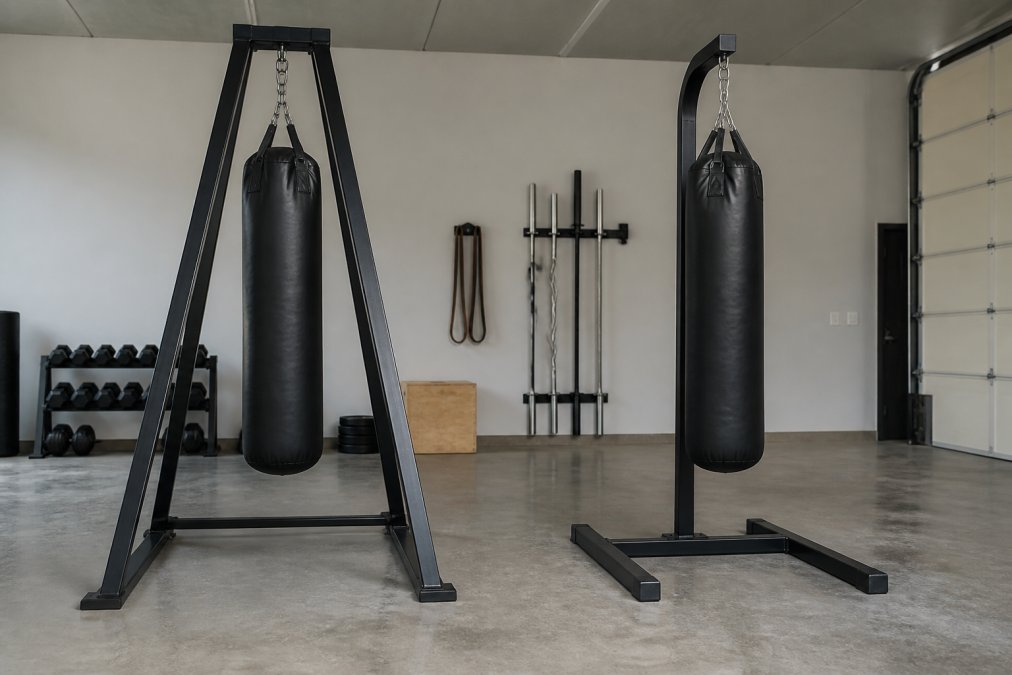
An A-frame with a 48-inch footprint and proper base weight resists tipping better than a freestanding stand with a smaller base. However, a freestanding stand with a large, heavy base, like the Heavy Duty 1 Bag Stand with its 12-inch square base, can achieve comparable stability through mass and low center of gravity.
For apartment dwellers or those with limited floor space, an A-frame design like the Cornerman ($549.99) offers excellent stability in a compact footprint. Its six height adjustments (72 to 102 inches) and 7.5-foot leg extension make it adaptable to different ceiling heights. For garage or basement setups where space is less constrained, a freestanding stand provides more training flexibility.

Space Planning and Floor Protection for Your Heavy Bag Stand
Before you buy a stable heavy bag stand, measure your space precisely. Ceiling height is the first constraint. A heavy bag needs clearance above for your strikes. If you're 6 feet tall and throw overhead kicks, you need at least 10 feet of ceiling height (acsm.org). The Cornerman adjusts from 72 to 102 inches (6 to 8.5 feet), making it suitable for lower ceilings. The Heavy Duty 1 Bag Stand offers two height settings: 7 feet 4 inches and 8 feet 6 inches.
Footprint is the second constraint. An A-frame stand with a 48-inch base requires a 4-foot by 4-foot clear area minimum. Add another 2 feet in front for your training stance, and you need roughly 48 inches wide by 72 inches deep.
Floor protection matters significantly. A heavy bag stand transmits impact forces directly into your floor. Concrete handles this well, but wood subfloors can develop stress cracks or flex excessively over time. Vibration dampening through rubber mats or interlocking foam tiles reduces impact transmission and protects your floor investment.
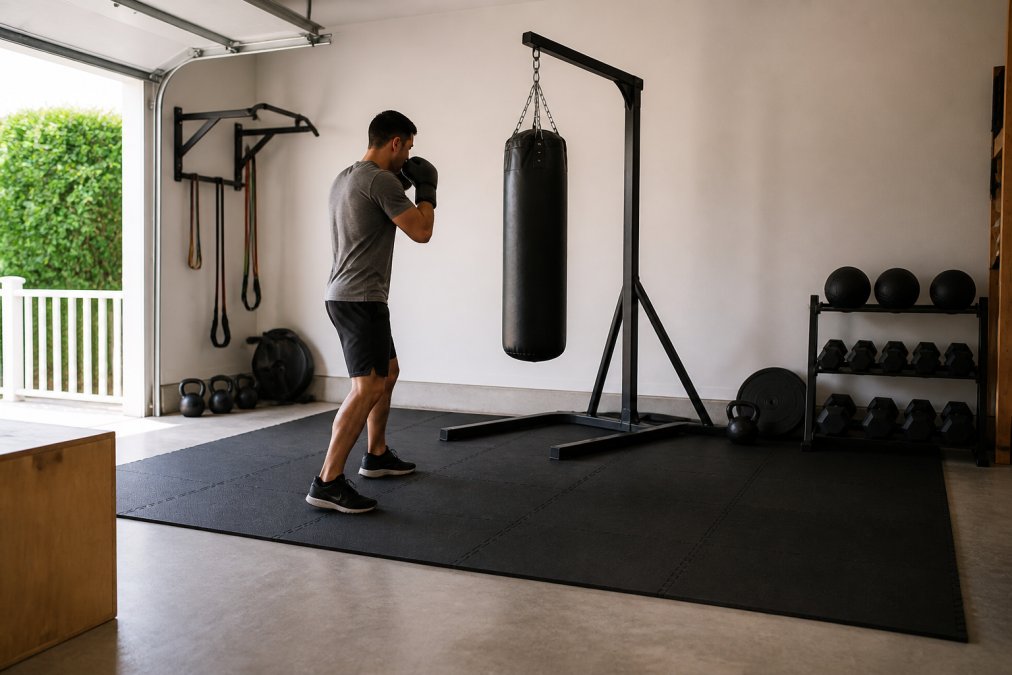
If your space has a wood subfloor, invest in 3/4-inch rubber matting under and around the stand. This costs $100-200 but prevents floor damage worth thousands and reduces noise transmission to rooms below.
A heavy bag swings outward when struck. You need clearance not just directly under the bag, but in the direction it swings. A 100-pound bag can swing 3-4 feet from its resting position (peer-reviewed research). Ensure no walls, equipment, or obstacles are within this radius.
How to Anchor a Heavy Bag Stand for Maximum Security
Anchoring your heavy bag stand transforms it from freestanding to fixed, dramatically improving stability during intense training. The most common method uses floor bolts or lag bolts through the base feet into concrete. If your floor is concrete, drill holes through the base feet, install concrete anchors, and bolt the stand down. This requires a drill, concrete bits, and bolts, a $30 investment that pays dividends in stability.
For wood floors, lag bolts through the base feet into the subfloor work, but you're relying on subfloor strength. A safer approach is to anchor the stand to wall studs using heavy-duty brackets and bolts, distributing forces upward into the building structure.
Cable anchoring is a lighter-duty option. Heavy-duty cables run from the base feet to wall-mounted eye bolts or floor anchors, creating tension that prevents tipping. This method works well for renters who can't drill into concrete or make permanent modifications.
The Cornerman and Heavy Duty 1 Bag Stand both include anchor points designed for this purpose. Before you anchor, verify that your floor can handle it. Concrete is ideal. Wood subfloors require additional reinforcement. If you're in an apartment, check your lease and get landlord approval before drilling.
Heavy Bag Stand Sandbag Weights and Ballast Systems
Sandbags and weight plates are the ballast that keeps a freestanding stand from tipping. The stand's base weight plus any added ballast must be heavy enough to resist the rotational force created by your strikes.
Most freestanding stands use weight pegs or slots in the base frame where you insert sandbags or weight plates. The Heavy Bag Stand models (White at $179.99 and Grey at $184.99) both include weight pegs for this purpose. These pegs typically accommodate sandbags or plates weighing 10-20 pounds each. A typical setup uses 4-6 pegs, adding 40-120 pounds of ballast to the stand's base weight.

Add ballast equal to at least 50% of your bag weight. A 100-pound bag needs 50 pounds of sandbags minimum. For intense training, add more, 100 pounds of ballast provides a safety margin that keeps the stand rock-solid.
Sandbags are cheaper than weight plates but require maintenance. Weight plates are more durable and easier to adjust, but cost more upfront. For a home gym, a mix of both works well. When loading pegs, alternate sides to maintain balance and keep the center of gravity centered.
Assembly, Maintenance, and Long-Term Durability
How you assemble and maintain your heavy bag stand determines whether it remains stable for years or develops problems within months. Most stand failures trace back to assembly shortcuts or neglected maintenance.
Assembly begins with reading the instructions carefully. Most stands require bolting the base frame together, then attaching the vertical support. Tighten all bolts firmly but not excessively; over-tightening can strip threads or crack welds. After assembly, test the stand before hanging a bag. Push on the vertical support from different angles. It should feel rigid with minimal flex. If there's noticeable movement, check that all bolts are tight and that the base is sitting flat on the floor.
Maintenance focuses on three areas: bolts, welds, and moving parts. Check all bolts monthly during heavy training phases. Vibration and impact gradually loosen fasteners. Inspect welds for cracks, especially around the base where stress concentrates. Small cracks grow; have them repaired immediately. Lubricate swivels, chains, and adjustment mechanisms monthly with light machine oil to prevent rust and keep joints moving freely.
Powder coating protects steel from rust. Inspect your stand's finish regularly and touch up small chips or scratches to prevent rust from spreading. The structural integrity of a stable heavy bag stand degrades under repeated impact, this is normal wear. A well-maintained stand lasts 5-10 years or longer. Neglected stands develop problems within 1-2 years.
| Maintenance Task | Frequency | Purpose | Impact on Stability |
|---|---|---|---|
| Bolt inspection and tightening | Monthly during heavy training | Prevent loosening from vibration | Critical, loose bolts cause wobbling |
| Weld inspection | Every 6 months | Detect stress cracks early | Critical, cracks spread rapidly |
| Lubrication of moving parts | Monthly | Prevent rust and stiffness | Moderate, affects smoothness, not stability |
| Powder coating touch-up | As needed (visible damage) | Prevent rust spread | Low, cosmetic unless rust penetrates |
| Base weight verification | Quarterly | Ensure ballast hasn't shifted | Moderate, affects tipping resistance |
Choosing a stable heavy bag stand requires balancing engineering, space, and maintenance. Combat Build Supply's stands, from the budget-conscious White and Grey models to the professional-grade Heavy Duty 1 Bag Stand and the compact Cornerman, each serve different training scenarios. The Cornerman excels in tight spaces with adjustable height and compact footprint. The Heavy Duty 1 Bag Stand delivers the rigidity serious athletes demand. The standard models provide solid performance at accessible price points.
Real stability comes from matching the stand to your space, anchoring it properly, adding appropriate ballast, and maintaining it consistently. A stand assembled well and maintained regularly will outperform a neglected one. Start with Combat Build Supply's options, measure your space carefully, and commit to the assembly and maintenance steps outlined above. You'll have a training platform that supports your goals for years.
=== FAQ ANSWERS (audit these too, same rules) ===
[1] Q: What weight capacity should my heavy bag stand have? A: Your heavy bag stand's weight capacity should exceed your bag's weight by at least 20 percent. If you're using a 70-pound bag, choose a stand rated for 85 pounds or more. Consider your own weight plus the bag weight when selecting a stand. Most quality stands support 100 pounds, which works for most home training setups.
[2] Q: How do I anchor a heavy bag stand to prevent tipping? A: The most effective method is bolting your stand directly to the floor using concrete anchors if you have a concrete floor, or lag bolts into floor joists if you have a wood floor. For temporary setups, add sandbag weights to the base weight pegs, this increases the stand's resistance to movement during intense training. Sandbag weights of 50 to 100 pounds per side provide significant stabilization for freestanding models without permanent installation.
[3] Q: Can I use sandbag weights instead of bolting my heavy bag stand down? A: Yes, sandbag weights work well for temporary or rental situations. Use heavy bag stand sandbag weights rated for your stand's capacity, typically 25 to 50 pounds each. Place them evenly on weight pegs to maintain balance. However, bolting remains the most secure option for serious, high-intensity training. Sandbag weights are ideal if you plan to move your stand or don't want to drill into your floor.
[4] Q: What's the difference between A-frame and freestanding heavy bag stands? A: A-frame stands have a triangular base that provides excellent stability and typically occupy less floor space, making them ideal for small rooms. Freestanding stands have a wider rectangular base and offer 360-degree access to your bag, which many martial arts practitioners prefer for footwork drills. Your choice depends on your space and training style.
Frequently Asked Questions
What weight capacity should my heavy bag stand have?
Your heavy bag stand's weight capacity should exceed your bag's weight by at least 20 percent. If you're using a 70-pound bag, choose a stand rated for 85 pounds or more. Consider your own weight plus the bag weight when selecting a stand. Most quality stands support 100 pounds, which works for most home training setups.
How do I anchor a heavy bag stand to prevent tipping?
The most effective method is bolting your stand directly to the floor using concrete anchors if you have a concrete floor, or lag bolts into floor joists if you have a wood floor. For temporary setups, add sandbag weights to the base weight pegs, this increases the stand's resistance to movement during intense training. Sandbag weights of 50 to 100 pounds per side provide significant stabilization for freestanding models without permanent installation.
Can I use sandbag weights instead of bolting my heavy bag stand down?
Yes, sandbag weights work well for temporary or rental situations. Use heavy bag stand sandbag weights rated for your stand's capacity, typically 25 to 50 pounds each. Place them evenly on weight pegs to maintain balance. However, bolting remains the most secure option for serious, high-intensity training. Sandbag weights are ideal if you plan to move your stand or don't want to drill into your floor.
What's the difference between A-frame and freestanding heavy bag stands?
A-frame stands have a triangular base that provides excellent stability and typically occupy less floor space, making them ideal for small rooms. Freestanding stands have a wider rectangular base and offer 360-degree access to your bag, which many martial arts practitioners prefer for footwork drills. Your choice depends on your space and training style.
This article was written using GrandRanker


