

Combat Sports Gear for Beginners: A 2026 Guide
Table of Contents
- What Combat Sports Gear Do You Actually Need on Day One?
- Essential MMA Gear for Beginners: The Full Checklist
- How to Choose Boxing Gloves for Beginners: Fit, Weight, and Closure
- Protective Gear: Mouthguards, Headgear, and Shin Guards
- The Starter Kit: What to Add as You Progress
- Gear Hygiene, Gym Etiquette, and Smart Buying Tips
- Finding a Boxing Equipment Store Near Me: Online vs. In-Person
- Conclusion: Build Your Kit the Smart Way
- Frequently Asked Questions
Last Updated: September 9, 2026
Walking into a martial arts gym for the first time is intimidating enough without worrying about whether your gear will hold up. Most beginners either overbuy equipment they rarely use or underbuy and end up with gear that falls apart within months. This guide from Combat Build Supply helps you build a practical, durable kit that matches your training goals.
What Combat Sports Gear Do You Actually Need on Day One?
Combat sports gear for beginners starts with a simple principle: buy only what your specific discipline requires for your first few sessions, then expand as your training intensity grows. Boxing demands gloves and hand wraps. Muay Thai adds shin guards and mouthguard. BJJ requires a gi or no-gi rash guard. MMA blends all of these.
The biggest mistake newcomers make is assembling a full kit before knowing which style they will stick with. Most gyms let you borrow loaner gear for the first week or two, so you can test the waters before spending money.
Essential MMA Gear for Beginners: The Full Checklist
For those training mixed disciplines, the essential MMA gear for beginners checklist includes boxing gloves, hand wraps, a mouthguard, shin guards, and appropriate clothing or compression gear. These five items cover striking, sparring, and bag work across most disciplines.
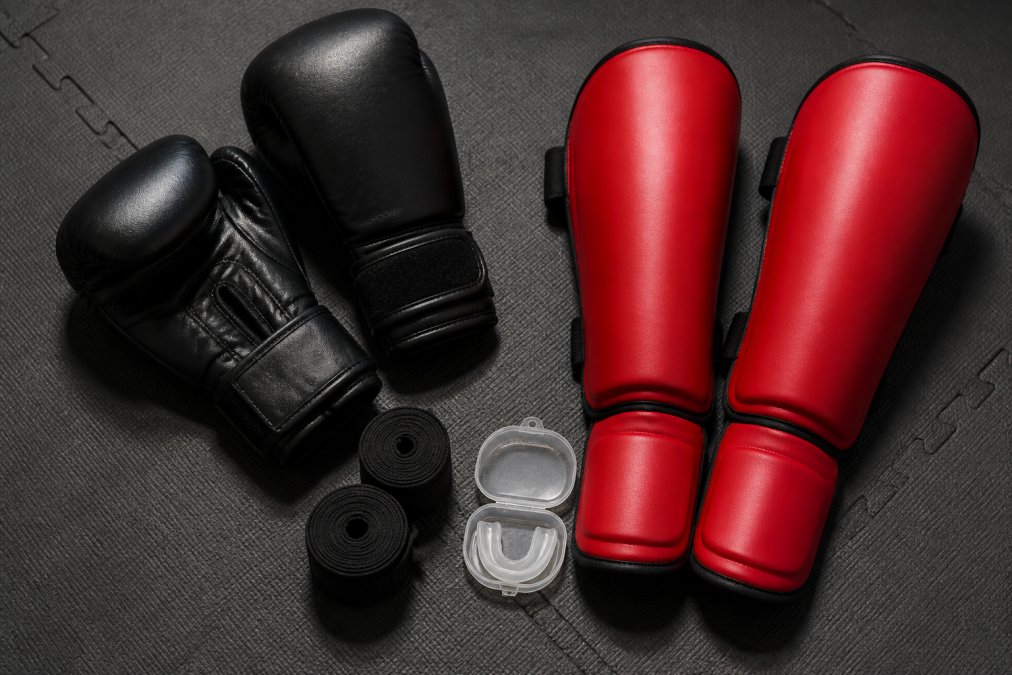
- Boxing gloves: Your primary tool for bag work, pad work, and sparring. Buy quality here.
- Hand wraps: Non-negotiable for wrist support and protecting the small bones in your hands.
- Mouthguard: Required for any sparring. A proper fit beats an expensive brand.
- Shin guards: Essential for Muay Thai and kickboxing; useful for MMA sparring.
- Rash guard or compression gear: Protects your skin on the mat and under gloves.
This list represents the minimum viable training kit. Everything else, from headgear to grappling dummies, can wait until you have established a consistent routine.
How to Choose Boxing Gloves for Beginners: Fit, Weight, and Closure
The most important decision for new strikers is how to choose boxing gloves for beginners, and it comes down to three factors: fit, weight, and closure type. Fit means your hand should slide in snugly with no excess space at the fingertips. Weight is measured in ounces, and the right number depends on what you are doing. Closure comes down to hook and loop versus lace-up.
A common approach for beginners is to start with 14 oz or 16 oz gloves. Heavier gloves provide more padding and protection for both you and your sparring partner. Lighter gloves, around 10 oz to 12 oz, work for bag work but offer less shock absorption. Hook and loop straps are the practical choice for most beginners because they are easy to put on and take off independently; lace-up gloves require help and are best left to competitive fighters.
Protective Gear: Mouthguards, Headgear, and Shin Guards
Protective gear is your primary defense against the most common beginner injuries. Understanding the mechanism of each piece prevents you from buying gear that gives a false sense of security. This section connects each item to the specific injury it prevents and the fitting standards that make it effective.
Mouthguards: Protecting Teeth, Jaw, and Brain
A mouthguard's primary job is to absorb and disperse the energy of an impact to your chin. A blow to the jaw transmits force directly to the temporomandibular joint (TMJ) and up into the base of the skull (peer-reviewed research). A properly fitted mouthguard creates a physical buffer between your upper and lower teeth, preventing them from slamming together and reducing the shock transmitted to the brain. This is why a loose, poorly fitted guard is nearly useless, it can shift on impact, offering no stable barrier.
For beginners, the choice is between a boil-and-bite guard and a custom-fitted guard. A boil-and-bite guard, which you soften in hot water and then bite down on to mold, is a solid starting point. The key is in the fitting process: you must bite down with firm, even pressure for the full time specified by the manufacturer, and then cool it in cold water to set the mold. A common mistake is not biting hard enough, which leaves the guard too thick in the back and encourages gagging.
A custom-fitted guard from a dentist offers a thinner, more precise fit that allows for easier breathing and speaking. The trade-off is cost and time, a dental visit and a higher price tag.
Headgear: Preventing Cuts, Not Concussions
This is the most misunderstood piece of protective gear. Headgear is designed to prevent superficial injuries, lacerations, abrasions, and cauliflower ear, by providing a padded barrier between your skin and an opponent's glove, elbow, or knee. It does not prevent your brain from sloshing inside your skull (the CDC). A punch that snaps your head back causes rotational acceleration of the brain, and no amount of external padding can stop that. Relying on headgear to 'protect your brain' is a dangerous misconception.
When selecting headgear, the critical specifications are coverage and padding density. For Muay Thai, look for a padded forehead bar and full cheek protection, as elbows and knees often target these areas. For boxing, clear peripheral vision is essential. The chin strap must be snug enough to prevent rotation on impact, but not so tight that it restricts blood flow.
Shin Guards: The Difference Between a Check and a Fracture
Shin guards are not just for your opponent's benefit, they protect you from your own offensive techniques. When you throw a kick and your opponent checks it with their shin, the impact point is your lower leg. A quality shin guard absorbs this shock, preventing deep bone bruises and hairline fractures common among beginners who train without protection.
The key specification is the density of the foam padding, not just its thickness. A thick but soft foam will compress on impact and offer little protection. Look for guards with a multi-layer or high-density foam core that maintains its structure under pressure. The fit is equally important: the guard must cover the full length of the shin from just below the knee to the top of the foot, and it must stay in place when you pivot and kick. Try on guards with the ankle strap secured tightly, and perform a few shadow kicks to ensure the guard does not rotate.
| Gear | Injury It Prevents | Fitting Standard | Red Flag to Avoid |
|---|---|---|---|
| Mouthguard | Dental fractures, jaw dislocation, concussion risk | Snug fit with no shifting; allows clear breathing | Guard that pops out when you talk |
| Headgear | Cuts, abrasions, cauliflower ear | Full cheek/forehead coverage; secure chin strap | Headgear that blocks peripheral vision |
| Shin guards | Bone bruises, hairline fractures | Full shin coverage; stays put during kicks | Foam that compresses completely under thumb pressure |
The Starter Kit: What to Add as You Progress
Once you have trained consistently for a few months, you will know which discipline fits you best. That is the moment to invest in higher-quality combat sports gear for beginners upgrades. For strikers, a dedicated heavy bag for home training transforms your ability to practice outside of class. A commercial-grade bag like the Panama 45D Heavy Punching Bag from Sting Sports USA provides the durability needed for daily sessions, with reinforced construction that withstands repeated heavy impact.

Consider adding a double-end bag for timing and accuracy, or an uppercut bag to work on specific combinations. Grapplers should invest in a quality gi that fits properly and can handle the stress of regular rolling. The key is to let your training dictate your purchases.

Gear Hygiene, Gym Etiquette, and Smart Buying Tips
Most gear guides stop at the point of purchase. But the real test of your equipment, and your training partners' safety, comes in the weeks and months after you start using it. This section covers how to keep your gear from becoming a biohazard and how to navigate the unwritten rules of the gym.
The Hygiene Protocol: Protecting Yourself and Your Partners
Your gear is a breeding ground for bacteria and fungi the moment it gets damp. Staph aureus, ringworm, and MRSA are common in combat sports gyms because the environment, warm, moist, and shared, is ideal for their spread (the CDC). A simple, consistent protocol prevents almost all of these issues.
After every single session, follow this sequence:
- Wipe down: Immediately after training, use a disinfectant wipe or spray on all surfaces of your gloves, shin guards, and headgear. Pay special attention to the interior lining, which absorbs the most sweat. Products with quaternary ammonium compounds are effective against ringworm and staph.
- Air out: Do not pack wet gear in a sealed bag. Unzip your gym bag and let everything air dry in a well-ventilated area. If you must pack it, use a mesh bag that allows airflow. A gear dryer or a simple fan speeds up the process and prevents the musty odor that signals bacterial growth.
- Wash fabrics: Hand wraps and rash guards should be washed after every use. Use a mild detergent and air dry them. Do not put hand wraps in a dryer, as the heat can break down the elastic and shorten their lifespan.
- Deodorize weekly: Once a week, do a deeper clean. For gloves, you can use a specialized glove deodorizer or a mixture of white vinegar and water (1:3 ratio) sprayed inside and left to dry. For mouthguards, soak them in a denture cleaner or a 50/50 hydrogen peroxide and water solution for 30 minutes.
The lifespan of your gear is directly tied to this routine. A pair of gloves that is cleaned and air-dried after every session can last 2-3 years. The same gloves left in a damp bag will break down internally within 6 months and become a health hazard long before they fall apart.
Gym Etiquette: The Rules No One Prints
Beyond the obvious, trim your nails, remove your shoes off the mat, there are specific gear-related etiquettes that vary by gym but are common enough to know about.
Ask before you buy. Many gyms have specific requirements that are not obvious from the outside. Some boxing gyms mandate a specific glove color for sparring to avoid confusion. Some BJJ schools require a white gi for the first six months. Some Muay Thai gyms have a policy against black soles on shin guards. Before you spend money, ask your coach two questions: 'Is there any gear requirement or restriction I should know about?' and 'Do you have a list of recommended brands or models?' This one conversation can save you from buying gear you cannot use.
Loaner gear is a privilege. If your gym lets you borrow gloves or shin guards for your first sessions, treat them with respect. Wipe them down after use. Do not assume they are clean because they are 'gym gear.' This is also your first test of hygiene habits, if you cannot be trusted to clean borrowed gear, you will not be trusted with shared mats.
The used gear question. Buying used gear is a smart way to save money, but only for certain items. It is safe to buy used: boxing gloves (if they are not cracked or excessively worn), shin guards, headgear, and gis (if they are not ripped and can be washed). It is never safe to buy used: mouthguards, hand wraps, and groin protectors. These items are impossible to fully sanitize and are molded to an individual's body. A used mouthguard is not just unhygienic, it is a safety hazard because it will not fit your teeth.
Smart Buying: The Cost-Per-Use Framework
Instead of looking at the sticker price, evaluate gear on a cost-per-use basis. The math is simple: quality gear is cheaper over time.
This framework also applies to what you buy first. Prioritize the items that touch your body and protect your joints: gloves, hand wraps, and mouthguard. These are non-negotiable for safety. Items like branded apparel or specialized bags can wait until you have confirmed your training routine is consistent.
Finding a Boxing Equipment Store Near Me: Online vs. In-Person
Many beginners search for a boxing equipment store near me, but the reality is that online retailers often offer better selection and pricing than local shops. Local stores let you try on gloves and feel materials, which is valuable for your first purchase.
The smart approach combines both. Visit a local store to determine your sizing and feel different materials, then shop online for the best price and selection. When you buy from an online retailer like Combat Build Supply, you gain access to the full catalog of professional-grade equipment, free shipping with every order, and a 100% refund on defective or non-functioning items. If you have questions about fitment or ceiling height for a heavy bag setup, their premium customer support team is available via live chat, email, or phone.
Conclusion: Build Your Kit the Smart Way
The mistake most beginners make is treating gear purchases as a one-time shopping spree rather than a gradual investment in their training. Start with the essentials, train consistently, and upgrade only when your routine demands it. Quality combat sports gear protects you from injury and makes every session more productive, whether you are training at a gym or building a dedicated home space.
At Combat Build Supply, we stock commercial-grade punching bags and training equipment designed to handle serious, consistent use. Our secure encrypted payments make ordering simple, and free shipping on every order means the price you see is the price you pay. Sign up now and build a kit that will carry you through years of training.
Frequently Asked Questions
What is the best boxing gear for beginners?
Start with the essentials: a pair of quality 12-16 oz boxing gloves, hand wraps, a mouthguard, and shin guards if you plan to kick. This core set covers most striking classes and lets you train safely. Avoid buying the cheapest option; a mid-range glove with good wrist support and padding density will last longer and protect your hands better as you learn proper form.
How should beginner boxing gloves fit?
Your hand should slide in without feeling cramped, but there should be no excess space at the fingertips. When you make a fist, your fingers should curl naturally, and the glove should feel snug. The hook-and-loop or lace-up closure should hold your wrist firmly. If the glove shifts around when you punch, it is too big and increases injury risk.
What equipment do I need for my first MMA class?
For your first class, bring a mouthguard, hand wraps, and a pair of MMA or grappling gloves. Many gyms let beginners start barefoot, but you will eventually need shin guards and rash guards for sparring. Check with your instructor first because rules vary by gym, and some loan gear for the first few sessions.
Is 27 too old to start Muay Thai?
No. Many people start combat sports in their late 20s and beyond. The key is choosing gear that offers solid impact protection and starting at a pace that matches your fitness level. Focus on technique and conditioning early. Your training intensity will build naturally as your body adapts to the demands of the sport.
How do I know if my combat sports gear is high quality?
Look at the materials and construction. Genuine or high-grade synthetic leather holds up better than cheap vinyl. Check the stitching, especially on gloves and bags, and examine the wrist support. For punching bags, a dense fill and strong hanging straps matter. Quality gear costs more upfront but avoids the cost and hassle of replacing broken equipment after a few months.


