

Choosing Gear for Home Practice: A 2026 Guide
Table of Contents
- Define Your Fitness Goals Before Choosing Gear for Home Practice
- How to Design a Home Training Space That Actually Works
- Essential Home Gym Equipment for Beginners
- Evaluating Home Gym Equipment Quality Before You Buy
- Budget, Resale Value, and Lifecycle When Choosing Gear for Home Practice
- Digital Fitness App Integration and Tracking
- Conclusion
Last Updated: August 19, 2026
Define Your Fitness Goals Before Choosing Gear for Home Practice
Choosing gear for home practice starts with knowing exactly what you're training for. Buy equipment before answering that question and you'll end up with gear that doesn't match your actual routine.
A clear fitness goal narrows your equipment list from dozens of options to a focused set of purchases. It also determines how much space you need, what your floor can handle, and whether you're optimizing for cardiovascular endurance, strength training, mobility, or all three.
Strength Training vs. Cardiovascular Endurance Goals
Strength training applies progressive overload to muscles through resistance. If your goal is building functional strength and muscle, prioritize adjustable dumbbells, a pull-up bar, and resistance bands.
Cardiovascular endurance training focuses on sustained aerobic output. A motorized treadmill or stationary bike covers most of that ground. High-intensity interval training blends both worlds, making a jump rope or dual-purpose bag particularly valuable.
For most people, you need both. Budget and space force a prioritization decision. Start with the category that aligns with your primary goal, then layer in the other.
Martial Arts and Combat Sports Considerations
Combat sports practitioners have a different calculus. Striking power, footwork, cardiovascular conditioning, and functional training all matter simultaneously. A heavy punching bag is not optional equipment; it's the centerpiece of the home setup.
For fighters, the bag is primary. Everything else, the exercise mat, resistance bands, and pull-up bar, supports the bag work.
How to Design a Home Training Space That Actually Works
Designing a home training space means solving the space vs. utility dilemma honestly. Most guides skip this and jump straight to product recommendations. That's backwards.
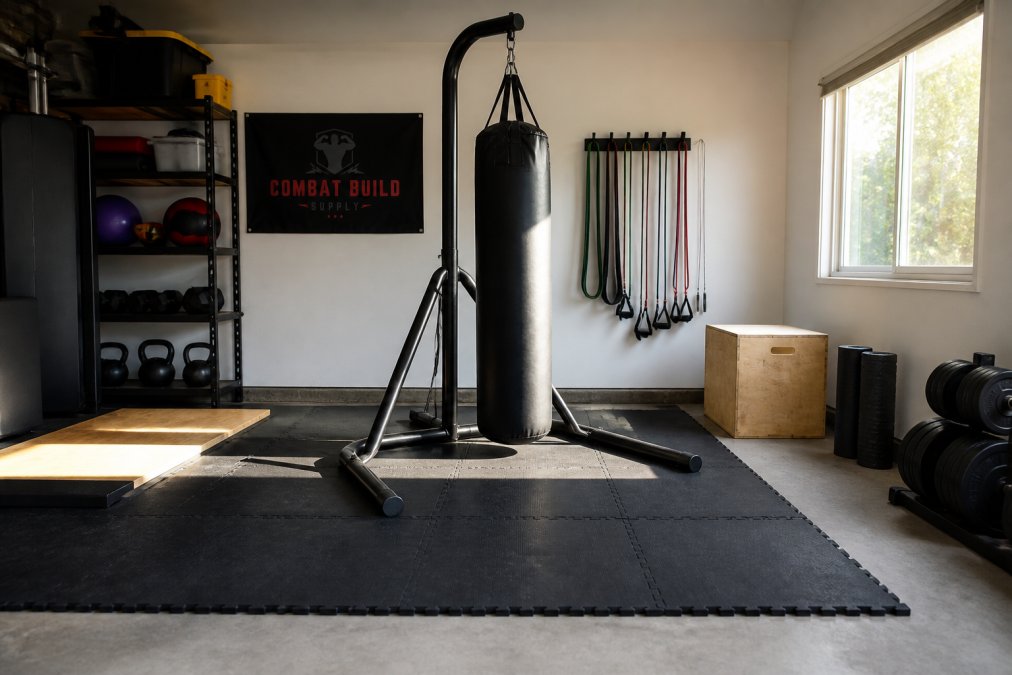
Measuring Footprint and Ceiling Height
Every piece of equipment has a footprint. Before you buy anything, measure your available space and map out where each item will sit. Leave at minimum 3 feet of clearance around any striking equipment for safe movement.
Ceiling height matters more than most buyers realize. A motorized treadmill needs at least 8 feet of clearance for a 6-foot user. A heavy bag requires enough overhead room to swing freely, typically 10 feet minimum from floor to mounting point. A pull-up bar needs clearance above the bar for your full extended body plus a few inches.
Noise, Flooring, and Safety Considerations
Noise and flooring are foundational decisions that affect every other purchase.
A motorized treadmill generates significant vibration. Without proper flooring, that vibration transfers to the structure below, which matters in apartments and multi-story homes. Interlocking rubber floor tiles or a thick exercise mat beneath equipment absorbs impact, protects your subfloor, and provides non-slip stability during training.
For striking work, a freestanding bag stand generates lateral force with every hit. A stand on bare concrete with no matting will walk across the floor. A stand on rubber flooring stays put.
According to the Consumer Product Safety Commission's home gym safety guidance, improperly anchored or installed exercise equipment is a leading cause of home gym injuries. Invest in proper flooring before you invest in the next piece of equipment.
Essential Home Gym Equipment for Beginners
The biggest mistake beginners make is buying too much at once. Start with a short, high-utility list and add equipment as your training demands it.
Cardio Equipment: Treadmills, Bikes, and Jump Ropes
A motorized treadmill is the gold standard for home cardio, but it's also the most expensive and space-consuming option. For beginners with limited space, a stationary bike offers comparable cardiovascular benefits with a smaller footprint.
The most underrated cardio tool for combat sports practitioners is the jump rope. It develops footwork, timing, and cardiovascular conditioning simultaneously. It costs almost nothing, stores in a drawer, and integrates directly into combat training warm-ups and cool-downs.
| Goal | Best Starting Option | Space Required | Budget Range |
|---|---|---|---|
| General cardio fitness | Stationary bike | Small (4 sq ft) | Low-medium |
| Running-specific training | Motorized treadmill | Large (30+ sq ft) | Medium-high |
| Combat sports conditioning | Jump rope | Minimal | Low |
| HIIT and full-body cardio | Jump rope + mat | Minimal | Low |
Strength and Resistance Gear: Dumbbells, Bands, and Pull-Up Bars
Adjustable dumbbells are the single best strength training investment for a home gym. A quality set replaces an entire rack of fixed-weight dumbbells, saves significant floor space, and supports progressive overload as your strength develops.
Resistance bands complement dumbbells well. They add variable resistance to movements, support mobility and warm-up work, and weigh almost nothing for storage. Many martial artists use them for rotational strength and shoulder stability work.
A pull-up bar develops upper body pulling strength that most home gym setups neglect. For combat sports practitioners, grip strength and lat development translate directly into clinch and grappling performance.
Punching Bags and Stands for Combat Training
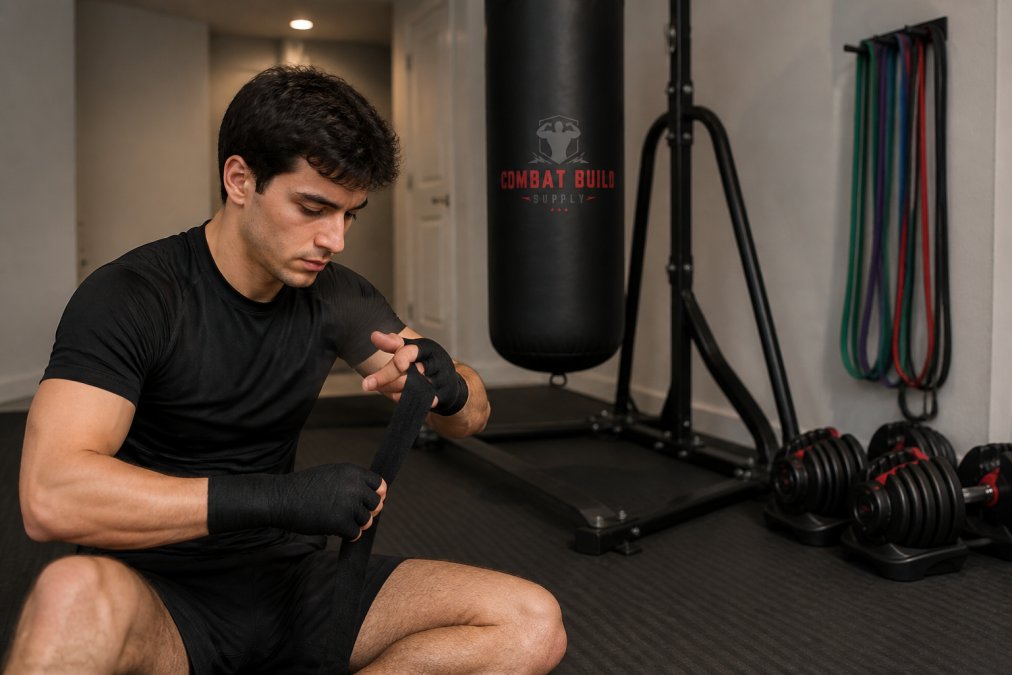
For anyone training striking, a punching bag is the non-negotiable centerpiece of essential home gym equipment. The question isn't whether to buy one; it's which mounting solution fits your space.
Wall-mounted bags like the Uppercut Fixed Wall Punching Bag from Combat Build Supply solve the ceiling height problem entirely. At $375.00, it mounts directly to a wall stud, keeps the bag stable during uppercut and hook combinations, and preserves floor space that a freestanding stand would occupy.
For practitioners who want to work multiple bag types, the Heavy Duty 1 Bag Stand at $509.99 offers adjustable height and stability to handle serious training loads. The Heavy Duty 2 Bag Stand at $574.99 adds a second station without doubling your footprint.


Speed bag work develops hand-eye coordination and rhythm. The Fold Away Speed Bag Platform at $143.99 folds flat against the wall when not in use, which is ideal for smaller training areas.

Evaluating Home Gym Equipment Quality Before You Buy
The question every serious buyer eventually asks is simple: how do I know this will hold up? Evaluating home gym equipment quality requires looking past marketing language and into actual specifications.
Build Quality, Weight Capacity, and Warranty
Weight capacity is the most honest indicator of build quality on striking equipment. A bag stand rated for a heavier load is built with thicker steel, better welds, and more stable geometry. That translates directly into reduced wobble during training and longer equipment life.
Check the gauge of steel on any stand or rack. Heavier gauge means more material and more stability. Look for welded joints over bolted connections at high-stress points. For treadmills and bikes, motor quality and frame warranty length matter most.
According to the American Council on Exercise's equipment selection guidelines, buyers should prioritize frame warranties of at least five years on major cardio equipment and lifetime warranties on strength equipment frames as a baseline quality indicator.
A 100% refund policy for defective items, like the guarantee Combat Build Supply offers, removes the risk from the purchase decision entirely.
Assembly Difficulty and Long-Term Maintenance
Assembly difficulty is a legitimate factor that most buying guides ignore. A bag stand that takes four hours to assemble with unclear instructions sets the wrong tone for your training setup.
Before purchasing, check whether the manufacturer provides step-by-step assembly instructions with hardware diagrams. For freestanding stands, verify that all hardware is included and that replacement parts are available if something strips or breaks.
Long-term maintenance on striking equipment is minimal but real. Bag stands benefit from periodic bolt tightening, especially in the first few months. Speed bag platforms need regular swivel replacement. Treadmills require belt lubrication per manufacturer schedules.
Budget, Resale Value, and Lifecycle When Choosing Gear for Home Practice
Budget decisions for home gym equipment involve more than the purchase price. Resale value and equipment lifecycle are variables that most buyers ignore until they're trying to sell a treadmill they no longer use.
Choosing gear for home practice with resale value in mind means prioritizing recognized build quality and durability over budget-friendly options that won't hold their value. A well-maintained heavy bag stand from a reputable manufacturer retains meaningful resale value. Generic equipment from unknown brands typically does not.
The lifecycle question is straightforward: how long will this piece of equipment remain useful as your training evolves? Adjustable dumbbells have essentially unlimited lifecycle. A fixed-weight machine has a ceiling. Resistance bands wear out and need replacement every one to two years under heavy use. A quality pull-up bar lasts indefinitely.
For beginners, the budget-friendly path is to prioritize high-lifecycle, low-maintenance equipment first. Adjustable dumbbells, resistance bands, a jump rope, and a pull-up bar cover most training needs at a fraction of the cost of a full cardio and strength setup.
For combat sports practitioners, a quality bag stand is a long-term investment that holds its value and supports daily high-intensity training. Skimping on that purchase often leads to a replacement purchase within 18 months.
As documented in the National Strength and Conditioning Association's home training recommendations, the most effective home gym setups are those built incrementally around the practitioner's primary training goals, rather than assembled all at once based on generic lists.
Digital Fitness App Integration and Tracking
Digital fitness app integration is increasingly relevant for serious practitioners.
Many modern cardio machines support Bluetooth connectivity to fitness tracker platforms. This integration lets you track cardiovascular endurance progress over time, set training zones, and monitor recovery metrics. For athletes managing training load alongside a demanding schedule, that data is genuinely useful.
For combat sports practitioners, fitness tracker data serves a different purpose. Heart rate monitoring during bag work provides objective intensity data that subjective effort perception often misses. You can track whether a three-round bag session is actually hitting the cardiovascular zones you're targeting.
Before purchasing any major cardio equipment, verify which apps it supports natively. Compatibility with widely-used platforms means you're not locked into a proprietary ecosystem that may not survive the equipment's useful life.
For strength training and striking work, app integration is less critical. Progressive overload tracking for adjustable dumbbells and resistance band work is straightforward with any basic fitness logging app. What matters more is consistency, which comes from having a setup that's easy to access, safe to use, and matched to your actual training goals.
| Equipment Type | Lifecycle | Resale Value | App Integration | Best For |
|---|---|---|---|---|
| Adjustable dumbbells | Very long | High | Limited | Strength training |
| Motorized treadmill | Medium | Medium | High | Cardio endurance |
| Heavy bag stand | Long | Medium-high | None | Combat sports |
| Resistance bands | Short (1-2 yrs) | Low | None | Mobility, warm-up |
| Jump rope | Long | Low | Low | Combat conditioning |
| Pull-up bar | Very long | Low | None | Upper body strength |
Building a home training space that actually supports your goals requires more than a list of equipment. The space vs. utility dilemma, the noise and flooring decisions, the build quality questions, and the budget trade-offs all need to be worked through before the first purchase. Combat Build Supply carries professional-grade striking equipment, bag stands, and training aids designed for practitioners who train seriously, backed by free shipping, secure payments, and a 100% refund guarantee on defective items. Get started with Combat Build Supply and build a home setup that performs as hard as you do.
Frequently Asked Questions
How do I choose home gym equipment that fits my space?
Start by measuring your available floor area and ceiling height before purchasing anything. A heavy bag stand, for example, needs at least 10 feet of vertical clearance and enough surrounding space for full movement. Prioritize equipment with a compact footprint or space-saving design, such as foldable speed bag platforms or wall-mounted bags. Sketch a basic home gym layout and assign zones for cardio, strength training, and martial arts work before ordering a single piece of gear.
What are the essential pieces of gear for a versatile home practice?
For a well-rounded setup, focus on five categories: a cardio option (jump rope or motorized treadmill), resistance tools (adjustable dumbbells or resistance bands), a pull-up bar for bodyweight work, an exercise mat for mobility and floor work, and a heavy bag or speed bag platform for combat training. This combination covers cardiovascular endurance, strength training, functional training, and skill-specific martial arts practice without requiring a large dedicated room.
How do I balance quality and budget when choosing home training gear?
Set a firm budget before browsing, then allocate the largest share to the equipment you will use most frequently and at the highest intensity. High-impact items like heavy bag stands and punching bags take the most punishment, so skimping on build quality there leads to early replacement costs. Budget-friendly options work well for accessories like resistance bands and exercise mats. Also factor in resale value: well-built gear from reputable brands holds its value far better than discount alternatives.
What safety considerations should I keep in mind for home practice gear?
Check the weight capacity rating on every piece of equipment before purchase, especially for bag stands and pull-up bars. Ensure your flooring can absorb impact; rubber or foam mats reduce both injury risk and noise transfer to lower floors. For ceiling-mounted bags, verify that the mounting point can support dynamic load, not just static weight. Non-slip pedals on cardio machines and stability features on free-standing stands are non-negotiable for high-intensity interval training and combat-style workouts.
Does home gym equipment integrate with fitness tracking apps?
Many modern cardio machines, including motorized treadmills and stationary bikes, connect via Bluetooth to fitness tracker apps and platforms. Smart features let you log sessions, monitor cardiovascular endurance progress, and program interval training automatically. Even non-connected equipment like heavy bags can be paired with wearable fitness trackers to capture heart rate and calorie data. When evaluating home gym equipment quality, check whether the unit supports app connectivity if tracking and progressive overload logging matter to your training plan.
How hard is it to assemble home gym equipment, and what maintenance does it need?
Assembly difficulty varies widely. Freestanding bag stands and adjustable dumbbell sets typically require 30 to 60 minutes with basic hand tools. Larger items like dual-station stands or motorized treadmills can take two to three hours and benefit from a second person. For maintenance, wipe down upholstery and metal frames after each session, check bolts monthly for tightening, and lubricate treadmill belts every three months. Choosing equipment with clear assembly instructions and accessible replacement parts reduces long-term hassle significantly.
This article was written using GrandRanker


