

Best Home Gym Equipment for Athletes: 2026 Guide
Table of Contents
- Quick Comparison: Best Home Gym Equipment for Athletes
- Essential Strength Training Gear for Athletes
- How to Design a Home Gym for Martial Arts
- Durable Gym Equipment for High-Intensity Interval Training
- Progressive Overload Tracking and Long-Term Durability
- How to Choose the Best Home Gym Equipment for Your Goals
- Conclusion
- Frequently Asked Questions
Last Updated: September 13, 2026
Quick Comparison: Best Home Gym Equipment for Athletes
Building a home gym that supports athletic performance comes down to matching equipment to your discipline, not chasing the longest feature list. At Combat Build Supply, we work with martial artists, combat athletes, and lifters who need gear that survives daily punishment. The best home gym equipment for athletes prioritizes structural rigidity, adjustable resistance, and a footprint that fits real training spaces.
Most buyers get this wrong by buying a rack first and figuring out the rest later. The smarter order: identify your primary movement patterns, then buy equipment that covers the most of them with the fewest compromises.
| Equipment | Price | Primary Use | Space Needed | Best For |
|---|---|---|---|---|
| Major Fitness F22 Power Rack | $929.99 | Squats, presses, cable work | 64.2" x 58.2" | All-in-one strength setups |
| Hydra Collegiate Power Rack | $1,199.99 | Heavy compound lifts | 3" x 3" uprights | High-capacity training |
| Body Solid GDCC250B Cable Crossover | $2,770.00 | Cable isolation, functional work | 164" x 29" | Full cable coverage |
| Powerline PFT50 Functional Trainer | $995.00 | Space-conscious cable work | 55" x 61" | Compact cable training |
| Troy Urethane Dumbbell Set | $3,663.00 | Free weight work | Rack: 98" x 25" | Complete dumbbell range |
| Trigon 30" Plyometric Box | $190.19 | Explosive power | 18" square top | Plyometric circuits |
| TKO Dual Leg Press/Calf Raise | $3,680.00 | Lower body strength | 76" x 45" | Leg development |
| NordicTrack X24 Treadmill | $3,299.00 | Cardio conditioning | 22" x 60" belt | Endurance training |
| 45-Degree Hyper | $499.00 | Posterior chain | 31" x 58" | Lower back and glutes |
| Nordic Ham Curl | $449.00 | Hamstring eccentric work | 20" x 49" | Injury prevention |
Essential Strength Training Gear for Athletes
The non-negotiable foundation for athletic strength training is a power rack paired with adjustable resistance tools.

A power rack lets you squat, press, and pull safely without a spotter, which matters when you train alone at home (osha.gov). The Major Fitness F22 All-In-One Home Gym Power Rack weighs 277.8 lbs with a wide base that stays planted under heavy loads. Its dual independent pulley system offers a 2:1 cable ratio across 17 adjustable positions, covering cable flys, lat pulldowns, and low rows from one station. The full attachment package, sandwich J-hooks, safety arms, dip bars, and a landmine, lets you run a complete program from day one.
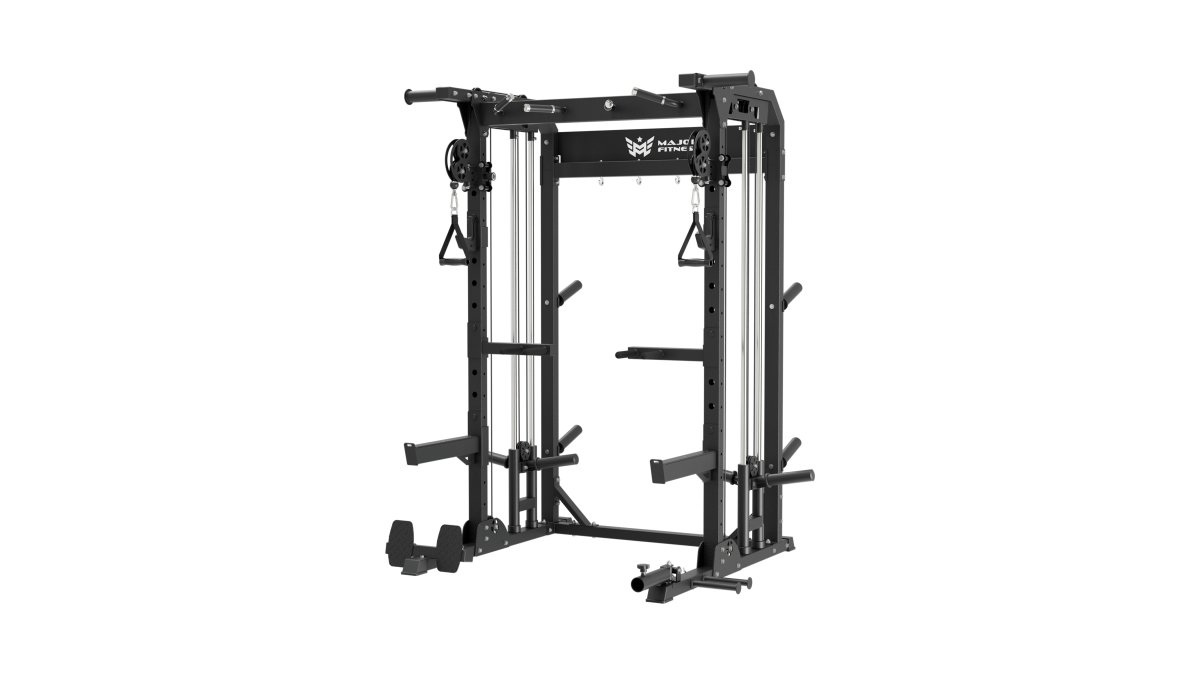
Power Racks: The Foundation of a Serious Home Setup
The Hydra Collegiate Power Rack handles 1,000 pounds and uses true 3" x 3" uprights, so you can mix and match attachments from other manufacturers without being locked into one brand. It arrives prebuilt, saving the assembly headache most racks come with.

Dumbbells and Cable Systems for Full-Body Conditioning
For full-body conditioning, the Troy Barbell Urethane Dumbbell Set with Rack covers 5 to 100 pounds in 5-pound increments. The 12-sided anti-roll design keeps weights in place, the urethane coating protects floors, and the matching rack uses angled tiers and plastic saddles to cut noise and wear.
If cable work is central to your program, the Body Solid GDCC250B Cable Crossover Machine delivers 19 height settings and 180 degrees of frictionless cable movement. It is a serious footprint commitment at 164 inches long, but it replaces several single-purpose machines.
How to Design a Home Gym for Martial Arts
Designing a home gym for martial arts starts with open floor space, not equipment density. You need room to move, shadowbox, and drill without tripping over racks.
The most common mistake is filling every corner with machines. Martial artists need a clear training area for footwork, bag work, and bodyweight circuits. Push racks and cable stations to the walls, and keep the center of the room open.
Space Planning and Footprint Considerations
Map your room before you buy anything. Mark out where each piece will live and walk the path between them, if you cannot move freely from rack to bag to mat, the layout will frustrate you daily.
For smaller spaces, the Powerline PFT50 Single Stack Functional Trainer packs a 210-pound weight stack and 180-degree swivel pulleys into a 55" x 61" footprint. The no-cable-change design keeps your heart rate up between exercises. It also includes a straight chin-up bar for pull-ups and leg raises.
Durable Gym Equipment for High-Intensity Interval Training
Durable gym equipment for high-intensity interval training needs to survive repeated impact and fast transitions. Cheap gear fails first at three predictable points: welded joints on plyo boxes, deck bushings on treadmills, and cable sheaves on functional trainers. If you train intervals three or more days a week, that is where your money either holds or walks out the door.
What Actually Breaks Under Interval Training
Impact concentrates at connection points. On a plyo box, the welds where the legs meet the frame take every landing. On a treadmill, the deck and motor bushings absorb thousands of foot strikes per session. On a cable machine, the sheave (the grooved wheel the cable rides in) wears fastest because it spins under load every rep. When evaluating gear for HIIT, look at how those three points are built, not the marketing copy.
Plyometric Boxes: Steel Frame vs. Wood
The Trigon Sports 30" Plyometric Box uses a heavy-duty powder-coated steel frame with an 18-inch laminated wood top and a non-slip synthetic surface, critical when landing box jumps at speed. The steel frame resists the lateral flex that eventually cracks all-wood boxes, and the laminated top spreads landing force across the platform instead of concentrating it at the edges.

A practical trade-off: steel-frame boxes are heavier and harder to reposition mid-circuit than foam or wood boxes, but they hold up far longer under daily jump volume. If you rotate between 20", 24", and 30" heights, buy the 30" as your primary landing platform rather than stacking cheaper boxes.
Treadmills Built for Sprint Intervals
For cardio intervals, the NordicTrack X24 Treadmill runs from a 40% incline to a -6% decline with a 0-12 MPH speed range (nordictrack.com). The SpringFlex cushioned deck absorbs impact, which reduces joint stress during repeated sprint intervals. The 24-inch touchscreen pairs with iFIT for trainer-led sessions.
What separates an interval-worthy treadmill from a walking treadmill is the motor's continuous duty rating and the deck's ability to handle repeated speed changes without lag. A treadmill that hesitates when you jump from a jog to an all-out sprint will break your interval timing and, eventually, its own belt. Look for a continuous-duty motor rather than peak output, and check that belt width supports your stride at speed, 22 inches is a common floor for sprint work.
Rowers, Bikes, and Air Trainers
For low-impact conditioning that still spikes heart rate, a rower or air bike belongs in the conversation. These machines have fewer impact points than a treadmill but more moving parts, chains, dampers, and fan bearings, that need periodic attention. Oil a rower's chain on the manufacturer's schedule, and check that an air bike's fan bearings spin freely with no grinding. If you hear a rattle under load, stop and inspect before the next session.
Matching HIIT Gear to Your Discipline
Interval training looks different depending on your sport, and the equipment should follow. A combat athlete needs a plyo box, a heavy bag, and open floor space for footwork circuits. An endurance runner needs a treadmill or air bike plus a plyo box for power maintenance. A team-sport athlete benefits from a functional trainer for rotational and unilateral work layered on a conditioning machine. Buy for the intervals you actually run, not the ones you imagine running.
Progressive Overload Tracking and Long-Term Durability
Progressive overload tracking is how you confirm that your equipment and programming are actually working. Without a record, you are guessing. Most home gym guides stop at the purchase and never explain how to measure whether the gear produces results or how to keep it alive, this section covers both, because they are the same problem: consistency over time.
What to Track and Why
Log every session: weight, sets, reps, and how the movement felt. A notebook or spreadsheet both work, the point is a baseline you can beat next week. Athletes who track consistently add load more deliberately than those who train by feel.
Beyond the basics, track these four metrics because they tell you whether your home setup is actually supporting progress:
- Estimated one-rep max (e1RM). Most lifters use a standard formula (weight × reps × 0.0333 + weight) to estimate a true max from a submaximal set. Watching e1RM trend up over four to six weeks is a cleaner signal than any single session.
- Volume load. Sets × reps × weight. Two athletes can lift the same top set and have very different total work. Volume load catches stagnation that top-set numbers hide.
- Reps at a fixed load. If you can do 8 reps at a weight that used to cap you at 5, you got stronger even if the bar never got heavier.
- Session RPE. Rate how hard the session felt on a 1-10 scale. Rising RPE at the same load is an early warning that recovery is slipping before performance drops.
Tools That Make Tracking Stick
A paper logbook is the cheapest option and never runs out of battery. A spreadsheet adds automatic e1RM and volume calculations. Dedicated apps, many are free or low-cost, handle the math and chart trends for you. The best system is the one you will actually open before every session. If you train alone at home, a wall-mounted whiteboard next to your rack removes the friction of finding your log mid-workout.
Long-Term Durability: What to Inspect and When
Long-term durability comes down to three things: frame gauge, coating quality, and moving-part maintenance. The TKO Dual Leg Press/Calf Raise Machine uses heavy gauge steel tubing with a graphite finish that resists moisture and scratches, plus self-lubricating pulleys that need almost no upkeep. The 45-Degree Hyper uses 2" x 2" 11-gauge steel and supports up to 500 pounds combined user weight and load.
Gauge determines how the frame behaves under load over thousands of reps: a lower gauge number means thicker metal, and 11-gauge resists the flex that eventually fatigues welds. Coating matters because moisture and sweat cause rust at scratches, which spreads under paint where you cannot see it. Moving parts matter because a frayed cable or seized pulley fails suddenly, often mid-rep.
Build a simple inspection routine into your training calendar:
- Monthly: Check cable sheaves for flat spots, fraying, or exposed core. Run a rag along the cable, if it snags, replace the cable before it snaps.
- Monthly: Inspect rack J-hooks and safety arms for cracks at the weld. Hairline cracks grow fast under load.
- Quarterly: Tighten every bolt on racks, benches, and machines to the manufacturer's torque spec. Vibration loosens hardware over time.
- Quarterly: Wipe down upholstery and steel with a mild cleaner. Sweat is acidic and degrades both.
- Annually: Inspect welds on high-impact items, plyo boxes, hyper frames, and leg press pivot points, for cracks or rust bleed.
When to Repair vs. Replace
A frayed cable, cracked weld, or seized bearing is a replace-now item, not watch-and-see. Upholstery tears, surface rust, and loose hardware are usually repair items. The rule: if a failure could drop a loaded bar or send you off a platform, replace it immediately; if it is cosmetic or slow-developing, schedule the fix and keep training.
How to Choose the Best Home Gym Equipment for Your Goals
Match equipment to your primary discipline first, then fill gaps. A powerlifter and a martial artist need very different setups.
Start with these questions:
- What are your three most important movement patterns?
- How much floor space can you dedicate permanently?
- What is your realistic weekly training frequency?
- Do you train alone or with a partner?
For martial artists, prioritize open floor space, a functional trainer or cable system, and posterior chain tools. The Nordic Ham Curl targets eccentric hamstring strength for injury prevention and sprint performance, has no moving parts, and supports users up to 1,000 pounds.
For strength-focused athletes, a rack plus dumbbells plus a leg press covers nearly everything. For hybrid athletes, a functional trainer plus a treadmill plus a plyo box covers conditioning and power.
Conclusion
Building a home gym that supports real athletic performance takes planning, not impulse buying. Combat Build Supply offers free shipping on every order, a 100% refund for defective or non-functioning items, and premium support via live chat, email, or phone. Our team can answer questions about ceiling height, stand stability, and whether a piece fits your training style before you commit.
Get started with Combat Build Supply and build a training space that keeps every session on track.
Frequently Asked Questions
What is the best all-in-one home gym equipment for athletes?
An all-in-one power rack with a cable system covers the most ground for athletes. The Major Fitness F22 at $929.99 includes a dual independent pulley system, 14 adjustable upright positions, and a full attachment package (J-hooks, safety arms, dip bars, landmine), so you can squat, press, and do cable work from one station. Pair it with the 45-Degree Hyper ($499) for posterior chain work.
How much space do you need for a professional-grade home gym?
Plan for at least 10 by 10 feet for a power rack plus lifting area. The Major Fitness F22 measures 64.2 inches wide, 58.2 inches deep, and 82.5 inches tall, so it fits in most garage or basement setups. If space is tight, the Body Solid Powerline PFT50 functional trainer ($995) has a smaller footprint at 55 by 61 inches and still supports full-body cable work.
Is it better to buy all-in-one machines or individual free weights for athletes?
It depends on your training style. All-in-one machines like the Body Solid GDCC250B cable crossover ($2,770) give you 19 height adjustments and 180-degree cable movement for isolation and sport-specific patterns. Free weights like the Troy Barbell Urethane Dumbbell Set ($3,663) build grip strength and stabilizer muscles that machines cannot replicate. Most athletes benefit from a mix: a rack for compound movements and dumbbells for accessory work.
What equipment is essential for high-intensity interval training at home?
HIIT demands gear that holds up under repeated impact. A plyometric box like the Trigon Sports 30-inch PLYO30 ($190.19) handles box jumps and depth drills with a non-slip surface and powder-coated steel frame. A treadmill such as the NordicTrack X24 ($3,299) covers sprint intervals with a 0-12 MPH range and 40% incline. Add a functional trainer for resistance-based circuits between cardio bursts.
How do you choose the best home gym equipment for martial arts and strength?
Start with your primary discipline. Fighters need cable systems for rotational power (the PFT50 at $995 offers 180-degree swivel pulleys), a heavy bag anchor point, and open floor space for shadow work. Strength athletes prioritize a power rack and barbell. The Hydra Collegiate Power Rack ($1,199.99) has a 1,000-pound capacity and true 3 by 3 inch uprights that accept attachments from multiple brands, so you can expand as your training evolves.


