

All in One Home Gym vs Individual Equipment: Which Fits
Last Updated: November 3, 2026
Quick Summary
The all in one home gym vs individual equipment decision comes down to floor space, training variety, and long-term spend, and neither option wins universally. An all-in-one machine concentrates cost upfront in one footprint, while individual equipment offers more exercise variety but keeps growing your budget.
- Measure footprint, operating clearance, ceiling height, access path, and floor protection before buying anything.
- The Major Fitness F22 all-in-one power rack costs $929.99 and ships with J-hooks, safety arms, dip bars, and a landmine.
- The B52 Smith machine measures 78.7 inches wide and 66.9 inches deep, so it needs a dedicated wall.
- Beginners should start with a barbell, a bench, and a way to load weight safely.
- An all-in-one machine caps at its weight stack or pulley capacity, while individual equipment grows with you.
Table of Contents
- All in One Home Gym vs Individual Equipment: The Core Trade-Off
- Cost of Ownership: Upfront Price and What You Keep Paying
- Space, Footprint, and Ceiling Height in Practice
- Exercise Variety, Guided Movement, and Progression Limits
- The Best All-in-One Gym Machine for Home Setups That Need One Station
- All-in-One Home Gym for Small Spaces: What Actually Fits
- Home Gym Equipment for Beginners: Where to Start Without Overbuying
- Which Setup Fits Your Training Goals
- Frequently Asked Questions
All in One Home Gym vs Individual Equipment: The Core Trade-Off
The global home fitness equipment market is projected to grow from $12.88 billion in 2025 to $22.99 billion by 2034, according to Fortune Business Insights' market analysis. That growth reflects a genuine dilemma for anyone building a home gym: buy one machine that does everything, or assemble a collection of individual pieces.
Here's the honest answer. An all in one home gym vs individual equipment decision comes down to three variables: how much floor space you have, how varied your training is, and how much you want to spend over time. Neither option wins universally.
Below, we break down the real trade-offs, including the ones most buying guides skip: long-term cost, progression limits, and what actually fits in a spare bedroom.
What Counts as an All-in-One Machine
An all-in-one home gym is a single unit that combines several training stations into one footprint. Common formats include power racks with integrated cable systems, Smith machines with pulley attachments, and functional trainers with guided bar paths.
Garage Gym Reviews' home gym overview groups these into four broad categories: power racks, cable machines, all-in-one gyms, and smart gyms. The defining feature is consolidation. One frame handles squats, presses, rows, cable flys, and lat pulldowns.
What Counts as Individual Equipment
Individual equipment means separate components: a barbell, a set of dumbbells, an adjustable bench, a squat rack, and plates. Each piece does one job well. You buy them over time and arrange them as your space allows.
The trade-off is obvious. Individual equipment offers more exercise variety and lets you upgrade piece by piece. It also demands more storage, more floor space, and more decisions.
Cost of Ownership: Upfront Price and What You Keep Paying
Entry price is where all-in-one machines look expensive and individual equipment looks cheap. That comparison is misleading because it stops at the sticker and ignores everything after checkout.
A single all-in-one unit bundles what would otherwise be several separate purchases.
Delivery and installation are often overlooked line items. Large racks and Smith machines are heavy, so plan for freight delivery and consider how the unit will reach your room.
Maintenance and replacement parts can favor individual equipment in one specific way: when a single component wears, you may replace that piece rather than servicing a whole unit.
The accessory trap is where individual setups quietly win the long game and all-in-one machines quietly lose it.
| Factor | All-in-One Machine | Individual Equipment |
|---|---|---|
| Upfront cost | Higher, single purchase | Lower per piece, adds up |
| Delivery and installation | Freight plus assembly, one event | Smaller shipments, repeated |
| Maintenance | Low, but proprietary parts | Low, standard replacement parts |
| Ongoing spending | Minimal after setup | Tends to keep growing |
| Replacement cost | One unit to service | Replace single pieces |
| Resale | Harder to sell locally | Easier to sell piece by piece |
| Space efficiency | High | Low to moderate |
Space, Footprint, and Ceiling Height in Practice
Floor space decides this argument more often than budget does.
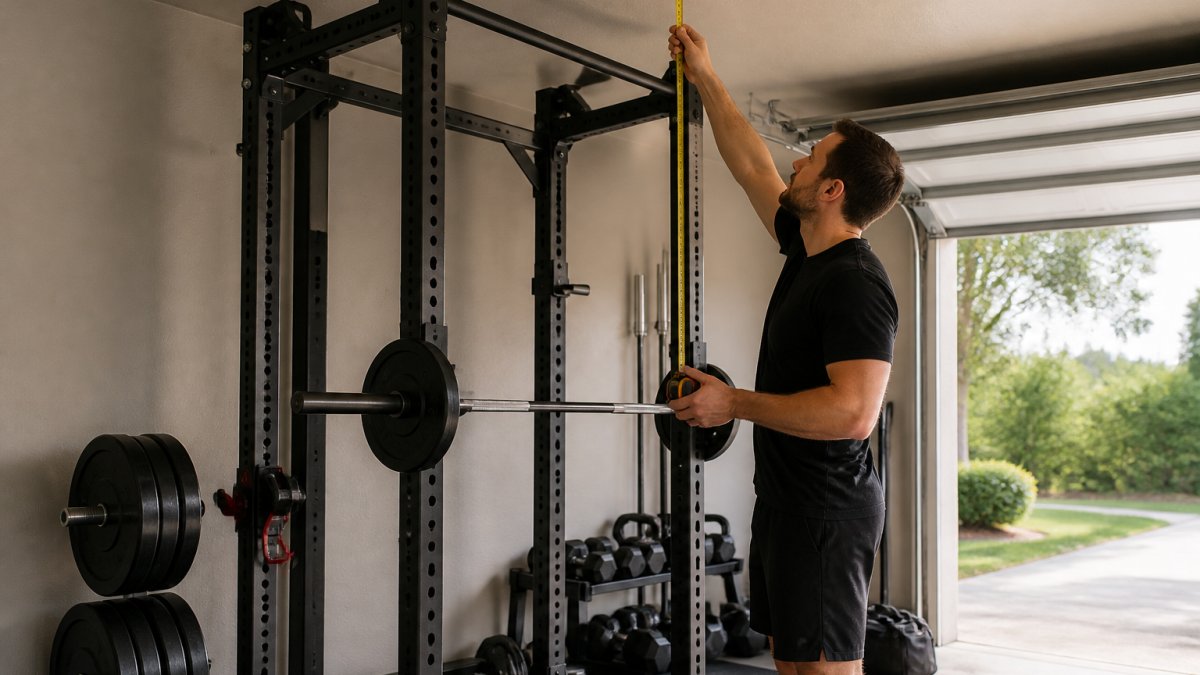
An all-in-one machine occupies one rectangle. The Major Fitness F22, for example, measures 64.2 inches wide, 58.2 inches deep, and 82.5 inches tall. That is the footprint, not the operating envelope.
Individual equipment scatters across the room. A rack, a bench, a dumbbell rack, and open floor for barbell work each claim their own zone. In a garage, that works. In an apartment, it usually does not. The measurement checklist that separates a workable room from a cramped one:
- Footprint: the unit's base dimensions, plus any folding or extending parts in use.
- Operating clearance: room on the loading sides, plus bar length for barbell work.
- Ceiling height: rack height plus your standing reach plus overhead press clearance. An 82.5-inch rack plus a standing press can exceed a standard 96-inch ceiling once you add your height and arm reach.
- Access path: door width, stair turns, and hallway clearance for freight delivery. Check the unit's width against your doorways before ordering.
- Floor protection and storage: rubber mats or tiles under the unit, and a plan for plates, dumbbells, and attachments that does not eat your working space.
Watch out: buying an all-in-one without checking ceiling height against overhead press clearance, or without checking the access path, can leave the unit unusable in your room.
For tighter rooms, a folding rack or wall-mounted setup often beats a full all-in-one. To compare footprint specs directly, the all in one home gym Smith machine Spirit B52 page lists full dimensions.

Exercise Variety, Guided Movement, and Progression Limits
Exercise variety favors individual equipment. Guided movement and simplicity favor all-in-one machines.
The Fitness Outlet's comparison of functional trainers and home gyms notes that functional trainers often offer greater exercise variety, while premium home gyms emphasize guided movement, simplicity, and durability.
Progression is the other limit. Individual equipment grows with you: add plates, buy heavier dumbbells, upgrade the bar. An all-in-one machine caps at its weight stack or pulley capacity. The B17 Flying Fortress offers expandable weight stacks, while many entry-level units do not.
If you want to see how much variety one machine can actually deliver, the Heritage Series B17 all in one functional trainer with Smith machine shows the full attachment range in one footprint.
Major Fitness F22 All-In-One Home Gym Power Rack →

The Best All-in-One Gym Machine for Home Setups That Need One Station
For home setups that need one station, the Major Fitness F22 All-In-One Home Gym Power Rack at $929.99 is a strong option. It covers squats, bench presses, cable flys, lat pulldowns, and low rows in one unit.
The F22 carries a 277.8 lb rack weight with a wide base, a dual independent pulley system with a 2:1 ratio across 17 positions, and 14 adjustable upright positions.
Lifters chasing maximal cable loads may want to compare pulley ratios across models.
Best for: intermediate to advanced lifters who want one rigid station and a full attachment package from day one. Skip if: you train almost entirely with free weights and already own a rack.
You can check the full specs on the Raptor F22 power rack home gym page.

All-in-One Home Gym for Small Spaces: What Actually Fits
An all-in-one home gym can suit smaller rooms when the unit's footprint fits with clearance on all sides, not just at the base.
The Major Fitness B52 All-In-One Home Gym Smith Machine at $1,499.99 packs a Smith machine, free weight rack, cable pulley system, independent dual pulleys, and landmine into one 5-in-1 station.
That width is the catch. At nearly 6.5 feet across, the B52 needs a dedicated wall. Measure your room's usable width before committing.
For tighter rooms, a folding rack or wall-mounted setup often beats a full all-in-one.
To compare footprint specs directly, the all in one home gym Smith machine Spirit B52 page lists full dimensions.
Home Gym Equipment for Beginners: Where to Start Without Overbuying
Beginners should buy for the next twelve months, not the next ten years. Home gym equipment for beginners works best as a small, focused set that covers the basics and leaves room to grow.
Start with three pieces: a barbell, a bench, and a way to load weight safely. The Major Fitness 7ft 20kg Home Gym Barbell at $259.99 is alloy steel with standard 2-inch Olympic sleeves, so it accepts plates you already own or buy later.
From there, add dumbbells. The Troy Barbell Urethane Dumbbell Set with Rack at $3,663.00 covers 5 to 50 lbs in 5 lb increments with a twin-tier rack, and the 12-sided anti-roll shape keeps weights where you put them.
If you are leaning toward individual equipment, the Troy Barbell urethane dumbbell set with rack is the most concrete starting point to compare against a machine.
One possible mistake is buying an all-in-one machine as a beginner and finding the guided movement does not match how you want to train.
Which Setup Fits Your Training Goals
Match the equipment to the training, not the other way around. Use this decision framework:
| Your situation | Recommended setup | Why |
|---|---|---|
| One station, mixed strength work | All-in-one power rack | Covers barbell and cable in one footprint |
| Small room, guided lifting | Smith machine all-in-one | Compact guided path, no spotter needed |
| Maximum exercise variety | Individual equipment | Free weights plus cables, grows with you |
| Tight budget, proven habit | Barbell and dumbbells first | Lowest entry, upgrade later |
| Martial arts supplemental strength | All-in-one with cable work | Cable and landmine variety in one unit |
| Long-term progression focus | Individual or expandable stack | Load capacity grows with you |
For a full room plan that accounts for clearance, storage, and staging, the best home gym setup guide walks through the whole space before you buy.
Frequently Asked Questions
Is an all-in-one home gym worth it compared with buying individual equipment?
It depends on how much space and budget you have and how you like to train. An all-in-one machine puts a rack, pulleys, and often a Smith bar in one station, so you cover squats, presses, rows, and cable work without filling a room. Individual equipment gives you more variety and lets you buy in stages. If you train alone and want one stable station, an all-in-one is worth it. If you want maximum exercise variety, separate pieces usually win.
Can an all-in-one home gym replace free weights?
Partly. An all-in-one with a power rack and J-hooks still lets you squat, bench, and press with a barbell, so free weight work stays in the program. What changes is the cable and guided work: a machine gives you pulley stations and a fixed bar path that free weights cannot. Most lifters keep a barbell and plates alongside the machine rather than choosing one or the other. The Major Fitness 7ft Olympic Barbell at $259.99 pairs with any rack in this range.
What are the disadvantages of an all-in-one home gym?
The main drawbacks are footprint, weight, and repairability. A full machine takes up a fixed floor area and cannot be folded away, and heavier frames like the 410.1 lb B52 are hard to move once assembled. Cable and pulley parts wear and need replacement, and you cannot sell one station piece by piece the way you can separate dumbbells or a barbell. Assembly also takes longer than setting up a bench and a set of dumbbells.
Is it cheaper to buy a home gym machine or individual equipment?
A single all-in-one machine can cover several stations for one purchase. The Major Fitness F22 All-In-One Home Gym Power Rack is $929.99 and includes J-hooks, safety arms, dip bars, a landmine, and cable handles. Building the same coverage from separate pieces means a rack, a cable tower, a landmine, and dip bars bought individually. Individual equipment only wins on cost when you buy used or start with one piece and add over time.
What equipment do I need to build a home gym for beginners?
Start with one strength station and one free weight tool. A power rack with a barbell covers squats, presses, and deadlifts, and a dumbbell set covers accessory and unilateral work. The Troy Barbell Urethane Dumbbell Set with Rack starts at $3,663.00 for the 5-50 lb set with a twin-tier rack, you can start with the rack and barbell first and add dumbbells later. Buy for the training you will do in six months, not the first week.
The right setup is the one you will actually use every week, and that usually means matching footprint and training style before price. Combat Build Supply stocks all-in-one machines and individual equipment with free shipping on every order, a 100% refund for defective or non-functioning items, and support by live chat, email, or phone to help you confirm dimensions before you buy. Get started with Combat Build Supply and build a training space that fits your room and your goals.


